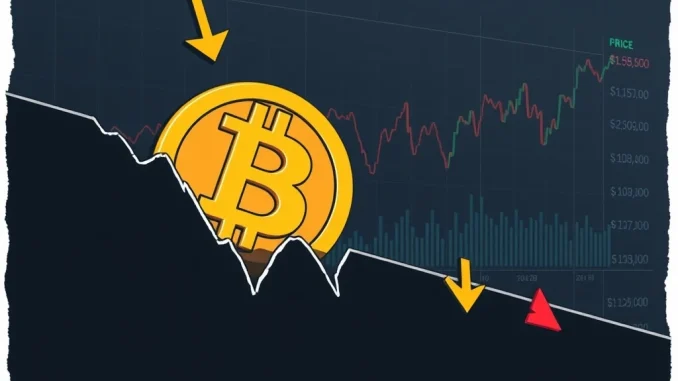
The cryptocurrency world is abuzz with uncertainty as Bitcoin finds itself caught in a challenging position. After a significant 2.7% drop, the flagship cryptocurrency is navigating a tight $117,000 trading range, leaving investors on edge. This recent dip has also triggered a substantial $100 billion slide in the overall crypto market cap, raising questions about the immediate future of digital assets. Is this a temporary setback or a sign of deeper volatility? Let’s dive into the details shaping today’s market.
Why is Bitcoin Trapped in This Critical Trading Range?
Bitcoin’s current predicament sees it oscillating within a narrow $4,300 band, specifically between $114,200 and $118,500. This tight trading range reflects a significant indecision among market participants. On one hand, bullish investors are eyeing a decisive breakout above $118,250, aiming for the psychological $120,000 level. On the other, bears are maintaining control, with selling pressure dominating below $116,500.
Technical indicators paint a mixed picture:
- Moving Averages: The 4-hour chart shows Bitcoin hovering near its 50-period ($117,689) and 34-period ($118,094) simple moving averages, indicating a tug-of-war between buyers and sellers.
- Bollinger Bands: These suggest tightening volatility, often a precursor to a significant price move in either direction, following a sharp pullback.
- Key Support Levels: Immediate support is identified at $116,100 and $115,400. A breakdown below $116,500 could trigger a slide towards $114,200, and potentially $112,000.
- Key Resistance Levels: A sustained push above $118,250 is crucial to reignite upward momentum, with $119.5K and $120,000 being the next targets.
Understanding the $100 Billion Crypto Market Cap Slide
The recent price action has underscored the fragility of the current market. A 2.7% drop on July 25 was a significant event, breaching the $117,261 consolidation level. This triggered a cascade of liquidations, with an estimated $700 million in leveraged long positions wiped out across the board. The most striking consequence was the erosion of $100 billion from the total crypto market cap, which now stands at $3.72 trillion.
While XRP alone saw $89 million in single-day liquidations during this selloff, analysts largely attribute the decline to profit-taking after Bitcoin’s recent rally, rather than a systemic bearish shift. However, the volume data reveals uneven buying pressure, with red volume bars dominating during declines, despite occasional rebound attempts. This suggests a cautious sentiment pervades the market.
Navigating BTC Price Volatility: What’s Next?
The total crypto market capitalization has fallen below critical support levels at $3.80 trillion and $3.73 trillion. Further selling pressure could push the cap towards $3.61 trillion if short-term liquidity challenges persist. Interestingly, liquidity remains concentrated in traditional assets, showing a hesitance to flow into riskier crypto holdings, even as the U.S. M2 money supply reaches a record $22.02 trillion.
For the BTC price, the path forward is highly dependent on its ability to reclaim and hold key resistance levels. Failure to stay above $116,500 could deepen the current correction. Conversely, a sustained breakout above $120,000 would be a strong bullish signal, potentially rekindling the momentum seen earlier in the month.
Is This Correction Healthy for the Bitcoin Market?
Analysts suggest that the current correction serves as a necessary recalibration after Bitcoin‘s impressive 33% rally from late June. Such pullbacks are common and can help flush out overleveraged positions, paving the way for more sustainable growth. However, the market remains vulnerable to further volatility, especially for those holding highly leveraged positions.
Despite the short-term turbulence, there are underlying signals of long-term confidence. MicroStrategy’s recent $2 billion STRC offering, aimed at acquiring more Bitcoin, highlights continued institutional demand. This suggests that while retail investors might be taking profits, major players are still accumulating, viewing these dips as buying opportunities.
Meanwhile, other major cryptocurrencies are also facing their own challenges. Ethereum, for instance, is dealing with validator exit pressure, with $2.3 billion in unstaking ETH looming. This adds another layer of complexity to the broader market sentiment.
In conclusion, the Bitcoin market finds itself at a critical juncture. It’s a standoff between bearish technical signals and a more optimistic long-term view driven by institutional adoption. Vigilance and careful risk management are paramount as the market awaits a decisive move. Whether Bitcoin breaks out or breaks down from its current range will set the tone for the weeks to come.
Frequently Asked Questions (FAQs)
Q1: What is Bitcoin’s current trading range?
Bitcoin is currently trapped in a tight trading range between approximately $114,200 and $118,500, reflecting indecision among market participants.
Q2: Why did the crypto market cap drop by $100 billion?
The crypto market cap experienced a $100 billion slide after Bitcoin saw a 2.7% drop on July 25, triggering $700 million in liquidations of leveraged long positions. This was largely attributed to profit-taking after a recent rally.
Q3: What are the key support and resistance levels for BTC price?
Key support levels for Bitcoin are $116,100 and $115,400. Key resistance levels to watch are $118,250, $119.5K, and the psychological $120,000 mark.
Q4: Is this a bearish trend for the crypto market?
While there has been a significant market cap slide and Bitcoin is in a tight range, analysts suggest the recent correction is primarily due to profit-taking after a strong rally, rather than a systemic bearish shift. Institutional demand, as seen with MicroStrategy, suggests underlying long-term confidence.
Q5: How does Ethereum’s unstaking affect the market?
Ethereum faces validator exit pressure with $2.3 billion in unstaking ETH looming. This could add selling pressure to Ethereum and potentially impact broader crypto market sentiment, though the full effect remains to be seen.