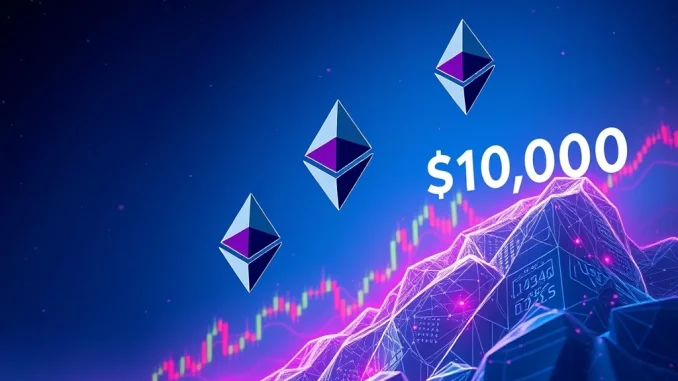
Is Ethereum on the verge of an epic surge? That’s the bold **ETH price prediction** coming from a seasoned voice in the financial world. Eric Jackson, the founder of Toronto-based hedge fund EMJ Capital, has publicly stated his conviction that ETH could indeed hit the coveted $10,000 mark during the current bull run. This isn’t just a casual guess; it’s a forecast rooted in several significant developments within the Ethereum ecosystem and the broader crypto market. Let’s dive into the factors that could propel Ethereum to unprecedented heights.
Why EMJ Capital’s Bold ETH Price Prediction Matters
When a figure like Eric Jackson, who manages a hedge fund, makes a definitive statement about a cryptocurrency’s future, the market takes notice. His **ETH price prediction** of $10,000 isn’t just a number; it reflects a deep analysis of market dynamics, technological advancements, and regulatory shifts. Jackson’s firm, **EMJ Capital**, operates in the realm of sophisticated investment strategies, meaning their insights are often backed by rigorous research and a professional understanding of financial markets. His optimism for Ethereum stems from a confluence of factors that, if they play out as expected, could create a perfect storm for ETH appreciation.
The Anticipated Catalyst: Ethereum ETF Approval and Staking
One of the most significant drivers identified by Jackson is the impending approval of an **Ethereum ETF** with staking capabilities. While spot Bitcoin ETFs have already made waves, the prospect of an Ethereum ETF that also allows for staking is a game-changer. Here’s why:
- Institutional Influx: An ETF provides a regulated, accessible vehicle for traditional financial institutions and retail investors to gain exposure to Ethereum without directly holding the cryptocurrency. This dramatically broadens the investor base.
- Staking Yields: The ability for an ETF to stake its underlying ETH holdings means it can generate yield. This makes the ETF more attractive compared to traditional assets, potentially drawing in capital looking for passive income opportunities.
- Market Underestimation: Jackson believes the market is currently underestimating the profound impact this development will have. The combined effect of increased demand from institutional investors and the attractive yield generation could create a significant supply shock.
- Projected Timeline: The expectation of approval by October of this year adds a clear timeline, building anticipation and potentially front-running price action.
The introduction of a staked Ethereum ETF would not only legitimize ETH further in traditional finance but also lock up a substantial amount of ETH, reducing circulating supply and increasing scarcity.
Unpacking Ethereum’s Deflationary Token Economy
Another powerful factor contributing to the potential surge to **ETH $10K** is Ethereum’s unique tokenomics, particularly after the Merge. Prior to the Merge, Ethereum was inflationary, meaning new ETH was constantly being created. However, with the transition to Proof-of-Stake (PoS) and the implementation of EIP-1559, Ethereum has become deflationary under certain network conditions. This means:
- ETH Burn Mechanism: A portion of transaction fees (base fee) is burned, permanently removing ETH from circulation.
- Reduced Issuance: With PoS, the amount of new ETH issued to validators is significantly lower than the amount of ETH created under the old Proof-of-Work system.
- Supply Shock Potential: As network activity increases, more ETH is burned, leading to a net reduction in the total supply. A decreasing supply against increasing demand is a classic recipe for price appreciation.
This fundamental shift in supply dynamics provides a strong bullish argument for Ethereum’s long-term value proposition.
Scaling Ethereum: Layer-2s and Real World Assets (RWAs)
Beyond the ETF and tokenomics, two other crucial elements are strengthening Ethereum’s foundation:
- Increased Layer-2 Transaction Fees: Layer-2 solutions like Arbitrum, Optimism, and Polygon are scaling Ethereum by processing transactions off-chain, then batching them and settling them on the mainnet. While L2s reduce transaction costs for users, their increased activity still drives demand for ETH as gas fees on the mainnet are required for settlement. More L2 activity means more base layer demand and potentially more ETH burned.
- Increased Tokenization of Real World Assets (RWAs): The tokenization of RWAs refers to representing tangible and intangible assets (like real estate, art, commodities, or even government bonds) as digital tokens on a blockchain. Ethereum is a leading platform for this due to its robust ecosystem, security, and smart contract capabilities. As more RWAs are tokenized, it drives utility and demand for the underlying blockchain’s native token (ETH), as it’s often used for gas fees or as collateral within these systems. This trend is just beginning and holds immense potential for bringing trillions of dollars into the crypto space, with Ethereum at the forefront.
Navigating the Current Crypto Bull Run: What to Watch
Jackson’s prediction is set against the backdrop of an ongoing **crypto bull run**. This broader market uptrend, fueled by factors like institutional adoption, halving events, and increasing mainstream acceptance, provides a fertile ground for individual assets like Ethereum to thrive. However, navigating a bull run requires vigilance. While the sentiment is overwhelmingly positive, market corrections are a natural part of any cycle. Investors should:
- Stay Informed: Keep an eye on regulatory developments, macroeconomic indicators, and network upgrades.
- Understand Risk: Despite bullish predictions, crypto markets are volatile. Never invest more than you can afford to lose.
- Diversify (if appropriate): While ETH has strong fundamentals, a balanced portfolio can mitigate risks.
The convergence of these powerful catalysts – a potential staked Ethereum ETF, deflationary tokenomics, and expanding utility via Layer-2s and RWAs – paints a compelling picture for Ethereum’s future. While no investment is guaranteed, the analysis from **EMJ Capital** offers a compelling vision for how ETH could indeed climb to $10,000 this cycle.
The journey to **ETH $10K** might be volatile, but the underlying technological and economic shifts suggest a robust foundation for growth. As the crypto landscape continues to evolve, Ethereum remains a central pillar, poised for significant expansion. Whether Jackson’s precise target is met or not, the factors he highlights are undoubtedly key drivers for Ethereum’s continued relevance and potential value appreciation in the coming months and years.
Frequently Asked Questions (FAQs)
1. What is an Ethereum ETF and why is it important?
An Ethereum ETF (Exchange-Traded Fund) is an investment vehicle that allows investors to gain exposure to Ethereum’s price movements without directly buying and holding the cryptocurrency. It’s important because it provides a regulated and accessible pathway for traditional investors and institutions to invest in ETH, potentially bringing in significant capital and increasing market liquidity.
2. How does Ethereum’s deflationary economy work?
Ethereum became deflationary after its transition to Proof-of-Stake (the Merge) and the implementation of EIP-1559. A portion of transaction fees (the base fee) is permanently burned, removing ETH from circulation. Additionally, the amount of new ETH issued to validators is significantly less than the amount burned during periods of high network activity, leading to a net decrease in total ETH supply over time.
3. What are Real World Assets (RWAs) and how do they impact ETH?
Real World Assets (RWAs) are tangible or intangible assets from the traditional financial world (like real estate, bonds, or commodities) that are tokenized, or represented as digital tokens, on a blockchain. As more RWAs are tokenized on Ethereum, it increases the demand for ETH, as it’s often needed for gas fees to process transactions or as collateral within these RWA-backed decentralized finance (DeFi) applications.
4. What factors could prevent ETH from reaching $10,000?
While the outlook is bullish, potential headwinds include unexpected regulatory crackdowns, significant macroeconomic downturns, major security breaches or technical issues within the Ethereum network, or a broader loss of confidence in the crypto market. Market volatility is also a constant factor.
5. What is EMJ Capital and why should I pay attention to their predictions?
EMJ Capital is a Toronto-based hedge fund founded by Eric Jackson. As a professional investment firm, their predictions are typically based on extensive market research, financial modeling, and a deep understanding of market trends and underlying asset fundamentals. While no prediction is guaranteed, insights from such firms can offer valuable perspectives for investors.
6. What is a ‘crypto bull run’ and are we currently in one?
A ‘crypto bull run’ refers to a sustained period where cryptocurrency prices are generally rising across the market, driven by strong investor confidence, increasing adoption, and positive news. Many analysts believe the market entered a new bull run following the Bitcoin halving and increasing institutional interest, though market cycles involve periods of both growth and consolidation.