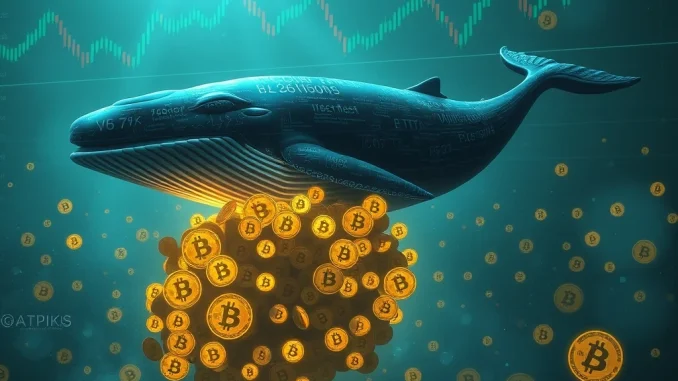
In a move that has sent ripples across the cryptocurrency landscape, a mysterious Bitcoin whale has activated a wallet dormant for eight years, initiating a colossal BTC transfer of 2,000 Bitcoins. This transaction, representing an astonishing 20,000% gain on an initial investment made in 2016, has ignited fervent crypto market speculation regarding the holder’s intentions and the potential ramifications for Bitcoin’s price trajectory. It’s a compelling narrative of patience, immense profit, and the ever-present intrigue of on-chain activity.
The Awakening of a Bitcoin Whale: An Epic Gain Unveiled
Imagine holding an asset for nearly a decade, watching it weather multiple market cycles, from euphoric highs to brutal crashes, only to emerge with a staggering 20,000% return. This is precisely the story of the anonymous Bitcoin whale behind the recent 2,000 BTC transfer. Purchased at approximately $500 per coin in 2016, these Bitcoins are now valued at an astounding $200 million, given Bitcoin’s recent trajectory near the $100,000 mark. The sheer scale and timing of this movement from a long-dormant wallet immediately captured the attention of analysts and investors alike.
This transaction serves as a powerful testament to the conviction of early Bitcoin adopters and the transformative potential of long-term Bitcoin holding. While many investors might have been tempted to sell during the 2017 bull run or the 2021 rally, this particular whale held firm, demonstrating a rare level of patience and belief in Bitcoin’s enduring value. The wallet’s inactivity since 2016 led many to theorize about its owner – perhaps an early investor with an iron will, or even a forgotten stash now rediscovered. On-chain data has confirmed the transfer, though the ultimate destination – be it an exchange, cold storage, or another wallet – remains shrouded in mystery, fueling further speculation.
| Metric | Details |
|---|---|
| Amount Transferred | 2,000 BTC |
| Initial Purchase Year | 2016 |
| Initial Purchase Price (per BTC) | ~$500 |
| Initial Investment Value | ~$1,000,000 |
| Current Value (at ~$100k/BTC) | ~$200,000,000 |
| Percentage Gain | ~20,000% |
| Holding Period | 8 Years |
Decoding the Signals: What Does This BTC Transfer Mean?
When a significant BTC transfer occurs, especially from a long-dormant wallet, the market immediately tries to decipher its meaning. Analysts have proposed several theories:
- Profit-Taking: The most straightforward interpretation is that the whale is realizing a portion of their substantial gains. After an 8-year hold and a 20,000% return, cashing out some profits is a logical financial decision.
- Asset Rebalancing: The whale might be rebalancing their portfolio, perhaps diversifying into other cryptocurrencies, traditional assets, or even real estate. This move could signal a shift in their overall risk appetite after navigating multiple volatile market cycles.
- Strategic Shift: It could indicate a more profound strategic pivot, perhaps anticipating future market conditions or preparing for a new investment opportunity. The timing, near Bitcoin’s all-time highs, is certainly noteworthy.
This behavior stands in stark contrast to the typical actions of retail traders, who often succumb to FOMO (Fear Of Missing Out) during bull runs and panic sell during corrections. The whale’s patience underscores a deep conviction that allowed them to transform a modest $1 million investment into a $200 million fortune.
Crypto Market Speculation: Ripple Effects and Resilient Sentiment
The immediate reaction to such a large BTC transfer is often one of apprehension. Retail investors, in particular, can be spooked by the prospect of a large sell-off impacting prices. However, broader sentiment in the crypto market speculation appeared surprisingly resilient. While some volatility was observed, it was largely offset by positive developments elsewhere in the ecosystem, such as robust Ethereum ETF inflows and growing interest in tokenized real-world assets.
This event drew comparisons to other high-profile on-chain movements, such as Ripple co-founder Chris Larsen’s periodic XRP sales. However, the Bitcoin transaction’s sheer scale and the unprecedented duration of the holding period distinguished it. It highlighted that while individual large transfers can cause ripples, the overall market infrastructure and institutional participation are becoming more robust, capable of absorbing such movements without catastrophic impacts.
The Institutional Hand: Galaxy Digital’s Prominent Role
Intriguingly, the narrative around this whale’s move intertwined with the operations of institutional players. While the 2,000 BTC transfer was from a long-dormant wallet, related on-chain activity pointed to the involvement of major crypto custody and trading firm, Galaxy Digital. Reports indicated that Galaxy Digital facilitated a separate, but potentially related, transfer of a staggering 80,000 BTC—also valued at approximately $200 million—linked to a similar long-term holding strategy.
This 80,000 BTC movement was described as one of the largest “Satoshi Era” transfers to date, with 40,000 BTC moved to Galaxy Digital in a single transaction, and another 40,000 BTC sent to an unspecified destination. Galaxy Digital’s involvement underscores the evolving role of institutional players in managing large-scale crypto assets. Their operations reflect the increasing regulatory compliance and sophisticated coordination required for such transactions, providing a more structured environment for high-value holdings to move. This institutional involvement suggests that even long-held, seemingly ‘forgotten’ Bitcoins are now being managed with professional oversight.
Navigating Bitcoin Market Psychology: Confidence vs. Caution
The implications of this whale’s action for Bitcoin’s market psychology are multifaceted. On one hand, the decision by a long-term holder to liquidate a portion of their holdings could be interpreted as a signal of reduced confidence in Bitcoin’s immediate long-term prospects, or simply a strategic rebalancing of assets after a significant run-up. Such large movements can trigger fear among those who believe in a fixed supply and minimal circulation of ‘old’ coins.
On the other hand, the mere fact that such a massive, long-held position exists and is now being activated can reinforce bullish sentiment. It tangibly demonstrates the immense rewards of patient, conviction-based investing in Bitcoin. It’s a real-world example of generational wealth being created through digital assets. However, analysts rightly caution that isolated transactions should not be overinterpreted. The market remains sensitive to both specific on-chain activity and broader macroeconomic factors, making a definitive interpretation challenging.
The Evolving Landscape of Crypto Liquidity
Structurally, this transaction highlights the dynamic nature of crypto liquidity. Long-held Bitcoin, often considered a stabilizing force due to its low turnover and perceived scarcity, now raises questions about potential market pressures. If more dormant positions follow suit, the increased liquidity could introduce new dynamics. The involvement of firms like Galaxy Digital in facilitating such large movements also indicates a maturation of the infrastructure supporting the crypto ecosystem, making it easier and more secure for whales to manage and move their assets.
As the crypto ecosystem continues to mature, such high-profile moves will undoubtedly continue to influence investor sentiment and market dynamics. Whether this whale’s action marks a broader trend or remains an isolated event, it serves as a powerful reminder of Bitcoin’s unique ability to reward long-term holders—and the inherent volatility that comes with significant on-chain activity. It reinforces the importance of understanding the fundamental value of Bitcoin, rather than reacting to every large transaction.
Conclusion: A Testament to Bitcoin’s Enduring Allure
The recent 2,000 BTC transfer by an eight-year dormant whale is more than just a large transaction; it’s a profound narrative about conviction, patience, and the incredible wealth-generating potential of Bitcoin. While it has certainly fueled crypto market speculation and raised questions about immediate price impacts, it also underscores the enduring allure of long-term Bitcoin holding. The involvement of institutional players like Galaxy Digital further cements the growing sophistication of the crypto market. As Bitcoin continues its journey, such whale movements will remain a focal point, reminding us of both the opportunities and the inherent dynamism of this revolutionary asset class.
Frequently Asked Questions (FAQs)
Q1: What is a Bitcoin whale?
A Bitcoin whale is an individual or entity that holds a very large amount of Bitcoin. While there’s no official threshold, it typically refers to holders with thousands of BTC, whose transactions can significantly impact market sentiment and liquidity due to their sheer size.
Q2: Why are large BTC transfers significant?
Large BTC transfers are significant because they can signal potential selling pressure if the coins are moved to an exchange, or simply a rebalancing of assets if moved to new cold storage. They often spark market speculation as investors try to decipher the whale’s intentions, which can influence short-term price movements and market psychology.
Q3: What does it mean for a wallet to be ‘dormant’?
A dormant wallet is a cryptocurrency address that has shown no outgoing transactions for an extended period, often years. When a dormant wallet suddenly becomes active, especially one holding a large amount of crypto, it draws significant attention as it implies a long-term holder is finally making a move.
Q4: How did Galaxy Digital play a role in recent large Bitcoin movements?
Galaxy Digital, a major institutional crypto firm, was involved in facilitating a separate but related large Bitcoin transfer of 80,000 BTC, linked to long-term holding strategies. Their involvement highlights the increasing role of institutional custodians and trading desks in managing significant crypto assets for high-net-worth individuals and entities, ensuring compliance and secure execution.
Q5: Does this 2,000 BTC transfer mean Bitcoin’s price will drop?
Not necessarily. While a large transfer to an exchange could indicate an intent to sell, the destination of these specific 2,000 BTC remains unclear. Market reactions to such events are mixed; sometimes they cause temporary dips, while other times the market absorbs them without significant impact, especially if broader sentiment is positive. Isolated transactions should not be overinterpreted as definitive market signals.
Q6: What is the ‘Satoshi Era’ in Bitcoin?
The ‘Satoshi Era’ refers to the very early days of Bitcoin, roughly from its inception in 2009 up to 2010 or early 2011, when Bitcoin was mined almost exclusively by its creator Satoshi Nakamoto and a handful of early adopters. Coins from this era are often referred to as ‘Satoshi-era coins’ and are highly valued due to their historical significance and the immense gains they represent for those who held them.