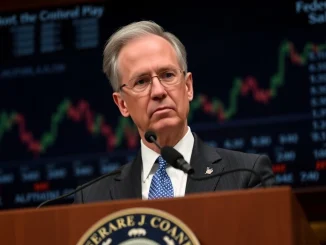
In the dynamic world of cryptocurrency, market movements are often intertwined with broader economic shifts and political decisions. A recent whisper from the White House, amplified by the Walter Bloomberg economic news account on X, suggests a significant shake-up: the potential dismissal of Federal Reserve Chairman Jerome Powell by former President Donald Trump. Such a move, if it materializes, could send ripples across traditional financial markets and, by extension, impact the crypto landscape, making the phrase ‘Trump fires Powell‘ a critical watchpoint for investors.
Trump Fires Powell: Are the Rumors True?
The economic news account Walter Bloomberg on X recently cited a White House official, indicating that former President Donald Trump could soon remove Federal Reserve Chairman Jerome Powell. While the report suggests the timing remains unspecified, the mere mention of such a possibility reignites discussions from Trump’s previous presidency. During his term, Trump frequently voiced strong criticisms of Powell and the Federal Reserve’s interest rate policies, often advocating for lower rates to stimulate the economy.
These latest rumors, even without concrete timing, underscore the potential for significant shifts in economic leadership should Trump return to office. The implications for market stability and the direction of US monetary policy are substantial, making this development a key point of interest for anyone tracking global finance.
Who is Jerome Powell, and Why Does His Leadership Matter?
Jerome Powell serves as the Chair of the Board of Governors of the Federal Reserve System, a position he has held since February 2018. As the head of the United States’ central bank, Powell plays a pivotal role in guiding the nation’s economic direction. His decisions and pronouncements significantly influence financial markets worldwide.
Key aspects of Powell’s role include:
- Setting Interest Rates: The Fed’s primary tool for managing inflation and employment. Higher rates can cool an overheating economy but might slow growth; lower rates can stimulate activity but risk inflation.
- Managing Monetary Policy: Overseeing the implementation of policies designed to achieve maximum employment and price stability.
- Financial Stability: Acting as a guardian of the financial system, responding to crises and ensuring the health of banks.
Powell’s approach to these responsibilities has been a point of contention for some, particularly regarding the pace of interest rate hikes and the response to inflation. His leadership directly impacts borrowing costs for businesses and consumers, the value of the dollar, and investor sentiment, all contributing to the broader economic impact.
What’s at Stake? Understanding the Federal Reserve’s Critical Role
The Federal Reserve, often called ‘the Fed,’ operates as an independent central bank, a structure designed to insulate it from political pressures. This independence is crucial for making objective decisions based on economic data rather than short-term political goals. The Fed’s dual mandate is to achieve maximum employment and stable prices (low and stable inflation).
A change in leadership, especially one perceived as politically motivated, could challenge this independence. The stakes are high:
- Market Confidence: Investor trust in the Fed’s autonomy and competence is vital for stable markets. Perceived political interference can erode this trust.
- Policy Consistency: A sudden shift in leadership might lead to abrupt changes in monetary policy, creating uncertainty for businesses and consumers.
- Global Standing: The US dollar’s status as the world’s reserve currency relies partly on the credibility of the Federal Reserve.
The ability of a President to unilaterally remove a Fed Chair is also a matter of legal and historical debate, adding another layer of complexity to the ‘Trump fires Powell‘ narrative.
What Could Be the Economic Impact of a Fed Leadership Change?
The potential economic impact of a change in Federal Reserve leadership, particularly one driven by political motivations, is significant. Markets thrive on predictability and stability. A sudden removal of the Fed Chair could trigger immediate volatility across various asset classes.
- Stock Markets: Uncertainty could lead to sell-offs as investors re-evaluate future economic conditions and corporate earnings.
- Bond Markets: Yields could fluctuate wildly, reflecting new expectations for interest rates and inflation.
- Currency Markets: The US dollar could weaken if global investors perceive a loss of independence or stability at the Fed.
- Inflation Outlook: A new Fed Chair might adopt a more dovish stance, potentially leading to higher inflation if rates are kept lower for longer.
For cryptocurrency markets, while not directly controlled by the Fed, they are sensitive to broader economic conditions. Increased volatility in traditional markets often spills over into crypto. Furthermore, if a new Fed Chair were to pursue policies leading to higher inflation, some investors might turn to Bitcoin and other cryptocurrencies as a hedge against fiat currency devaluation, enhancing the narrative around ‘Trump fires Powell‘ and its ripple effects.
How Might Shifting Monetary Policy Affect Your Investments?
Any significant shift in monetary policy, especially one prompted by a change in leadership at the Federal Reserve, directly impacts investment strategies. If a new Fed Chair were to pursue a more accommodative policy, such as lower interest rates:
- Borrowing Costs: Loans for businesses and consumers would become cheaper, potentially stimulating economic activity and corporate expansion.
- Risk Assets: Lower interest rates can make riskier assets, including stocks and cryptocurrencies, more attractive compared to lower-yielding bonds or savings accounts. This could potentially boost the crypto market.
- Inflation: A sustained period of lower rates could lead to increased inflation, which some investors see as a positive for assets like Bitcoin that have a limited supply.
Conversely, market instability stemming from political interference could lead to a ‘flight to safety,’ where investors move away from risk assets. The overall sentiment surrounding the ‘Trump fires Powell‘ speculation will dictate much of the immediate market reaction, emphasizing the need for investors to stay informed and agile.
Conclusion: Navigating the Uncertainty
The rumors surrounding former President Trump’s potential desire to remove Jerome Powell from his position as Federal Reserve Chairman introduce a layer of uncertainty into the economic outlook. While the specific timing and even the certainty of such a move remain unconfirmed, the discussion itself highlights the critical importance of the Fed’s independence and the profound economic impact of its leadership. For investors in both traditional and cryptocurrency markets, understanding the potential shifts in monetary policy and their broader implications will be crucial for navigating the evolving financial landscape. Staying informed about these developments will be key to making strategic decisions in the face of potential changes.
Frequently Asked Questions (FAQs)
1. What is the Federal Reserve?
The Federal Reserve is the central bank of the United States. Its primary roles include conducting national monetary policy, supervising and regulating banking institutions, maintaining financial stability, and providing financial services to depository institutions and the U.S. government.
2. Why would Trump want to fire Jerome Powell?
During his previous term, Donald Trump frequently criticized Jerome Powell and the Federal Reserve’s policies, particularly their decisions to raise interest rates. Trump often advocated for lower rates, believing they would further stimulate economic growth and enhance the US’s competitive edge. His desire to ‘Trump fires Powell‘ stems from a fundamental disagreement on monetary policy direction.
3. How would firing the Fed Chair impact the economy?
Firing the Fed Chair could lead to significant market volatility, decreased investor confidence, and uncertainty about future monetary policy. It could also raise questions about the Fed’s independence, potentially impacting the US dollar’s stability and global financial perceptions. The immediate economic impact would likely be negative due to the shock.
4. What does this mean for cryptocurrency markets?
While not directly regulated by the Fed, cryptocurrency markets are influenced by broader economic conditions. If a new Fed Chair pursued more inflationary policies (e.g., lower rates), some investors might see crypto as a hedge. Conversely, if the uncertainty leads to a general ‘risk-off’ sentiment in traditional markets, crypto could also see declines. The impact would depend on the specific policies enacted and market reactions to them.
5. Is it easy to fire a Federal Reserve Chairman?
No, firing a Federal Reserve Chairman is not straightforward. While the President appoints the Chair, they can only be removed ‘for cause,’ which typically means for malfeasance or neglect of duty. There is historical precedent for presidents expressing dissatisfaction, but no Fed Chair has ever been removed by a president. Such a move would likely face significant legal and political challenges.
6. What is ‘monetary policy’?
Monetary policy refers to the actions undertaken by a central bank, like the Federal Reserve, to influence the availability and cost of money and credit to help promote national economic goals. These actions primarily involve managing interest rates, controlling the money supply, and regulating banks, all aimed at achieving maximum employment and price stability.