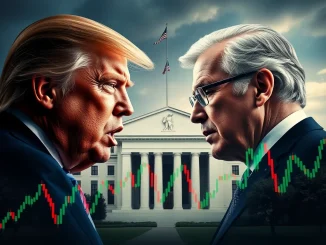
The financial world is buzzing following a bombshell report from The New York Times: President Donald Trump reportedly showcased a draft letter aimed at firing Federal Reserve Chairman Jerome Powell. For anyone invested in the volatile world of cryptocurrencies, this news isn’t just political drama; it’s a potential tremor that could ripple through global markets and, by extension, impact the crypto landscape. The ongoing Trump Powell saga underscores the delicate balance between political will and central bank independence.
The Shockwave: Trump Powell Dynamics Unveiled
The revelation that President Trump has a draft letter ready to dismiss Jerome Powell is a significant development. This isn’t the first time Trump has voiced his displeasure with the Fed’s policies, particularly its interest rate hikes. He has publicly called for Powell’s resignation on numerous occasions, often blaming the Fed for perceived economic slowdowns. This latest report, however, moves beyond verbal criticism to a tangible, albeit unexecuted, step. What does this escalating tension between the White House and the central bank truly signify?
Key aspects of this dynamic:
- Unprecedented Action: While presidents often criticize the Fed, directly threatening to fire its chairman is highly unusual and challenges the long-standing tradition of central bank independence.
- Market Uncertainty: Such political interference creates significant uncertainty for investors, potentially leading to increased volatility in traditional markets, which can spill over into crypto.
- Policy Implications: A change in Fed leadership could signal a shift in monetary policy, impacting interest rates, inflation, and the broader economic outlook.
Understanding the Federal Reserve’s Crucial Role
The Federal Reserve is the central bank of the United States, responsible for conducting monetary policy, supervising and regulating banking institutions, maintaining the stability of the financial system, and providing financial services to depository institutions, the U.S. government, and foreign official institutions. Its independence from political pressure is considered crucial for its ability to make sound economic decisions based on data, not political cycles.
The Fed’s primary tools include:
- Interest Rates: Adjusting the federal funds rate influences borrowing costs for banks and consumers.
- Quantitative Easing/Tightening: Buying or selling government securities to inject or withdraw money from the economy.
- Bank Regulation: Ensuring the stability and integrity of the banking system.
Any perceived threat to this independence can undermine global confidence in the U.S. financial system, potentially driving investors towards alternative assets, including cryptocurrencies, or away from risk entirely.
What Does This Mean for Jerome Powell’s Future?
The question on everyone’s mind is whether President Trump will actually use the draft letter to fire Jerome Powell. While the President has the power to appoint the Fed chair, the legal grounds for firing one are murky and untested. The Federal Reserve Act states that Fed governors “may be removed for cause by the President.” What constitutes “for cause” is open to interpretation and would likely face significant legal challenges.
The implications of such a move would be profound:
- Constitutional Crisis: It could spark a constitutional crisis, challenging the separation of powers and the independence of critical institutions.
- Market Panic: Financial markets would likely react negatively to such an unprecedented disruption, fearing instability and unpredictable policy.
- Global Repercussions: Other central banks and international financial bodies would closely watch, potentially losing confidence in U.S. economic governance.
Navigating Market Volatility: Impact Beyond the Trump Fed Standoff
The ongoing tension between the White House and the Trump Fed creates a climate of uncertainty that affects all financial markets, including cryptocurrencies. While crypto markets often march to their own beat, they are not entirely immune to macroeconomic shifts and investor sentiment. When traditional markets experience turmoil due to political instability or concerns over central bank policy, the ripple effect can be felt across the board.
For crypto investors, this situation highlights:
- Safe Haven Narrative: Some argue that Bitcoin, often dubbed “digital gold,” could serve as a hedge against traditional market instability and inflation stemming from unconventional monetary policy.
- Increased Correlation: Conversely, during periods of extreme market stress, crypto assets have sometimes shown increased correlation with traditional risk assets, leading to broader sell-offs.
- Regulatory Scrutiny: Political instability can sometimes lead to increased scrutiny on nascent industries like crypto, as policymakers look for ways to stabilize financial systems.
Understanding these macro currents is crucial for making informed decisions in the crypto space.
Beyond the Headlines: The Quest for Economic Stability
Ultimately, the core of this debate revolves around economic stability. The Federal Reserve’s mandate is to foster maximum employment and price stability. Political interference, especially in such a high-profile manner, risks undermining these objectives by introducing unpredictability into policy decisions. For investors, businesses, and everyday citizens, a stable economic environment is paramount.
The broader implications include:
- Investor Confidence: Erosion of confidence in U.S. institutions can deter investment, both domestic and foreign.
- Policy Effectiveness: If the Fed’s independence is compromised, its ability to effectively manage the economy could be hampered.
- Global Standing: The U.S. dollar’s role as the world’s reserve currency and the nation’s financial leadership could be challenged.
While the immediate focus is on the drama between Trump and Powell, the long-term consequences for the U.S. economy and global financial markets are far more significant.
Conclusion
The New York Times report about President Trump’s draft letter to fire Jerome Powell is a stark reminder of the delicate interplay between politics and monetary policy. While the immediate outcome remains uncertain, the implications for the Federal Reserve’s independence and overall market stability are profound. For cryptocurrency enthusiasts, this situation underscores the importance of monitoring macroeconomic trends, as they inevitably shape the broader investment landscape. The coming months will undoubtedly reveal whether this draft letter remains just a threat or becomes a pivotal moment in U.S. economic history.
Frequently Asked Questions (FAQs)
Q1: What is the significance of the Federal Reserve’s independence?
The Federal Reserve’s independence is crucial because it allows the central bank to make monetary policy decisions based on economic data and long-term stability goals, free from short-term political pressures or election cycles. This independence helps maintain credibility and confidence in the U.S. financial system.
Q2: Has a U.S. President ever fired a Federal Reserve Chairman before?
No, a U.S. President has never fired a Federal Reserve Chairman. While the President appoints the chairman, the Federal Reserve Act states that governors (including the chairman) can be removed “for cause.” The legal interpretation of “for cause” in this context is untested and would likely lead to significant legal and political challenges.
Q3: How could this situation impact cryptocurrency markets?
While not directly related, political instability and uncertainty in traditional financial markets can indirectly affect cryptocurrency markets. Some investors might view cryptocurrencies like Bitcoin as a hedge against traditional market volatility or inflation if confidence in central banks corrodes. Conversely, during extreme market stress, crypto assets can also experience sell-offs alongside traditional risk assets.
Q4: What is the “Trump Powell” tension about?
The “Trump Powell” tension refers to the public disagreements between former President Donald Trump and Federal Reserve Chairman Jerome Powell. Trump frequently criticized Powell and the Fed’s decisions, particularly regarding interest rate hikes, which Trump believed were hindering economic growth. This tension escalated with reports of Trump considering Powell’s dismissal.
Q5: What are the potential economic consequences if Powell were fired?
If Jerome Powell were fired, it could lead to significant market instability, a potential constitutional crisis regarding central bank independence, and a loss of global confidence in the U.S. financial system. It could also signal a shift in monetary policy, creating uncertainty about future interest rates and inflation.
Q6: What is the Federal Reserve’s primary mandate?
The Federal Reserve’s primary mandate, often referred to as its “dual mandate,” is to foster maximum employment and price stability. This means working to keep unemployment low and inflation under control to promote a healthy and stable economy.