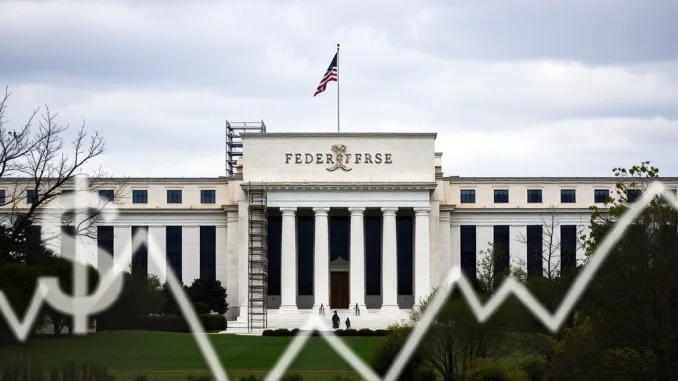
While the world of cryptocurrency often feels distinct from traditional finance, the foundational decisions made by institutions like the Federal Reserve ripple across all markets. Recently, an intense political debate has erupted over the Federal Reserve’s unique funding model and the colossal $2.5 billion self-funded renovation of its Washington D.C. headquarters. This isn’t just about bricks and mortar; it’s about the very independence of the central bank and its profound influence on the U.S. economy.
Federal Reserve Funding: An Unconventional Approach
One of the most distinguishing features of the Federal Reserve is its financial independence. Unlike most government agencies that rely on annual appropriations from Congress, the Fed operates without taxpayer dollars. This unique funding model is central to its ability to make crucial economic decisions free from direct political influence.
So, how does the Fed fund itself, including major projects like its headquarters renovation?
- Interest Income: The primary source of revenue comes from interest earned on its vast portfolio of government securities, such as Treasury bonds and mortgage-backed securities. These assets were largely accumulated during crisis-era interventions, like the 2008 financial crisis and the 2020 pandemic, as part of its quantitative easing programs.
- Service Fees: The Fed also earns income from fees charged for financial services provided to banks, such as check clearing, fund transfers, and automated clearinghouse (ACH) operations.
- Foreign Currency Investments: Interest on foreign currency investments held by the Fed also contributes to its revenue streams.
This self-sustaining mechanism allows the Federal Reserve to cover its operational costs, including staff salaries, infrastructure upgrades, and research, without drawing from public funds. This structure is intended to insulate the central bank from short-term political pressures, enabling it to focus on its long-term mandate of stable prices and maximum employment.
The Escalating Fed Renovation Costs: A Point of Contention
The renovation of the Federal Reserve’s 1930s-era headquarters in Washington, D.C., has become a lightning rod for criticism, particularly concerning its escalating budget. Initially estimated at $3.1 billion, the project’s current cost stands at $2.5 billion, a figure that has drawn significant scrutiny.
What’s driving these significant Fed Renovation Costs?
- Modernization Needs: The headquarters, built in the 1930s, requires extensive upgrades to meet contemporary security, energy efficiency, and technological standards. This includes modernizing outdated systems and infrastructure.
- Scope Changes and Delays: Like many large-scale construction projects, the renovation has faced delays and unforeseen challenges, which often lead to increased expenses.
- Inflationary Pressures: Rising costs for materials, labor, and specialized services contribute to budget overruns, especially over a multi-year project timeline.
Critics argue that the substantial budget raises questions about fiscal prudence, even if the funds are self-generated. Comparisons have been drawn to other federal building projects, such as the $1 billion 2007 renovation of the Herbert Hoover Department of Commerce building, highlighting the general high costs associated with modernizing aging government infrastructure.
Central Bank Autonomy: A Double-Edged Sword?
The controversy surrounding the renovation costs has reignited broader debates about the Federal Reserve’s autonomy. While its independence is a cornerstone of its effectiveness, critics argue it can also obscure accountability.
During a 2025 visit, Donald Trump notably criticized the project as an example of federal waste, with his allies suggesting that delays and overruns could justify removing Fed Chair Jerome Powell. Though Trump later reaffirmed he would not fire Powell, the incident underscored the political tensions surrounding the Fed’s self-funded operations.
Arguments for Central Bank Autonomy often center on:
- Insulation from Politics: Independence allows the Fed to make tough, often unpopular, decisions necessary for long-term economic stability without fear of political reprisal.
- Swift Crisis Response: The ability to act decisively and implement monetary policy tools quickly during economic crises is enhanced by not having to wait for congressional appropriations.
- Long-Term Focus: An independent Fed can prioritize the economy’s long-term health over short-term political cycles.
However, the renovation debate highlights the challenges:
- Accountability Concerns: If the Fed doesn’t rely on taxpayer money, how is it held accountable for its spending decisions? Critics argue there’s less direct oversight compared to other agencies.
- Public Perception: Large, self-funded projects can create a perception of unchecked spending, even if legally permissible, leading to public distrust.
Monetary Policy and Its Unforeseen Impacts
The Federal Reserve’s financial health is intricately linked to its primary function: implementing Monetary Policy. While its revenue typically exceeds its expenses, recent economic conditions have presented a unique challenge.
As the Fed aggressively raised interest rates in 2022 and 2023 to combat inflation, its own costs increased significantly. This is because the Fed pays interest on reserves held by commercial banks and on repurchase agreements, which rose with the federal funds rate. When these expenses exceed the income generated from its securities portfolio, the Fed does not run a deficit in the traditional sense. Instead, it creates a “deferred asset.”
What exactly is this “deferred asset”?
- It’s a negative liability on the Fed’s balance sheet, representing a temporary shortfall where expenses outpace income.
- By mid-2025, this balance had accumulated to $236.6 billion.
- Analysts note that this is a temporary state. As interest rates eventually decline and the Fed’s long-term securities yield more than its short-term borrowing costs, it will offset these losses. The deferred asset will eventually be repaid from future net earnings before the Fed resumes remitting profits to the U.S. Treasury.
This situation underscores how the very tools of monetary policy, essential for managing the broader economy, can directly impact the Fed’s own financial standing. It’s a complex interplay that further complicates the public’s understanding of the central bank’s operations.
Economic Oversight: Balancing Independence with Accountability
The ongoing political backlash over the renovation costs underscores a broader and enduring debate about economic oversight. While the Federal Reserve’s funding model is legally and structurally insulated from direct congressional appropriation, the expectation of accountability remains high.
Chair Powell has consistently defended the renovation as necessary for maintaining the agency’s functionality and security, viewing infrastructure investments as an essential component of the Fed’s ability to fulfill its dual mandate. However, he has largely avoided addressing specific cost overruns directly.
The unique position of the Fed means that traditional forms of oversight, such as budget reviews, do not apply in the same way. Instead, accountability often comes through:
- Congressional Hearings: Fed officials regularly testify before Congress, providing updates on monetary policy and operations.
- Transparency Reports: The Fed publishes extensive data and reports on its balance sheet, income, and expenditures.
- Internal Audits: The Fed has its own internal audit processes to ensure fiscal responsibility.
Yet, for critics, these mechanisms may not be enough when billions of dollars are involved in a single project. The challenge lies in striking a balance: maintaining the Fed’s crucial independence while ensuring sufficient transparency and accountability to the public it serves.
The Enduring Significance of Fed Independence
The Federal Reserve’s ability to self-fund its operations underscores its unique and powerful role in the U.S. financial system. By leveraging its earnings from monetary policy tools, the central bank can pursue long-term investments and respond swiftly to economic crises without direct political interference or reliance on taxpayer dollars.
This model, while occasionally contentious and sparking intense political debate, reinforces the Fed’s capacity to act decisively in the face of economic volatility. The renovation controversy, while significant, ultimately serves to highlight this core principle: the Fed’s financial autonomy is a cornerstone of its ability to fulfill its critical mandate of achieving stable prices and maximum employment for the nation.
As debates over the renovation continue, the broader conversation about federal spending and the delicate balance between institutional independence and public accountability will undoubtedly persist.
Frequently Asked Questions (FAQs)
Q1: How does the Federal Reserve fund its operations without taxpayer money?
The Federal Reserve primarily funds itself through interest earned on its vast portfolio of government securities (like Treasury bonds) accumulated during monetary policy operations. It also generates revenue from fees for financial services provided to banks and interest on foreign currency investments.
Q2: What is the purpose of the Federal Reserve’s headquarters renovation?
The renovation aims to modernize the Fed’s 1930s-era headquarters to meet contemporary security, energy efficiency, and technological standards. This includes upgrading outdated infrastructure and systems to ensure the agency’s continued functionality and security.
Q3: Why has the $2.5 billion renovation project sparked political debate?
The project has drawn political scrutiny due to its substantial cost, perceived delays, and overruns. Critics, including former President Donald Trump, have questioned the fiscal prudence of the self-funded project, arguing for greater accountability despite the Fed’s financial independence.
Q4: What is a “deferred asset” in the context of the Fed’s finances?
A “deferred asset” is a negative liability on the Federal Reserve’s balance sheet. It accumulates when the Fed’s expenses (primarily interest paid on reserves and repurchase agreements) exceed its income from its securities portfolio. This temporary shortfall is expected to be offset by future net earnings as interest rates normalize.
Q5: How does the Fed’s independence impact its ability to fulfill its mandate?
The Fed’s financial independence is designed to insulate it from short-term political pressures, allowing it to make difficult monetary policy decisions necessary for long-term economic stability. This autonomy enables the central bank to act swiftly in response to economic crises, focusing on its dual mandate of stable prices and maximum employment.