For anyone deeply invested in the evolving landscape of cryptocurrencies and traditional finance, recent XRP News signals a pivotal shift. Ripple’s strategic acquisition of Hidden Road, a prominent prime brokerage firm, isn’t just another corporate maneuver; it’s a groundbreaking step towards seamlessly integrating traditional finance (TradFi) with decentralized finance (DeFi). This move promises to reshape how institutions engage with digital assets, paving the way for unprecedented growth and innovation.
Ripple Hidden Road: Forging the Institutional Gateway
Ripple’s bold acquisition of Hidden Road is a testament to its commitment to building robust institutional-grade crypto infrastructure. CEO Brad Garlinghouse has consistently emphasized the critical role of prime brokers like Hidden Road. These entities act as essential intermediaries, providing vital services such as trade execution, clearing, and custody for large financial players like hedge funds, asset managers, and trading desks. Historically, this domain has been the exclusive playground of established giants like Goldman Sachs and JPMorgan. However, the emergence of agile fintech innovators like Ripple is challenging this status quo, extending their reach beyond traditional cross-border payments into comprehensive digital asset solutions.
The integration of Hidden Road into Ripple’s expansive ecosystem is set to significantly accelerate the adoption of DeFi among traditional financial participants. Hidden Road’s strong capital base and expanding client roster are instrumental in facilitating smoother transitions between legacy financial systems and cutting-edge DeFi platforms. This synergy ensures not only compliance with stringent regulatory standards but also the efficient handling of substantial trading volumes, addressing key concerns that have previously deterred mainstream institutional engagement.
Accelerating the TradFi DeFi Bridge
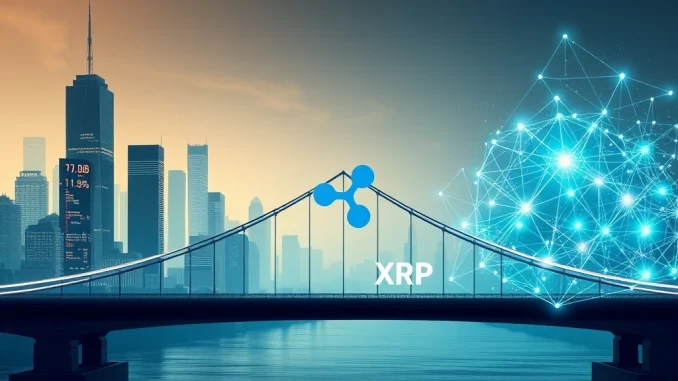
The convergence of traditional finance and decentralized finance represents one of the most exciting and transformative trends in the global economy. For years, the gap between these two worlds seemed vast, fraught with regulatory uncertainties, technological complexities, and a general lack of trust from established players. Ripple’s acquisition of Hidden Road directly tackles these challenges, effectively constructing a vital TradFi DeFi Bridge. This bridge is designed to be robust, secure, and compliant, offering institutions the confidence to venture into the digital asset space.
Here’s how this acquisition is accelerating the bridge-building process:
- Enhanced Liquidity and Access: Prime brokers provide access to deep liquidity pools across various exchanges and OTC desks, which is crucial for institutions dealing with large order sizes without significant price impact.
- Risk Management: Hidden Road’s robust risk management frameworks, including margin lending and collateral management, are essential for institutional clients navigating volatile crypto markets.
- Operational Efficiency: By offering consolidated services (trading, clearing, settlement), prime brokers streamline operations, reducing the complexity and cost for institutions engaging with multiple DeFi protocols and digital assets.
- Regulatory Compliance: Operating within established regulatory frameworks, Hidden Road helps ensure that institutional engagement with DeFi adheres to necessary legal and compliance standards, mitigating legal risks.
This strategic move by Ripple signals a clear intent to be at the forefront of this convergence, providing the necessary infrastructure for institutions to confidently step into the future of finance.
Institutional Crypto Adoption: A Tipping Point?
The narrative around cryptocurrencies is rapidly shifting from speculative retail interest to serious Institutional Crypto Adoption. Brad Garlinghouse has consistently highlighted that the burgeoning demand for secure, compliant, and scalable DeFi solutions is the primary driver behind this institutional curiosity. More prime brokers are expected to follow Ripple’s pioneering lead as the market continues to mature and regulatory clarity improves.
Recent legislative developments, such as the U.S. GENIUS Act, are playing a crucial role in providing much-needed legal clarity for DeFi platforms. This regulatory certainty fosters innovation and encourages significant capital inflows from institutional investors who previously remained on the sidelines due to legal ambiguities. Ripple’s focus on foundational infrastructure and unwavering compliance, rather than short-term price speculation, positions it as a pragmatic and reliable player in this rapidly evolving sector. Garlinghouse’s reiterated vision prioritizes long-term institutional adoption over immediate market gains, a stance that has significantly bolstered confidence in the company’s strategic direction among serious investors.
Understanding XRP Price Potential in a New Landscape
While Ripple’s primary focus is on building robust infrastructure for institutional adoption, the implications for XRP Price Potential are naturally a topic of keen interest. A recent blockchain tracker observed a substantial $108 million XRP transfer, underscoring continued ecosystem growth and activity among large holders. Furthermore, a software developer noted that if the convergence of traditional finance and DeFi continues at its current pace, multi-trillion-dollar markets could emerge for XRP. While this remains a speculative forecast, it highlights the immense potential unlocked by Ripple’s strategic infrastructure plays.
It’s important to understand that XRP’s value proposition extends beyond mere speculation. As Ripple expands its utility through acquisitions like Hidden Road, XRP’s role as a bridge currency for cross-border payments and a facilitator of on-demand liquidity within a compliant institutional framework becomes increasingly vital. The more institutions leverage Ripple’s infrastructure for digital asset transactions and DeFi access, the greater the underlying utility and demand for XRP could become. This long-term, utility-driven growth contrasts sharply with volatile, hype-driven price movements, suggesting a more sustainable path for XRP.
Ripple’s Vision: Democratizing Access and Ensuring Compliance
The market’s response to the Hidden Road acquisition has been largely positive. While XRP’s price has exhibited short-term volatility, it has shown resilience, reflecting underlying confidence in Ripple’s infrastructure advancements. Ripple’s strategic pivot from solely a payments-centric model to a comprehensive platform for institutional DeFi activity underscores its ambition to democratize access to crypto markets. Crucially, this expansion is meticulously designed to address long-standing concerns about transparency and regulatory alignment, key barriers for traditional financial institutions.
As the DeFi ecosystem continues to mature, the role of sophisticated fintech firms in bridging traditional and decentralized systems will become increasingly indispensable. Ripple’s proactive move with Hidden Road is not merely a business expansion; it is a powerful signal of the sector’s inevitable trajectory toward institutional legitimacy and seamless mainstream integration. This marks a significant milestone in the journey towards a more interconnected and efficient global financial system.
What Does This Mean for the Future?
- Increased Institutional Participation: Expect a surge in hedge funds, asset managers, and even central banks exploring digital assets and DeFi protocols through compliant channels.
- Regulatory Evolution: As more institutions enter, regulatory bodies will likely accelerate efforts to create clearer frameworks, further legitimizing the space.
- New Financial Products: The TradFi-DeFi bridge will likely spawn innovative financial products and services that blend the best of both worlds, offering new investment opportunities.
- Enhanced Market Efficiency: The reduced friction and increased transparency offered by blockchain-based systems, facilitated by prime brokers, will lead to more efficient global markets.
In conclusion, Ripple’s acquisition of Hidden Road is a game-changer. It’s a strategic move that not only solidifies Ripple’s position as a leader in institutional crypto infrastructure but also significantly accelerates the integration of traditional finance with the innovative power of decentralized finance. This development holds profound implications for the entire financial ecosystem, promising a future where digital assets are not just an alternative, but an integral part of global finance.
Frequently Asked Questions (FAQs)
Q1: What is Hidden Road, and why is its acquisition by Ripple significant?
Hidden Road is a prime brokerage firm specializing in digital assets. Its acquisition by Ripple is significant because it provides a critical gateway for traditional financial institutions (like hedge funds and trading desks) to access the decentralized finance (DeFi) market in a compliant and secure manner. This accelerates the bridging of traditional finance (TradFi) and DeFi.
Q2: How does Ripple’s acquisition of Hidden Road accelerate the TradFi-DeFi bridge?
Hidden Road offers essential services such as trade execution, clearing, and custody for institutions, which are vital for large-scale engagement with digital assets. By integrating Hidden Road, Ripple can provide institutions with a compliant, robust, and familiar infrastructure to access DeFi, reducing barriers related to liquidity, risk management, operational efficiency, and regulatory compliance.
Q3: What role does XRP play in Ripple’s strategy with Hidden Road?
While the acquisition primarily focuses on infrastructure for institutional access to DeFi, XRP’s role as a bridge currency for cross-border payments and a facilitator of on-demand liquidity within Ripple’s ecosystem is reinforced. As more institutions leverage Ripple’s infrastructure for digital asset transactions, the underlying utility and potential demand for XRP could increase, supporting its long-term value proposition.
Q4: How is institutional crypto adoption being impacted by regulatory developments?
Regulatory developments, such as the U.S. GENIUS Act, are providing much-needed legal clarity for DeFi platforms. This clarity fosters innovation and encourages capital inflows from institutional investors who previously hesitated due to regulatory uncertainties. Ripple’s focus on compliance further aligns with these evolving regulatory landscapes, making institutional engagement more feasible.
Q5: What are the long-term implications of this acquisition for the crypto market?
The acquisition signifies a major step towards mainstream integration of digital assets. It suggests increased institutional participation, the emergence of new blended financial products, enhanced market efficiency, and continued evolution of regulatory frameworks. It positions fintech firms like Ripple as key players in shaping the future of global finance by seamlessly connecting traditional and decentralized systems.