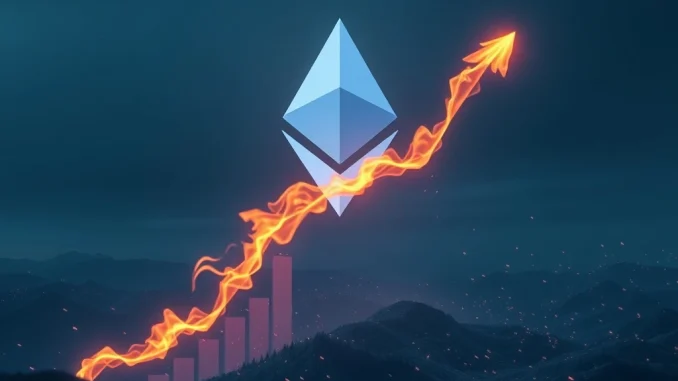
Have you ever tried to make a transaction on the Ethereum blockchain only to find yourself facing unexpectedly high costs? If so, you’re not alone. Recently, the crypto world witnessed a dramatic surge in Ethereum gas fees, reaching levels that left many users scratching their heads and wallets a little lighter. This spike wasn’t random; it was directly tied to the highly anticipated ERA airdrop, a phenomenon that underscored the delicate balance between network demand and transaction costs on the world’s second-largest cryptocurrency blockchain.
What Triggered the Surge in Ethereum Gas Fees?
The immediate catalyst for this dramatic increase in transaction costs was the opening of claims for the ERA airdrop. Airdrops, for the uninitiated, are a popular method for new crypto projects to distribute tokens to a wide audience, often as a way to bootstrap their community or reward early adopters. When a large number of users rush to claim these free tokens simultaneously, it creates a sudden, intense demand for block space on the Ethereum network.
Pseudonymous analyst @ai_9684xtpa, a well-known voice in the crypto community, was quick to highlight the impact on X (formerly Twitter). They reported that as soon as the ERA airdrop claims went live, Ethereum gas fees soared to an astonishing 36.7 Gwei. To put that into perspective, while 36.7 Gwei might seem like a modest number on its own, it represents a significant jump from typical baseline fees, especially when thousands of users are competing to get their transactions processed quickly.
- Sudden Demand Spike: Airdrop claims flood the network, creating a bottleneck.
- Block Space Competition: Users bid higher gas prices to ensure their transactions are prioritized.
- Gwei as a Metric: Gas prices are measured in Gwei (giga-wei), where 1 Gwei equals 0.000000001 ETH.
The Impact of High ETH Burn Rates
Beyond the immediate financial burden on users, the surge in activity also led to a substantial amount of ETH burned. The analyst’s report indicated that approximately 30.73 ETH, valued at roughly $105,000 at the time, was burned in just one hour. This phenomenon is a direct consequence of Ethereum’s EIP-1559 upgrade, implemented as part of the London hard fork in August 2021.
EIP-1559 introduced a mechanism where a portion of every transaction fee, known as the ‘base fee,’ is burned instead of going entirely to miners (now validators). This burning mechanism has a deflationary effect on Ethereum’s supply, as ETH is permanently removed from circulation. While a high burn rate can be seen as a positive for ETH’s long-term value proposition due to reduced supply, it also highlights periods of intense network congestion and high transaction costs for users.
Consider the implications:
| Aspect | Description | Impact of High ETH Burn |
|---|---|---|
| EIP-1559 | Introduced base fee and tip mechanism for transaction fees. | A portion of fees is permanently removed from circulation. |
| Deflationary Pressure | Reduces the total supply of ETH over time. | Potentially increases ETH’s scarcity and value. |
| Network Congestion Indicator | High burn rates often correlate with high network usage. | Signals periods of high demand and higher transaction costs for users. |
Navigating the ERA Airdrop Frenzy
For those involved in the ERA airdrop, the experience was a mixed bag. On one hand, receiving free tokens is always exciting. On the other hand, the cost of claiming these tokens sometimes offset a significant portion of their value, especially for smaller allocations. This scenario isn’t unique to ERA; it’s a recurring challenge during any popular airdrop or NFT mint on the Ethereum network.
So, how can users better navigate these frenzied periods? Here are a few actionable insights:
- Monitor Gas Prices: Use tools like Etherscan’s Gas Tracker or reputable dApps to monitor real-time gas prices. Waiting for off-peak hours (e.g., late night UTC) can often result in lower fees.
- Prioritize Transactions: For time-sensitive transactions, you might have to pay a higher ‘priority fee’ (formerly ‘tip’) to ensure your transaction gets included in the next block. For non-urgent claims, patience is key.
- Consider Layer 2 Solutions: Many projects, including airdrops, are increasingly leveraging Layer 2 scaling solutions like Arbitrum, Optimism, Polygon, or zkSync. These solutions offer significantly lower fees and faster transaction times, providing a viable alternative to the mainnet for certain operations.
Broader Implications for the Ethereum Network
The ERA airdrop incident serves as a stark reminder of the ongoing challenges and opportunities facing the Ethereum network. While Ethereum remains the backbone of decentralized finance (DeFi), NFTs, and a vast array of dApps, its scalability limitations, particularly during peak demand, are consistently brought to the forefront.
The good news is that the Ethereum community and developers are actively working on solutions. The transition to Ethereum 2.0 (now simply ‘the Merge’ and subsequent upgrades) aims to improve scalability, security, and sustainability through sharding and other enhancements. Meanwhile, Layer 2 solutions are rapidly maturing, offering immediate relief by processing transactions off-chain and then bundling them onto the mainnet.
This dynamic interplay between demand, fees, and scaling solutions is a critical narrative for the future of decentralized applications. It pushes developers to innovate and users to adapt to a constantly evolving ecosystem.
What Does This Mean for Cryptocurrency News?
For those following cryptocurrency news, events like the ERA airdrop gas fee surge are more than just technical hiccups; they are significant indicators of market sentiment, user behavior, and the health of the underlying blockchain infrastructure. They generate headlines, spark discussions, and influence investor decisions.
The consistent reporting on gas fee fluctuations, network congestion, and the success (or challenges) of scaling solutions forms a crucial part of the ongoing narrative around Ethereum’s viability as a global computing platform. It informs users about potential costs, helps developers understand network bottlenecks, and provides analysts with data points to assess the ecosystem’s growth and resilience. Staying informed through reliable cryptocurrency news sources is essential for anyone participating in this fast-paced industry.
Summary: Navigating Ethereum’s Dynamic Landscape
The recent surge in Ethereum gas fees, fueled by the ERA airdrop, was a vivid demonstration of supply and demand dynamics on the blockchain. It highlighted how intense interest in new projects can quickly push transaction costs sky-high, leading to significant amounts of ETH burned and impacting user experience. While these events can be frustrating for users, they also underscore the robust activity on the Ethereum network and the ongoing importance of scaling solutions. As the crypto space continues to evolve, staying abreast of cryptocurrency news and understanding the underlying mechanisms of blockchain networks will be key to navigating its exciting yet sometimes challenging landscape.
Frequently Asked Questions (FAQs)
Q1: What are Ethereum gas fees?
Ethereum gas fees are the costs associated with performing a transaction or executing a smart contract on the Ethereum blockchain. They are paid in Gwei (a small denomination of ETH) to compensate network validators for processing and securing transactions. The fee amount fluctuates based on network congestion and demand for block space.
Q2: Why do Ethereum gas fees surge during airdrops?
Gas fees surge during popular airdrops because a large number of users simultaneously rush to claim their tokens. This creates a sudden, intense demand for transaction processing on the network, leading to competition among users who bid higher gas prices to ensure their transactions are prioritized and included in the next block.
Q3: What does it mean when ETH is “burned”?
When ETH is “burned,” it means that a certain amount of Ether is permanently removed from circulation. This occurs due to Ethereum’s EIP-1559 upgrade, where a portion of every transaction’s base fee is sent to an unspendable address, effectively reducing the total supply of ETH and potentially making it more scarce over time.
Q4: How can I reduce the gas fees I pay on Ethereum?
You can reduce gas fees by monitoring network congestion and transacting during off-peak hours when fees are typically lower. Utilizing Layer 2 scaling solutions (like Arbitrum, Optimism, or Polygon) for supported dApps and transactions can also significantly reduce costs, as these networks process transactions more cheaply off the main Ethereum chain.
Q5: Is the Ethereum network prepared for future high-demand events?
The Ethereum network is continuously evolving to address scalability. While events like the ERA airdrop highlight current limitations, ongoing upgrades (like sharding in future Ethereum updates) and the rapid development of Layer 2 solutions are designed to significantly increase transaction throughput and reduce fees, making the network more robust for future high-demand events.