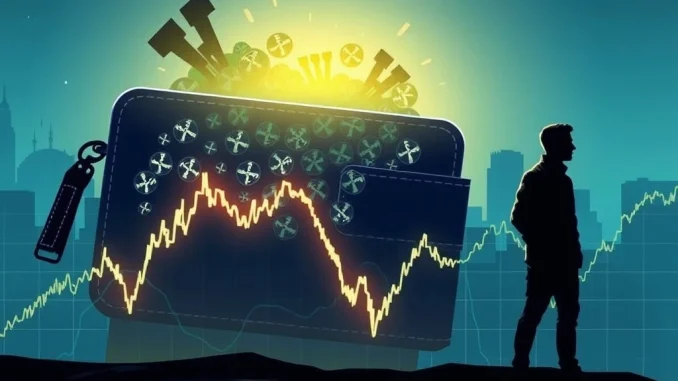
Are you watching the crypto markets with bated breath? Recent developments surrounding Ripple co-founder Chris Larsen’s substantial XRP wallet have sent ripples, and not the good kind, across the market. Warnings of a potential XRP price drop of up to 13% are echoing through the community, as analysts scrutinize a wallet historically linked to Larsen, holding an staggering $9 billion worth of XRP tokens.
Understanding the XRP Price Drop Threat
The crypto world is buzzing with concern over the potential sell-side pressure stemming from a massive XRP wallet. This wallet, associated with Ripple co-founder Chris Larsen, holds approximately 2.58 billion XRP, valued at roughly $8.83 billion. The sheer size of this holding, equivalent to 0.6% of the total XRP supply, has analysts worried about its impact on market stability if further liquidated. Recent activity, including a 50 million XRP transfer to exchanges in early July, has only intensified these fears. Analyst J. A. Maartunn of CryptoQuant highlighted the risk, questioning, “If $200 million was just the warm-up… what’s next?”
The concern isn’t just theoretical. XRP’s price trajectory has been volatile. After surging to a post-2021 high of $3.60 on July 17, the token quickly corrected to $3.18, a 13% decline. This slump coincided with mixed social media reactions to Larsen’s transactions, with some seeing them as profit-taking, while others accused him of offloading at peak prices. The historical precedent of crypto whale-driven sell-offs suggests that even partial disposals from such a large wallet could trigger significant liquidity shocks, amplifying the risk of a substantial XRP price drop.
Chris Larsen XRP Holdings: A Closer Look
The focus on Chris Larsen XRP holdings is not new, but the current scale of his linked wallet has brought renewed scrutiny. His recent transfers, including a $175 million outflow on July 25 and a prior $140 million transfer, have been interpreted by some market participants as a strategic approach to unlocking value from his substantial holdings. This has led to warnings from traders like ManLy, who cautioned investors about becoming “exit liquidity.” This phrase refers to a situation where late buyers inadvertently provide the necessary capital for large holders to sell their assets, often at the expense of new investors.
The implications of such large movements from a single entity are profound. While Larsen has been instrumental in building the Ripple ecosystem, his actions as a major holder also carry the potential for market destabilization. The transparency of blockchain transactions allows for this kind of scrutiny, but it also means that every significant move by a large holder like Larsen is watched closely, influencing market sentiment and investor behavior.
The Anatomy of a Crypto Whale Sell-Off
What exactly happens when a crypto whale like Chris Larsen potentially offloads significant holdings? It’s a delicate balance of supply and demand. When a large amount of a cryptocurrency, such as XRP, is suddenly made available for sale, it increases the supply without a corresponding increase in demand. This imbalance naturally pushes prices down. Here’s a simplified breakdown:
- Increased Supply: A large sale introduces a substantial volume of tokens into the market.
- Demand Lag: Unless there’s immediate, massive buying interest, demand struggles to absorb this new supply.
- Price Erosion: Sellers must lower their asking price to find buyers, leading to a downward spiral.
- Panic Selling: Smaller investors, seeing the price fall, might panic and sell their holdings, exacerbating the decline.
This dynamic is why the lingering $9 billion balance in Larsen’s wallet continues to prompt calls for caution. The market’s reaction to these developments remains uncertain, and further sales from this wallet could deepen the correction, particularly if institutional demand for Ripple XRP wanes.
Navigating Ripple XRP Market Volatility
The recent events highlight the inherent volatility in the crypto market, especially for assets like Ripple XRP. While XRP plays a role in the broader altcoin recovery following Bitcoin’s consolidation, its price performance has also been constrained by weaker fundamentals and ongoing regulatory uncertainty in the U.S. The legal battles surrounding XRP’s unregistered status continue to cast a shadow, adding another layer of complexity for investors.
Market turbulence isn’t exclusive to XRP; broader crypto market dips, like a recent Bitcoin price decline triggered by an 80,000 BTC sale, show how interconnected and sensitive the ecosystem is. However, for XRP, the direct threat from a known large holder adds a unique dimension of risk. The situation underscores the challenges of balancing retail optimism with the significant risks posed by whale activity in an asset class that is still largely unregulated.
Actionable Insights for Your XRP Wallet
Given the current market dynamics and the potential for a significant XRP price drop, what steps can investors take to protect their holdings? Caution and strategic planning are key. Here are some actionable insights:
- Stay Informed: Continuously monitor on-chain analytics and news related to large XRP movements.
- Risk Management: Consider hedging your positions to mitigate potential losses. This could involve using derivatives or setting stop-loss orders.
- Avoid FOMO: Resist the urge to buy into rapid pumps, especially if they are not backed by strong fundamental news, as these could be engineered by large holders looking to offload.
- Diversify: Do not put all your capital into a single asset. Diversifying your crypto portfolio can help spread risk.
- Understand “Exit Liquidity”: Be aware of the concept of “exit liquidity” and avoid becoming the counterparty for a large whale’s sell-off.
“Don’t be the exit liquidity. Protect yourself,” is a mantra worth remembering, as liquidity risks persist. The ability to identify and react to potential large-scale selling events is crucial for navigating these turbulent waters.
Conclusion
The scrutiny surrounding Chris Larsen’s $9 billion XRP wallet serves as a potent reminder of the power and potential pitfalls of crypto whale activity. While such individuals are often pioneers in the space, their large holdings can significantly influence market dynamics, leading to rapid price swings and uncertainty. The warnings of a potential XRP price drop highlight the importance of vigilance and sound risk management for investors. As the crypto market matures, understanding the interplay between large holders, market sentiment, and regulatory clarity will be paramount for anyone looking to navigate this exciting yet challenging landscape. Protecting your investments means staying informed and making calculated decisions, especially when significant on-chain movements are at play.
Frequently Asked Questions (FAQs)
1. Why is Chris Larsen’s XRP wallet a concern?
Chris Larsen’s wallet holds an estimated $9 billion worth of XRP, representing a significant portion of the total supply. Analysts are concerned that if a substantial amount of this XRP is sold, it could create immense sell-side pressure, leading to a sharp decline in XRP’s price and market instability.
2. What is an “XRP price drop warning”?
An XRP price drop warning refers to alerts issued by market analysts and traders, suggesting that the price of XRP could significantly decrease due to specific market factors, in this case, the potential liquidation of large holdings from Chris Larsen’s wallet. Recent transfers have already correlated with a 13% decline.
3. What is “exit liquidity” in the context of crypto?
“Exit liquidity” occurs when large holders (whales) sell their assets into market demand, often during a price surge, and smaller, retail investors buy these assets, effectively providing the “liquidity” for the whale to “exit” their position. This can leave retail investors holding assets that then decline in value.
4. How much XRP is in Chris Larsen’s wallet?
According to recent analyst warnings, the wallet historically linked to Chris Larsen retains approximately 2.58 billion XRP tokens, valued at around $8.83 billion. This constitutes about 0.6% of the total XRP supply.
5. Does Ripple comment on Chris Larsen’s wallet activity?
Ripple has not publicly commented on the specific transactions or the balance in Chris Larsen’s personal wallet. The company’s focus is typically on its corporate strategy and the utility of XRP for cross-border payments, rather than individual holdings of its co-founders.
6. What should XRP investors do amidst these warnings?
Investors are advised to exercise caution, stay informed about market movements and on-chain analytics, and consider risk management strategies such as hedging positions or setting stop-loss orders. Diversifying portfolios and avoiding FOMO (Fear Of Missing Out) are also recommended to mitigate potential risks associated with large whale activity.