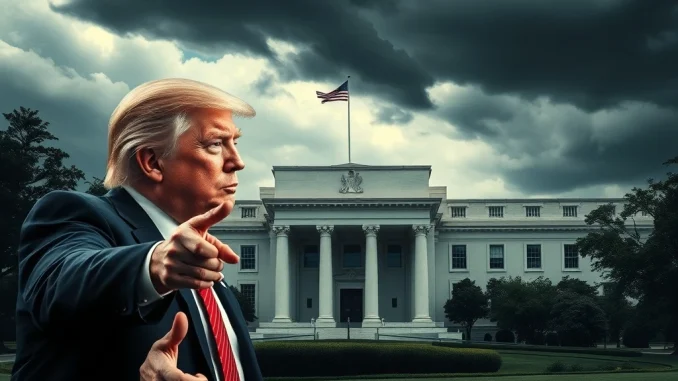
Are you tracking the latest shifts in global finance and their ripple effects on your digital assets? The cryptocurrency world often dances to the tune of macroeconomic policies, and a recent high-profile encounter between former President Donald Trump and Federal Reserve Chair Jerome Powell has sent tremors through the markets. This isn’t just political theater; it’s a crucial discussion about Trump rate cuts that could profoundly reshape economic landscapes and, by extension, the entire crypto market. Let’s dive into the details of this tense standoff and what it could mean for your portfolio.
The High-Stakes Showdown: Why Trump Rate Cuts Matter
In a rare and highly scrutinized visit to the Federal Reserve’s headquarters on July 24, 2025, former President Donald Trump publicly escalated his calls for Federal Reserve Chair Jerome Powell to lower interest rates. This visit, the first by a sitting president in nearly two decades, highlighted months of underlying tension between the White House and the central bank. Trump’s primary message was clear: “I’d love him to lower interest rates,” emphasizing the need to stimulate both the broader economy and the struggling housing market.
During a tour of the Fed’s $2.5 billion renovation project, Trump didn’t hold back, even joking about appointing himself to lead the Fed. His advocacy for significant Trump rate cuts aligns with his economic agenda, aiming to bolster housing affordability and spur growth. He asserted that “Lower interest rates will make homebuying attractive,” underscoring a key driver behind his public pressure. Beyond policy, Trump also scrutinized the renovation’s costs, leading to a public correction from Powell regarding the project’s budget.
Upholding Autonomy: The Battle for Fed Independence
The Federal Reserve operates under a mandate of independence, a cornerstone of its function to manage monetary policy free from direct political influence. Despite Trump’s direct appeals and accusations that Powell was maintaining high rates for “political reasons,” Chair Powell maintained a neutral expression throughout the visit. This stoic demeanor underscored the Fed’s historical commitment to its autonomy, a principle enshrined in federal law.
The tension between political demands and the Fed’s commitment to data-driven policy highlights the ongoing battle for Fed independence. While presidents have historically expressed views on monetary policy, such a public and direct confrontation within the Fed’s own walls is uncommon. Analysts widely view such pressure as risking the undermining of the institution’s credibility and its ability to make unbiased decisions crucial for long-term economic stability. However, the Fed’s historical resilience suggests it is unlikely to capitulate solely to presidential demands.
Decoding Jerome Powell’s Stance Amidst Political Pressure
At the center of this dynamic is Federal Reserve Chair Jerome Powell, whose term expires in May 2026. Powell has consistently reiterated the Fed’s commitment to its dual mandate of maximizing employment and maintaining price stability, guiding policy decisions based on evolving economic indicators, not political timelines. During Trump’s visit, Powell calmly corrected the president’s claims about the renovation budget, clarifying that Trump had conflated expenses from a completed initiative with the ongoing project.
Despite previous instances where Trump briefly floated the idea of firing Powell, causing market volatility, he later dismissed the suggestion as “highly unlikely.” Powell’s measured responses and the central bank’s steadfast adherence to its mandate signal a firm resolve against external pressures. The upcoming July 29–30 policy meeting is anticipated as a potential inflection point, with decisions contingent on fresh economic data rather than presidential persuasion.
What Does This Mean for the Crypto Market Impact?
The interplay between monetary policy and digital assets is undeniable. Historically, lower U.S. yields have often correlated with a rise in cryptocurrency prices, as investors seek higher returns in alternative assets. This is why the potential for Trump rate cuts has sparked considerable interest within the crypto community.
Should the Federal Reserve move towards a more accommodative monetary policy, the resulting boost in liquidity could significantly impact crypto markets. This would particularly benefit major cryptocurrencies like Bitcoin (BTC) and Ether (ETH), which often serve as bellwethers for the broader market. Furthermore, Layer 1 tokens such as Solana (SOL) and Avalanche (AVAX) could also see increased investor interest as capital flows into higher-risk, higher-reward assets. While no official rate cut has been announced, the mere discussion and potential shift in policy create a speculative environment, influencing investor sentiment and contributing to the overall crypto market impact.
The Future of Interest Rates: A Data-Driven Approach
As the 2026 election approaches, the dynamic between political pressures and the Fed’s data-driven approach to setting interest rates will remain a focal point. Trump’s calls for cuts reflect an emphasis on short-term economic growth, while the Federal Reserve’s cautious stance underscores its mandate to balance inflation control with employment stability. The central bank’s officials have consistently signaled that future policy decisions will remain dependent on incoming economic data, including inflation figures, employment reports, and global economic conditions.
The ongoing renovation project at the Fed, which has faced cost overruns attributed to “unforeseen increases,” also remains under public scrutiny. Trump’s critiques of these expenses, including private amenities, have intensified political attention. However, the Fed attributes delays and cost increases to external factors. The outcome of this high-stakes dynamic will likely shape broader market sentiment and policy expectations in the coming months, influencing everything from housing affordability to the trajectory of digital assets.
The recent encounter between Donald Trump and Jerome Powell underscores a fundamental tension in economic governance: the push for immediate economic stimulus versus the long-term stability sought by an independent central bank. While Trump’s public pressure for Trump rate cuts is clear, Jerome Powell and the Federal Reserve continue to signal their commitment to data-driven policy and Fed independence. The potential crypto market impact of any future changes to interest rates remains a key area of observation for investors. As economic indicators evolve, the world watches to see how this crucial dynamic will unfold and reshape global financial landscapes.
Frequently Asked Questions (FAQs)
Q1: What was the main purpose of Donald Trump’s recent visit to the Federal Reserve?
Donald Trump’s visit on July 24, 2025, was primarily to publicly pressure Federal Reserve Chair Jerome Powell to lower interest rates, aiming to stimulate the U.S. economy and housing market. It also highlighted ongoing tensions between the White House and the Fed.
Q2: Why is Trump pushing for rate cuts?
Trump advocates for rate cuts as part of his broader economic agenda, believing that lower interest rates will make homebuying more attractive, stimulate economic growth, and boost overall market activity.
Q3: How has the Federal Reserve responded to Trump’s demands for rate cuts?
Federal Reserve Chair Jerome Powell has maintained a neutral expression and reiterated the Fed’s commitment to its independence and data-driven policy decisions. The Fed continues to base its monetary policy on economic indicators rather than political pressure.
Q4: What is the potential impact of rate cuts on the cryptocurrency market?
Historically, lower U.S. interest rates and yields have led investors to seek higher returns in alternative assets, including cryptocurrencies like Bitcoin (BTC) and Ether (ETH). Accommodative monetary policy could increase liquidity in crypto markets, potentially boosting prices for various digital assets, including Layer 1 tokens.
Q5: What is the significance of the Federal Reserve’s independence?
The Fed’s independence is crucial for its ability to make unbiased monetary policy decisions based on economic data, free from short-term political pressures. This autonomy helps maintain price stability, maximize employment, and ensure long-term economic health.
Q6: When is the next key Fed policy meeting that could discuss interest rates?
The article mentions that Powell’s July 29–30 policy meeting is seen as a potential inflection point for discussions on interest rates, contingent on evolving economic indicators.