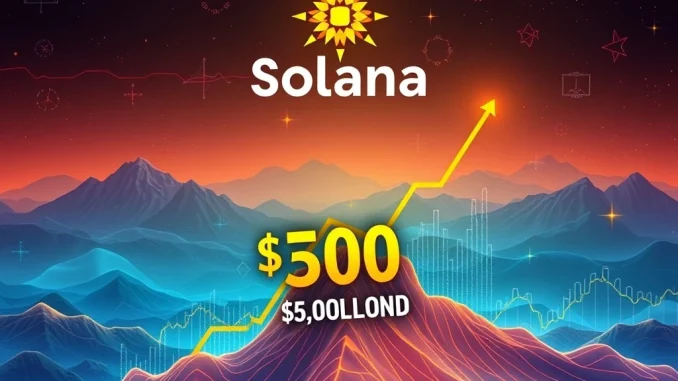
The cryptocurrency world is abuzz with exciting news as Solana (SOL) has once again demonstrated its remarkable resilience and growth, officially reclaiming a staggering $100 billion market capitalization. This significant milestone underscores Solana’s growing influence and the renewed confidence of investors in its high-performance blockchain. What exactly is driving this impressive surge, and what does it mean for the future of decentralized finance and beyond?
Solana’s Phenomenal Market Cap Rebound: A Closer Look
According to the latest data from CoinGecko, the Solana market cap has surged to approximately $102.66 billion, a testament to its robust performance in the current market cycle. This impressive valuation places Solana firmly among the top cryptocurrencies by market capitalization, signaling its strong competitive position. Accompanying this reclaim, the SOL price has also seen a significant uptick, currently trading at $190.68, reflecting a healthy 5.70% increase over the past 24 hours. This isn’t just a number; it represents a collective belief in Solana’s technological capabilities and its potential to scale the decentralized web.
The journey to reclaim the $100 billion mark has been dynamic, characterized by periods of intense development, community engagement, and strategic partnerships. This achievement is particularly noteworthy given the broader market volatility, highlighting Solana’s distinct trajectory and growing ecosystem.
What’s Driving the SOL Price Surge?
The recent rally in the SOL price isn’t a random occurrence; it’s the culmination of several key factors working in synergy. Understanding these drivers provides insight into Solana’s current momentum and its potential for sustained growth:
- Vibrant Ecosystem Growth: Solana’s ecosystem continues to expand at an astonishing pace. From decentralized finance (DeFi) protocols and non-fungible tokens (NFTs) to gaming and DePIN (Decentralized Physical Infrastructure Networks) projects, the platform is attracting a diverse range of builders and users. This organic growth fuels demand for SOL, as it’s used for transaction fees and staking within the network.
- Increased Developer Activity: A thriving developer community is the backbone of any successful blockchain. Solana has seen a consistent increase in active developers, leading to the deployment of innovative dApps and infrastructure improvements. This continuous innovation keeps the network competitive and appealing.
- Network Upgrades and Stability: While Solana has faced past challenges with network outages, significant efforts have been made to enhance its stability and reliability. Projects like Firedancer, a new independent validator client, promise to drastically improve network resilience and throughput. State compression, another significant innovation, allows for more efficient data storage, reducing costs and increasing scalability for applications like NFTs.
- Institutional Interest: Growing interest from institutional investors is a strong validation for any cryptocurrency. Products like Grayscale’s Solana Trust indicate increasing institutional appetite for SOL, bringing more capital and legitimacy to the ecosystem.
- Strategic Partnerships: Collaborations with major brands and technology companies are bringing Solana to a wider audience. These partnerships often involve integrating Solana’s blockchain technology into existing products and services, showcasing its real-world utility.
Understanding Solana’s Blockchain Technology
At its core, Solana’s blockchain technology is designed for speed, efficiency, and scalability, setting it apart in the crowded crypto landscape. Its unique architecture addresses some of the most pressing challenges faced by older blockchain networks, particularly concerning transaction throughput and costs. Here are some of its distinguishing features:
- Proof-of-History (PoH): This innovative consensus mechanism, combined with Proof-of-Stake (PoS), allows Solana to process transactions at an incredibly high speed. PoH creates a historical record of events, enabling validators to agree on the order of transactions without needing to communicate extensively, thus speeding up the block finalization process.
- High Transaction Throughput (TPS): Solana boasts a theoretical throughput of tens of thousands of transactions per second (TPS), significantly higher than many other major blockchains. This capacity makes it ideal for applications requiring rapid processing, such as high-frequency trading, gaming, and real-time payments.
- Low Transaction Fees: Despite its high speed, Solana maintains remarkably low transaction fees, making it accessible for everyday use and micro-transactions. This cost-effectiveness is crucial for mass adoption and fosters a more inclusive digital economy.
- Scalability: Solana’s design is inherently scalable, capable of growing to meet increasing demand without sacrificing decentralization or security. Its unique innovations, such as Sealevel (parallel smart contracts) and Gulf Stream (mem-pool-less transaction forwarding protocol), contribute to its robust architecture.
Solana’s Position in the Broader Crypto Market
In the dynamic and ever-evolving crypto market, Solana has carved out a significant niche for itself, often dubbed an ‘Ethereum killer’ due to its high throughput and lower fees. While Ethereum remains the dominant smart contract platform, Solana offers a compelling alternative for developers and users seeking faster, cheaper transactions. Its resurgence reflects a broader trend of diversification within the crypto space, where investors are looking beyond Bitcoin and Ethereum to high-potential alternative Layer-1 blockchains.
However, Solana’s journey hasn’t been without its hurdles. Past network outages raised concerns about its stability and centralization. The Solana team has actively addressed these issues through ongoing development and community-driven initiatives, aiming to strengthen network resilience and foster greater decentralization. This commitment to improvement has played a crucial role in rebuilding trust and attracting new users and capital.
Compared to other Layer-1 solutions, Solana’s distinct technical approach and thriving developer community position it as a formidable competitor, constantly pushing the boundaries of what’s possible in the blockchain space.
The Road Ahead for Solana: What’s Next?
The journey for Solana is far from over. Reclaiming the $100 billion market cap is a significant achievement, but it’s also a stepping stone for future growth. The focus now shifts to sustained development, ecosystem expansion, and addressing remaining challenges. Key areas of future development include:
- Continued Infrastructure Improvements: Further enhancements to network stability and decentralization remain a priority. Projects like Firedancer are critical for ensuring Solana’s long-term reliability.
- Mass Adoption of dApps: The success of dApps built on Solana, particularly in gaming, DeFi, and consumer-facing applications, will be crucial for attracting a wider user base.
- Enterprise and Institutional Integration: Deeper integration with traditional finance and enterprise solutions could unlock massive new markets for Solana’s technology.
- Community Governance and Participation: Empowering the community through decentralized governance will be vital for Solana’s long-term health and decentralization goals.
The energy surrounding Solana is palpable, driven by a community that believes in its vision of a scalable and accessible blockchain future. Its ability to innovate rapidly and adapt to market demands will be key to maintaining its momentum and achieving its ambitious goals.
Actionable Insights for the Solana Enthusiast
- For Investors: While the recent surge is exciting, always conduct thorough due diligence (DYOR). Consider Solana’s long-term potential, technological advancements, and ecosystem growth. Diversification is key in the volatile crypto market.
- For Developers: Solana offers a high-performance environment for building dApps. Explore its developer tools, documentation, and vibrant community to contribute to its growing ecosystem.
- For Users: Engage with the diverse dApps on Solana. Experience the low fees and fast transactions firsthand, from trading on DEXs to exploring NFT marketplaces and gaming platforms.
Conclusion
Solana’s triumphant reclamation of the $100 billion market capitalization is more than just a financial milestone; it’s a powerful statement about its resilience, innovation, and growing prominence in the blockchain space. The factors driving the SOL price surge—from its expanding ecosystem and robust blockchain technology to increasing institutional interest—paint a promising picture for its future. As the crypto market continues to mature, Solana’s commitment to scalability, speed, and user-friendliness positions it as a formidable contender in the race to build the next generation of decentralized applications. While challenges remain, the dedication of its community and developers suggests a bright and impactful journey ahead for Solana.
Frequently Asked Questions (FAQs)
1. What is Solana (SOL)?
Solana (SOL) is a high-performance blockchain platform designed for decentralized applications (dApps) and crypto projects. It is known for its high transaction throughput, low transaction costs, and unique Proof-of-History (PoH) consensus mechanism combined with Proof-of-Stake (PoS).
2. What is Solana’s market cap, and why is it significant?
Solana’s market capitalization recently reclaimed $100 billion, currently standing at approximately $102.66 billion. This figure represents the total value of all SOL tokens in circulation and is a significant indicator of its market presence, investor confidence, and overall health within the cryptocurrency ecosystem.
3. Why has the SOL price been increasing recently?
The recent increase in SOL price is attributed to several factors, including the rapid expansion of its ecosystem (DeFi, NFTs, gaming), increased developer activity, ongoing network stability improvements (like Firedancer), growing institutional interest, and strategic partnerships.
4. What are the key features of Solana’s blockchain technology?
Solana’s core technological features include its innovative Proof-of-History (PoH) consensus mechanism, exceptionally high transaction throughput (TPS), remarkably low transaction fees, and inherent scalability designed to handle a large volume of users and applications.
5. What are the main challenges or risks associated with Solana?
Historically, Solana has faced challenges with network outages, which raised concerns about its stability and decentralization. While significant efforts are being made to address these issues, potential investors should be aware of these past incidents and the ongoing efforts to mitigate them.
6. How does Solana compare to Ethereum?
Solana is often compared to Ethereum as a smart contract platform. Key differences include Solana’s significantly higher transaction speed and lower fees due to its unique architecture, compared to Ethereum’s current (pre-sharding) lower throughput and higher gas fees. Both platforms aim to provide infrastructure for decentralized applications, but they achieve this through different technological approaches.