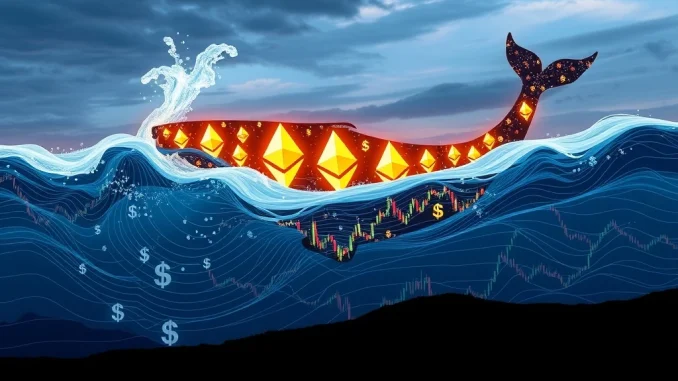
The cryptocurrency world is abuzz following a significant transaction that saw an anonymous Ethereum whale offload a staggering $13.92 million worth of ETH. This massive sell-off, executed over a 10-hour period on July 26, 2025, has not only generated a substantial $2.69 million profit for the large holder but also ignited widespread concerns about potential ETH price volatility across the broader crypto market. Such large-scale movements by ‘whales’ – entities holding significant amounts of a cryptocurrency – often act as seismic tremors, sending ripples through the digital asset landscape and prompting investors to scrutinize market dynamics.
Decoding the Ethereum Whale’s Massive Sell-Off
On July 26, 2025, the crypto community witnessed a calculated move by a prominent Ethereum whale. This anonymous entity liquidated 3,810 ETH, amounting to $13.92 million, within a 10-hour window. The transaction wasn’t just large; it was strategically timed, allowing the whale to pocket an impressive $2.69 million in profit. This profit-taking maneuver highlights the sophisticated understanding and real-time market insight often possessed by such large holders. Their actions are not random; they are typically a response to perceived favorable market conditions, aiming to maximize returns on their substantial investments.
The immediate implication of such a significant sell-off is the potential for sudden liquidity shifts. When a large volume of an asset is sold, it can temporarily flood the market, creating selling pressure that might lead to price corrections. For retail investors, tracking these movements becomes crucial as they can signal shifts in market sentiment and structure. The speed and scale of this particular transaction underscore a calculated approach to securing gains after a period of price appreciation for Ethereum.
Understanding ETH Price Dynamics Post-Liquidation
Whenever a major Ethereum whale makes a move, the immediate question on everyone’s mind is: how will this impact the ETH price? While a $13.92 million sell-off is significant, especially for individual investors, it’s important to view it within the context of Ethereum’s overall market capitalization and daily trading volume. Historically, whale-driven sales have often led to temporary price fluctuations rather than sustained downturns.
- Short-Term Volatility: The most immediate effect is often increased short-term volatility. The sudden influx of supply can cause the price to dip as buyers absorb the sold assets.
- Market Sentiment: Such events can influence market psychology. Some retail investors might interpret a whale sell-off as a negative signal, leading to panic selling, while others might see it as a buying opportunity.
- Resilience Factors: Ethereum’s ecosystem is vast and resilient. Its foundational role in decentralized finance (DeFi), NFTs, and smart contracts, coupled with ongoing technological upgrades (like future scalability solutions), provides a strong underlying support that often helps it absorb such shocks.
The $2.69 million profit generated by the whale serves as a reminder of the potential rewards in crypto, but also the risks associated with rapid price movements. Understanding these dynamics is key for any investor navigating the digital asset space.
Navigating Crypto Market Volatility: What Investors Need to Know
The recent Ethereum whale sell-off serves as a stark reminder of the inherent crypto market volatility. While the allure of significant gains is strong, the market’s susceptibility to large individual transactions necessitates a cautious and informed approach from investors. Here’s what you need to consider:
- Liquidity Shifts: Large transactions can swiftly alter market liquidity, creating imbalances between buyers and sellers that lead to rapid price swings.
- Psychological Impact: Whale movements can trigger herd mentality. When big players move, smaller investors might follow suit, amplifying market reactions.
- Long-Term vs. Short-Term: It’s crucial to differentiate between short-term fluctuations caused by whale activity and long-term market trends driven by fundamental developments. Ethereum’s long-term trajectory is supported by its continuous development, growing adoption, and pivotal role in the blockchain ecosystem.
For investors, reacting impulsively to every large transaction can be detrimental. Instead, focusing on a disciplined investment strategy and understanding the broader market context is paramount. Tools like dollar-cost averaging can help mitigate the risks associated with market timing, allowing investors to build positions gradually without being overly exposed to sudden price drops.
The Power of On-Chain Analytics in Tracking Whale Activity
In the transparent world of blockchain, every transaction leaves a trace. This is where on-chain analytics platforms become invaluable. For instance, analysts like @ai_9684xtpa leveraged these tools to quickly identify and report on the whale activity, providing crucial insights into the $13.92 million sell-off.
On-chain analytics transforms raw blockchain data into actionable intelligence by:
- Aggregating Transaction Patterns: Identifying clusters of transactions from the same wallet or associated wallets to understand large-scale movements.
- Wallet Clustering: Linking various wallet addresses to a single entity, providing a clearer picture of an individual or institution’s total holdings and activity.
- Timing Anomalies: Highlighting unusual timing or rapid sequences of transactions that might indicate strategic maneuvers.
This analytical layer is essential for understanding market mechanics, anticipating liquidity shifts, and even discerning investor sentiment. The transparency of blockchain, coupled with sophisticated analytical tools, empowers investors with data that was previously unavailable in traditional markets. It allows for a deeper dive into the market’s underlying structure, enabling more informed decision-making and bridging the gap between technical data and strategic investment planning.
Beyond the Waves: Ethereum’s Long-Term Resilience
While the recent Ethereum whale sell-off certainly created ripples, it’s vital to place such events within the broader context of Ethereum’s long-term outlook. Ethereum’s foundational role in decentralized finance (DeFi), its robust smart contract capabilities, and its ongoing commitment to scalability solutions position it as a cornerstone of the blockchain industry. Despite temporary price corrections caused by large liquidations, the ecosystem’s resilience remains strong.
Key factors contributing to Ethereum’s sustained growth and stability include:
- Ongoing Technological Upgrades: Continuous development, including upcoming network upgrades aimed at improving efficiency and reducing transaction costs, strengthens its core infrastructure.
- Growing Institutional Interest: Increasing adoption by institutional investors and traditional finance players adds significant capital and credibility to the network.
- Vibrant Developer Ecosystem: A large and active community of developers continuously builds new applications and protocols on Ethereum, fostering innovation and utility.
These fundamental strengths suggest that while short-term volatility from significant whale activity is inevitable, Ethereum’s broader trajectory remains positive. Investors are generally advised to focus on long-term horizons, employ robust risk management tools, and avoid reactive trading in response to isolated market events. The transparency offered by blockchain data continues to empower investors, fostering a more informed and resilient market environment.
The $13.92 million sell-off serves as a compelling case study in the dynamic interplay between large holder behavior and broader market forces. By dissecting such events with the aid of tools like on-chain analytics, participants can gain a clearer understanding of the crypto landscape. This empowers them to balance strategic insights with disciplined investment practices, ultimately contributing to a more mature and resilient market.
Frequently Asked Questions (FAQs)
What is an Ethereum whale?
An Ethereum whale is an individual or entity that holds a very large amount of Ethereum (ETH), enough to potentially influence its market price through significant buy or sell orders. Their actions are closely watched by other investors due to their potential market impact.
How does a whale sell-off impact ETH price?
A large whale sell-off can increase the supply of ETH on exchanges, creating selling pressure that may lead to a temporary dip or increased volatility in the ETH price. The extent of the impact depends on the volume sold, overall market liquidity, and prevailing market sentiment.
Can on-chain analytics predict whale movements?
While on-chain analytics cannot predict exact future movements, they can identify patterns, large transactions, and wallet clustering, providing insights into potential upcoming liquidity shifts or changes in sentiment. This data helps investors make more informed decisions by understanding historical and current large-holder behavior.
Should I panic if a whale sells a large amount of Ethereum?
Panicking and making impulsive decisions is generally not recommended. While whale sell-offs can cause short-term volatility, it’s important to consider Ethereum’s long-term fundamentals, ongoing development, and broader market trends. A disciplined investment strategy, such as dollar-cost averaging, can help mitigate risks associated with such events.
What is the significance of the $2.69 million profit in this whale transaction?
The $2.69 million profit highlights the substantial gains possible for large, well-timed cryptocurrency investments. It underscores the strategic acumen of the whale, who likely capitalized on favorable market conditions to maximize their returns, and serves as an example of the high reward potential in crypto, albeit for those with significant capital and market insight.