The cryptocurrency world is currently experiencing a fascinating shift. After a period of exhilarating all-time highs, Bitcoin finds itself in a crucial phase of Bitcoin market consolidation. This isn’t a retreat, but rather a strategic pause, a period where the market catches its breath and recalibrates. What does this mean for the future trajectory of the world’s leading digital asset, and could a significant retest of key price levels truly be on the horizon?
What Does Bitcoin Market Consolidation Signify?
Following its impressive rally to new record highs, Bitcoin’s momentum has naturally slowed. This period, known as consolidation, is a normal and often healthy part of any asset’s price cycle. It’s characterized by prices trading within a defined range, as buyers and sellers find a temporary equilibrium.
According to Glassnode, a leading on-chain analytics firm, this slowdown is evident in key metrics. The Realized Profit to Loss Ratio, for instance, has seen a notable drop from 3.9 to 2.6. This specific metric indicates a cooling in overall market profitability. When the ratio is high, it suggests a significant portion of the market is holding unrealized profits, often leading to profit-taking. A decline suggests that fewer large profits are being taken, or that new money is entering at these higher ranges, adjusting to the new reality.
Glassnode’s insights further suggest that investors are actively adjusting to these range-bound conditions. This means the market isn’t in a state of panic selling, but rather one of re-evaluation and position-building. It’s a time when market participants digest recent gains and prepare for the next potential move.
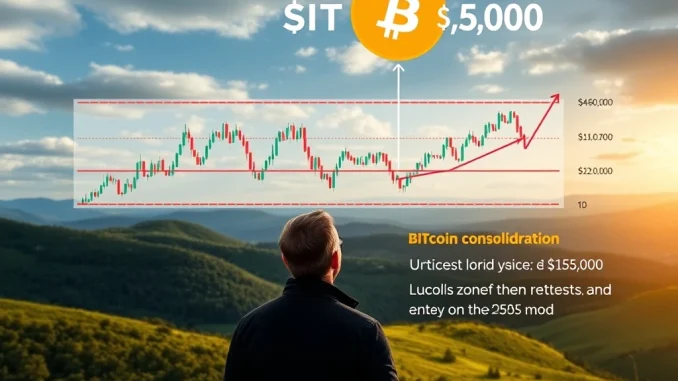
Is a Bitcoin Price Retest of $115K Truly Possible?
One of the most talked-about scenarios in the current market is the potential for a Bitcoin price retest of the $115,000 level. This isn’t just a random number; it’s identified by popular trader Daan Crypto Trades as a key liquidity point. What exactly does this mean, and why is it so important?
A ‘retest’ refers to the price returning to a previously significant level, often a support or resistance zone, to confirm its strength. In this context, $115,000 is being highlighted as a magnet for price action due to the accumulation of trading interest around that level.
According to Cointelegraph, Daan Crypto Trades has pointed out that positions are actively building in this range. This accumulation of orders – both buy and sell – creates a pool of liquidity. When the price approaches such a liquidity zone, it often triggers a cascade of trades, potentially fueling the next significant price move, whether upwards or downwards. A successful retest of a support level, for example, can confirm its strength and pave the way for a renewed uptrend.
Understanding Critical Bitcoin Liquidity Levels
To truly grasp the significance of a potential $115,000 retest, it’s vital to understand Bitcoin liquidity levels. Liquidity refers to the ease with which an asset can be converted into cash without affecting its market price. In cryptocurrency, it’s often represented by the density of buy and sell orders at various price points on exchanges.
Key liquidity levels are areas on the price chart where a large volume of orders are clustered. These can be:
- Accumulation Zones: Where buyers are actively placing bids, creating strong support.
- Distribution Zones: Where sellers are placing asks, creating strong resistance.
- Stop-Loss Clusters: Many traders place stop-loss orders at similar levels, which, if triggered, can add to market volatility and accelerate price movements towards these liquidity points.
The $115,000 mark is being observed as one such critical liquidity point. The build-up of positions around this price suggests that a significant amount of capital is positioned there, waiting for a catalyst. Whether the market is heading towards this level to fill existing orders or to trigger stop losses, its magnetic pull cannot be ignored. Understanding these levels helps investors anticipate potential turning points and volatility spikes.
Navigating Current Crypto Market Trends: What’s Next?
Beyond Bitcoin’s immediate consolidation, it’s important to consider broader crypto market trends. Bitcoin often acts as the market’s bellwether, and its consolidation period has ripple effects across the altcoin ecosystem. While Bitcoin takes a breather, we often see altcoins experiencing their own mini-rallies, as capital rotates from BTC into other digital assets.
Current trends suggest:
- Altcoin Season Potential: As Bitcoin stabilizes, traders often look for opportunities in altcoins, especially those with strong fundamentals or upcoming catalysts.
- Increased Volatility in Smaller Caps: While Bitcoin consolidates, smaller market cap altcoins can exhibit higher volatility, offering both significant opportunities and risks.
- Focus on On-Chain Data: More investors are turning to on-chain metrics (like those provided by Glassnode) to gain deeper insights into market structure and investor behavior, moving beyond just price charts.
- Macroeconomic Influences: Global economic indicators, interest rate decisions, and geopolitical events continue to play a significant role in overall crypto market sentiment.
Staying informed about these broader trends is crucial for making well-rounded investment decisions during this consolidating phase.
How is Bitcoin Investor Behavior Adapting to Range-Bound Conditions?
The current market conditions are shaping Bitcoin investor behavior in interesting ways. Gone are the days of easy, parabolic gains. Now, investors are navigating a more nuanced environment, requiring patience and strategic thinking.
- Profit-Taking: Many long-term holders and those who bought at lower prices are likely taking some profits off the table, contributing to the selling pressure that prevents immediate upward surges. This is a natural and healthy part of a market cycle.
- Accumulation by Whales: Conversely, significant entities (whales) and institutional investors often use consolidation periods to accumulate more Bitcoin at relatively stable prices, viewing it as an opportunity before the next leg up.
- Shift from FOMO to Strategy: The fear of missing out (FOMO) that drives bull markets often subsides during consolidation. This allows investors to make more rational, strategy-driven decisions rather than emotional ones.
- Increased Derivatives Activity: Range-bound markets often see an increase in derivatives trading (futures, options), as traders attempt to profit from smaller price movements or hedge their spot positions.
Glassnode’s observation that investors are ‘adjusting to range-bound conditions’ underscores this shift. It implies a maturation of the market where participants are becoming more sophisticated in their approach to volatility and sideways price action.
Key Takeaways for Investors in a Consolidating Market
Navigating a period of Bitcoin market consolidation requires a thoughtful approach. Here are some actionable insights:
- Monitor Key Levels: Keep a close eye on the $115,000 liquidity zone, as well as other significant support and resistance levels. These will provide clues for the next major price move.
- Risk Management is Paramount: Volatility can still be high within a range. Ensure your portfolio is diversified and that you have stop-loss orders in place for active trades.
- Patience is a Virtue: Consolidation phases can be frustratingly slow. Avoid impulsive decisions driven by short-term fluctuations.
- Education and Research: Use this time to deepen your understanding of on-chain metrics, market cycles, and the fundamentals of projects you invest in.
- Consider Dollar-Cost Averaging (DCA): For long-term investors, DCA can be an effective strategy during consolidation, allowing you to accumulate Bitcoin at an average price over time.
Conclusion: Preparing for Bitcoin’s Next Chapter
Bitcoin’s current phase of consolidation is not a sign of weakness, but rather a crucial period of market digestion and preparation. The cooling of the Realized Profit to Loss Ratio, as highlighted by Glassnode, indicates a healthy adjustment from rapid profit-taking to more stable conditions. The spotlight on the $115,000 mark by traders like Daan Crypto Trades underscores the importance of liquidity levels in shaping future price action. As investors adapt to these range-bound conditions, the stage is being set for Bitcoin’s next significant move. Whether it’s a retest of key levels or a breakout to new territory, understanding the dynamics of market consolidation, liquidity, and investor behavior will be key to navigating the evolving crypto landscape successfully. The market is taking a breath; smart investors should use this time to strategize and position themselves for what comes next.
Frequently Asked Questions (FAQs)
Q1: What does Bitcoin market consolidation mean for my investments?
A1: Bitcoin market consolidation means the price is trading within a relatively narrow range after a significant move. For investors, this suggests a period of lower volatility compared to rapid surges, but it also means less immediate profit potential from quick upward movements. It’s a time for the market to stabilize and prepare for its next directional move.
Q2: Why is the Realized Profit to Loss Ratio important in this analysis?
A2: The Realized Profit to Loss Ratio, as noted by Glassnode, indicates the average profitability of coins being spent on-chain. A drop from 3.9 to 2.6 signals that fewer large profits are being taken, or that new money is entering at current levels, suggesting a cooling in profitability and investors adjusting to current price ranges rather than aggressively selling into gains.
Q3: What is a ‘key liquidity point’ like $115,000, and why is it significant?
A3: A key liquidity point is a price level where a large number of buy and sell orders are clustered. For example, $115,000 is highlighted as such a point. Its significance lies in its potential to act as a magnet for price, as the market may move towards it to fill these orders, potentially triggering stop losses or attracting new buying/selling interest, thus fueling the next major price movement.
Q4: How does Bitcoin Investor Behavior change during consolidation?
A4: During consolidation, Bitcoin investor behavior often shifts from aggressive buying (FOMO) to more strategic actions. This includes profit-taking by early buyers, accumulation by whales at stable prices, and increased interest in derivatives trading to profit from smaller movements. Investors tend to focus more on fundamental and on-chain analysis rather than emotional reactions.
Q5: Should I buy Bitcoin during a consolidation phase?
A5: Buying during a consolidation phase can be a strategic move for long-term investors, especially if employing a Dollar-Cost Averaging (DCA) strategy. It allows you to accumulate Bitcoin at an average price before a potential breakout. However, it’s crucial to manage risk, as consolidation can sometimes precede a downward move, or simply extend for a longer period than anticipated.