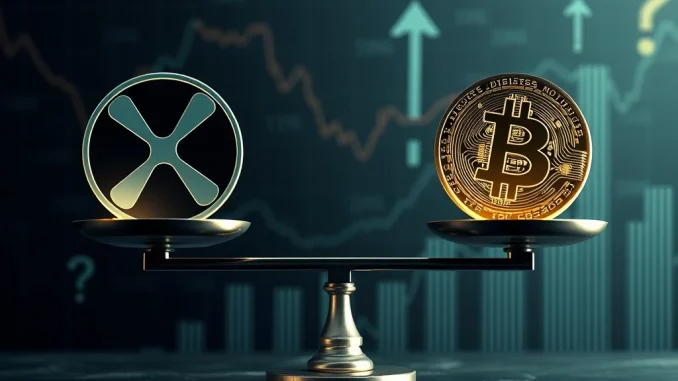
Imagine a world where XRP, currently hovering around $3, suddenly rockets to over $30. Sounds ambitious? A prominent cryptocurrency analyst has reignited this exact debate, claiming that the true XRP price should reflect a historical Bitcoin ratio, suggesting a valuation far beyond its current trading range. This provocative claim has sent ripples through the crypto market, prompting investors and analysts alike to re-evaluate what truly drives XRP’s valuation.
The Bitcoin Ratio Revelation: Is a $30 XRP Price Realistic?
The heart of this intriguing argument stems from cryptocurrency commentator Amonyx, who recently made a bold assertion: XRP’s valuation should, by historical precedent, be trading above $30 today. This isn’t a random figure; it’s derived from a specific historical comparison – the token’s Bitcoin ratio back in 2018.
During the peak of the 2017-2018 bull run, XRP briefly achieved a Bitcoin-denominated price of 0.0002247 BTC. Amonyx specifically cites a ratio close to 0.00026 BTC. The mathematical logic is straightforward: if you multiply this 2018 ratio by Bitcoin’s current impressive value, which stands at approximately $117,800, the implied XRP price indeed surges past the $30 mark.
However, the undeniable reality presents a stark contrast. As of late July 2025, XRP is trading at approximately $3.06, creating an enormous chasm between this theoretical target and its actual market price [1]. This discrepancy immediately raises questions about the validity of using past ratios in a dramatically different market landscape.
The 2018 Bitcoin ratio for XRP was undeniably driven by intense speculative enthusiasm rather than established, sustainable utility. Back then, XRP soared to third place in market capitalization, propelled by widespread optimism surrounding Ripple‘s vision for global payments and its underlying technologies. The narrative was powerful: XRP would revolutionize cross-border transactions, and this belief fueled its ascent against Bitcoin. However, the market dynamics of today are vastly different, demanding a fresh perspective on XRP’s valuation.
Why the XRP Valuation Debate Heats Up: A Shifting Crypto Market
The current crypto market operates under fundamentally different conditions than those of 2018. Bitcoin, for instance, has firmly cemented its position as a digital store of value and an increasingly recognized institutional asset. Its market dominance has solidified, and its narrative has matured beyond mere speculation. In contrast, XRP, while still focused on payments, continues to navigate complex regulatory landscapes, particularly in key markets.
Analysts are quick to point out that the 2018 Bitcoin ratio was inherently unsustainable. It represented a speculative bubble rather than a reflection of fundamental value or widespread adoption. Today’s XRP valuation, they argue, is a more grounded assessment. It takes into account real-world utility, the pace of adoption by financial institutions, and the progress Ripple has made in achieving regulatory compliance. The market has become more discerning, moving beyond simple historical comparisons to evaluate assets based on their intrinsic value proposition and ecosystem development [1].
The shift in the crypto market paradigm means that investors are no longer solely looking at historical price relationships. Instead, they are scrutinizing:
- Regulatory Clarity: The ongoing legal battles and regulatory uncertainties surrounding XRP have undoubtedly weighed on its price and potential for institutional adoption.
- Real-World Utility: While Ripple continues to push its payment solutions, the actual transaction volume and widespread integration of XRP in global finance are critical metrics.
- Competitive Landscape: The payments sector has become increasingly crowded, with numerous blockchain and traditional finance solutions vying for market share.
- Broader Market Sentiment: General investor sentiment towards altcoins, influenced by Bitcoin’s performance and macroeconomic factors, plays a significant role.
This evolution underscores why a simple Bitcoin ratio from years past might not accurately reflect the current or future XRP price.
Ripple’s Journey: Navigating Regulatory Waters and Future Forecasts
Looking at XRP’s performance in 2025 reveals a mixed picture. While the token did manage to surpass its 2018 peak of $3.40, reaching a recent high of $3.66, it has noticeably lagged behind Bitcoin’s remarkable ascent. Bitcoin’s meteoric rise has set a high bar, and many altcoins, including XRP, have struggled to keep pace with its institutional-driven momentum.
Despite these challenges, Ripple has made significant strides in bolstering the XRP ecosystem. Progress towards regulatory clarity, particularly in some jurisdictions, has provided a degree of confidence. Furthermore, strategic enterprise partnerships, such as Ripple‘s initiative to launch the RLUSD stablecoin, are designed to expand the utility and adoption of the XRP Ledger. These developments are crucial for XRP’s valuation and its long-term viability in the competitive crypto market [1].
However, the path forward is not without hurdles. Institutional adoption for XRP remains slower compared to Bitcoin, which has seen considerable interest from large investment firms and traditional finance. Persistent regulatory scrutiny in key global markets continues to act as a constraint on growth, creating uncertainty for potential corporate partners and investors. This regulatory overhang, combined with broader crypto market volatility, was evident in mid-July 2025, when XRP experienced a 10% price drop, highlighting the token’s susceptibility to market shifts and sentiment [1].
When it comes to future XRP price forecasts, opinions diverge widely among analysts and AI models:
| Source/Analyst | XRP Price Prediction | Timeframe/Conditions |
|---|---|---|
| Leading Firms | $7 to $15 | Next 12 to 18 months |
| Leading Firms (for $30) | Only with significant new catalysts | Longer term |
| CoinPedia | $5.81 | If financial institutions adopt for liquidity provisioning |
| DeepSeek (AI Model) | $30 | By 2026 |
| CoinCodex | $3.00 to $3.62 (average $3.27) | For 2025 |
This table vividly illustrates the spectrum of predictions, from cautious short-term outlooks to highly ambitious long-term targets. It reinforces the idea that while a $30 XRP price is theoretically possible for some, it is contingent on substantial developments, particularly concerning widespread institutional adoption and definitive regulatory clarity for Ripple‘s ecosystem.
Beyond the Bitcoin Ratio: What Truly Drives XRP’s Value?
The ongoing debate between historical projections and current valuations underscores a fundamental evolution within the crypto market. Investors and seasoned analysts are increasingly moving away from relying solely on Bitcoin ratio comparisons or other speculative benchmarks. Instead, the focus has shifted towards independent metrics that reflect an asset’s genuine utility and ecosystem health.
For XRP’s valuation, this means a greater emphasis on tangible factors such as:
- Transaction Volume: The actual amount of XRP being moved across the XRP Ledger for cross-border payments and other use cases.
- Regulatory Advancements: Clear, favorable regulations in major economies would significantly de-risk the asset and open doors for broader institutional participation.
- Ecosystem Growth: The expansion of dApps, stablecoins (like RLUSD), and other projects built on the XRP Ledger, increasing its overall utility and network effect.
- Partnerships and Integrations: New collaborations with financial institutions, payment providers, and businesses that actively utilize XRP or the XRP Ledger for their operations.
While Amonyx’s argument based on the 2018 Bitcoin ratio holds mathematical validity, it arguably overlooks the profound maturation of both Bitcoin and XRP, as well as the broader crypto market itself. Bitcoin has matured into a macro asset, while XRP continues to carve out its niche in the payments sector, albeit with its own unique set of challenges and opportunities.
For investors considering XRP’s valuation and future potential, the actionable insight is clear: prioritize fundamental analysis over historical correlations. Monitor Ripple‘s progress on key fronts, including legal developments, the rollout of new products like RLUSD, and the pace of enterprise adoption. These elements, far more than a bygone Bitcoin ratio, will ultimately determine XRP’s price trajectory and its long-term position in the digital asset economy.
The debate surrounding XRP’s valuation and the ambitious $30+ price target, driven by a historical Bitcoin ratio, serves as a powerful reminder of the crypto market‘s dynamic nature. While mathematically compelling, the 2018 comparison highlights how much the digital asset landscape has evolved. Today, XRP’s price is increasingly influenced by its fundamental utility, regulatory clarity, and the growth of the Ripple ecosystem. As the market matures, a grounded approach to valuation, focusing on real-world adoption and strategic developments, will be paramount. For those tracking XRP, the journey ahead remains captivating, marked by both significant potential and ongoing challenges.
Frequently Asked Questions (FAQs)
Q1: What is the basis for the $30+ XRP price prediction?
A1: The $30+ XRP price prediction is primarily based on a historical Bitcoin ratio from 2018. Cryptocurrency commentator Amonyx asserted that if XRP were to maintain its 2018 peak ratio to Bitcoin (around 0.00026 BTC), its current XRP price would exceed $30, given Bitcoin’s present value.
Q2: Why is the 2018 Bitcoin ratio comparison debated for XRP?
A2: The debate arises because the 2018 ratio was largely driven by speculative enthusiasm and a less mature crypto market. Critics argue that today’s market conditions are vastly different, with Bitcoin solidifying as a store of value and XRP facing ongoing regulatory hurdles. Current XRP valuation is seen as more grounded in utility and compliance progress.
Q3: What factors currently influence XRP’s valuation?
A3: Beyond historical ratios, XRP’s valuation is now primarily influenced by its transaction volume, progress in regulatory clarity, ecosystem growth (e.g., new projects on the XRP Ledger, like Ripple‘s RLUSD stablecoin), and the pace of institutional partnerships and adoption.
Q4: What are the key challenges facing XRP’s growth?
A4: Key challenges include ongoing regulatory scrutiny in major markets, which can deter institutional adoption, slower-than-expected enterprise integration compared to Bitcoin, and general crypto market volatility that can lead to significant price fluctuations.
Q5: What is Ripple’s role in XRP’s ecosystem?
A5: Ripple is the company that developed XRP and the XRP Ledger. It plays a crucial role in promoting XRP’s utility for cross-border payments, fostering partnerships with financial institutions, and developing new products and initiatives (like the RLUSD stablecoin) that aim to expand the XRP ecosystem and drive its adoption.
Q6: What are the future price predictions for XRP?
A6: Future XRP price predictions vary widely. Some leading firms project XRP could reach $7-$15 in the next 12-18 months, while others like CoinPedia suggest $5.81 with increased institutional adoption. AI models like DeepSeek anticipate a $30 target by 2026 under specific conditions, while CoinCodex projects a narrower range of $3.00-$3.62 for 2025.