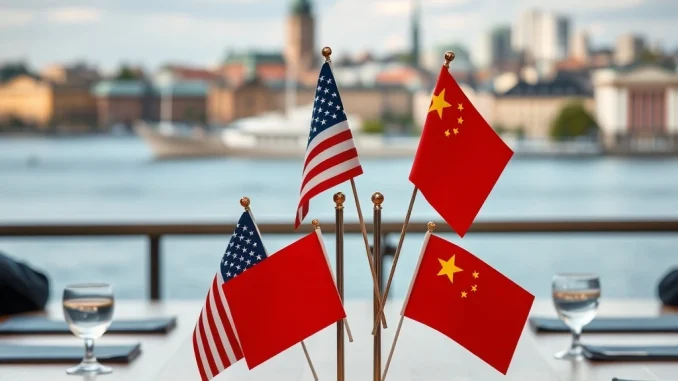
In an announcement that has reverberated across global financial markets, U.S. Treasury Secretary Scott Bessent revealed on Fox Business Network’s ‘Mornings With Maria’ that the third round of high-stakes US-China trade talks is scheduled to take place in Stockholm, Sweden, on July 28-29. This revelation, reported by Reuters, signals a critical juncture in the ongoing economic dialogue between the world’s two largest economies. For investors, including those in the cryptocurrency space, understanding the nuances of these discussions is paramount, as their outcome could significantly influence broader market sentiment and stability.
Understanding the US-China Trade Talks: What’s at Stake?
The relationship between the United States and China has been characterized by periods of intense competition and strategic cooperation, particularly concerning trade. These US-China trade talks are not just about tariffs; they encompass a wide array of complex issues including intellectual property rights, technology transfer, state subsidies, and market access. The first two rounds, while laying some groundwork, did not yield definitive breakthroughs, making this third round in Stockholm particularly crucial.
For context, consider the following key aspects that often dominate these discussions:
- Tariffs and Trade Balances: A persistent point of contention has been the trade deficit, with both sides imposing and threatening tariffs on various goods. These duties directly impact businesses, supply chains, and consumer prices globally.
- Technology and Semiconductors: The race for technological supremacy, especially in advanced semiconductors and AI, has led to export controls and restrictions, creating friction and uncertainty for tech companies worldwide.
- Market Access and Fair Competition: Both nations seek fairer access for their companies in each other’s markets, alongside concerns about subsidies and state-owned enterprises that could distort competition.
Why are the Stockholm Trade Talks So Significant?
The choice of Stockholm, a neutral ground, for these Stockholm trade talks itself carries symbolic weight, suggesting a mutual desire to find common ground away from domestic pressures. The timing is also important, as global economic indicators show signs of volatility, making a stable US-China relationship more vital than ever.
These discussions aim to address deep-seated structural issues that have fueled trade tensions for years. A successful outcome could alleviate pressure on global supply chains, reduce inflationary pressures, and boost investor confidence. Conversely, a failure to make progress could lead to renewed escalation, further disrupting international commerce and fostering an environment of uncertainty.
The Potential Impact on the Global Economy Impact
The reverberations of these trade negotiations extend far beyond Washington D.C. and Beijing. The interconnectedness of the global economy means that decisions made by these two giants have a profound global economy impact. For instance:
- Supply Chain Resilience: Companies worldwide have been grappling with supply chain disruptions. Positive movement in trade talks could encourage diversification and reduce bottlenecks.
- Inflationary Pressures: Tariffs are essentially taxes on imported goods, which can be passed on to consumers. A reduction or removal of tariffs could help ease inflationary pressures.
- Investor Confidence: Certainty and predictability are highly valued by investors. Progress in trade talks can lead to increased foreign direct investment and market stability across various asset classes, including traditional stocks, bonds, and even indirectly, cryptocurrencies. While crypto markets operate on their own unique dynamics, broader economic stability often correlates with investor sentiment and liquidity, influencing digital asset valuations.
The stakes are incredibly high, with potential outcomes ranging from a gradual de-escalation of tensions to a hardening of positions, each carrying distinct implications for economic growth and stability.
Navigating Future Trade Negotiations: What to Expect?
While the immediate focus is on the upcoming trade negotiations in Stockholm, it’s important to view this as part of an ongoing process. Future rounds will likely be necessary, irrespective of the outcome of this meeting. Key challenges include bridging fundamental differences in economic models and addressing long-standing grievances. Both sides are under pressure to show progress to their domestic audiences, which can complicate compromise.
Businesses and investors should continue to monitor developments closely. Diversifying portfolios, understanding exposure to trade-sensitive sectors, and staying informed about policy shifts are actionable insights in this volatile environment. The path forward is unlikely to be smooth, but each round of talks represents an opportunity for dialogue and potential resolution.
Insights from Scott Bessent and Beyond
The announcement by U.S. Treasury Secretary Scott Bessent underscores the Biden administration’s commitment to engaging China on economic issues, even amidst broader geopolitical competition. Bessent’s role as a key negotiator highlights the Treasury’s central position in these discussions, focusing on economic stability and fair trade practices. His public revelation on a major business network also signals transparency and an attempt to manage market expectations.
While specific details of the agenda remain tight-lipped, the mere fact that these talks are proceeding at a high level suggests both nations recognize the imperative of managing their economic relationship responsibly. The world will be watching Stockholm intently, hoping for constructive dialogue that paves the way for a more predictable and prosperous global economic landscape.
In conclusion, the upcoming US-China trade talks in Stockholm represent a critical moment for global commerce and financial markets. The outcomes of these Stockholm trade talks will have a significant global economy impact, influencing everything from supply chains to investor confidence. As trade negotiations continue, the insights provided by figures like Scott Bessent offer a glimpse into the high-level efforts to navigate this complex relationship. While direct impacts on cryptocurrency markets are typically indirect, the broader economic stability fostered by successful talks can create a more favorable environment for all asset classes.
Frequently Asked Questions (FAQs)
Q1: What are the main objectives of the upcoming US-China trade talks?
A1: The primary objectives of the US-China trade talks typically include addressing trade imbalances, resolving disputes over intellectual property rights, discussing technology transfer policies, and ensuring fair market access for businesses. Both sides aim to find common ground to stabilize their economic relationship and reduce trade tensions.
Q2: Why were Stockholm chosen as the venue for these trade negotiations?
A2: Stockholm, Sweden, was likely chosen as a neutral venue to facilitate the trade negotiations between the U.S. and China. A neutral location helps to create an environment conducive to dialogue, free from the domestic political pressures or symbolic implications that might arise from meeting in either country’s capital.
Q3: How might the outcome of these talks affect global financial markets?
A3: The outcome of these talks could significantly impact global financial markets. Positive progress could lead to increased investor confidence, reduced market volatility, and potentially ease inflationary pressures by reducing tariffs. Conversely, a lack of progress or an escalation of tensions could trigger market downturns, supply chain disruptions, and increased economic uncertainty, affecting everything from stocks and bonds to commodities and potentially indirectly, cryptocurrencies.
Q4: Is there a direct impact on cryptocurrency markets from these trade talks?
A4: While the US-China trade talks do not have a direct, immediate impact on cryptocurrency markets in the way they do on traditional equities or currencies, they can have an indirect influence. Broader global economic stability and investor sentiment, which are heavily influenced by these talks, often ripple into the crypto space. When traditional markets are stable and confidence is high, it can create a more favorable environment for risk assets like cryptocurrencies.
Q5: Who is Scott Bessent and what is his role in these discussions?
A5: Scott Bessent is the U.S. Treasury Secretary. In this role, he is a key figure in the economic policy of the United States and a primary negotiator in international financial and trade discussions. His role in these trade negotiations involves representing the U.S. economic interests, discussing financial regulations, and working towards resolutions on trade disputes with China.
Q6: What happened in the previous rounds of US-China trade talks?
A6: The previous rounds of US-China trade talks typically involved high-level discussions between economic delegations from both countries. While they often established dialogue and clarified positions on various trade issues, they frequently concluded without major breakthroughs on the most contentious points, such as structural economic reforms or significant tariff reductions. Each round aims to build upon the last, seeking incremental progress towards a comprehensive agreement.