Even in the dynamic world of cryptocurrencies, understanding broader economic trends is paramount. What happens in traditional markets often creates ripples that eventually reach digital assets. Recently, a monumental shift has captivated financial analysts worldwide: the UK FTSE 100 has not just risen, but soared to an unprecedented record high. This isn’t just a win for British equities; it’s a powerful signal about evolving global trade dynamics and shifting investor sentiment that every market participant, including crypto enthusiasts, should pay close attention to.
The UK FTSE 100 Hits Historic Peaks: What’s Driving This Surge?
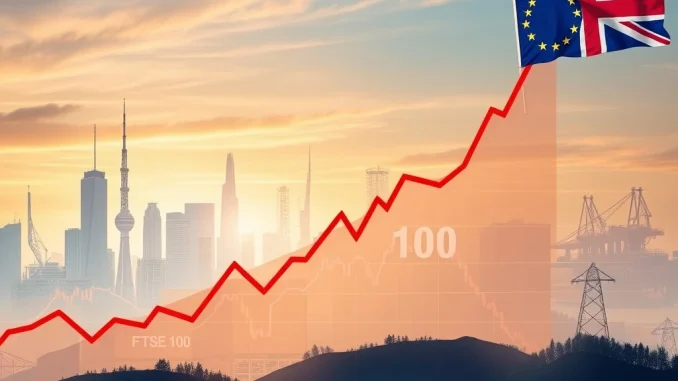
In July 2025, the UK’s benchmark FTSE 100 index achieved a significant milestone, closing above 9,070 points and reaching an intraday high that marked a new record. This remarkable performance represents a substantial turnaround for an index that had, for years, lagged behind its global counterparts. So, what’s behind this impressive ascent? It’s a confluence of factors, primarily renewed demand for its export-oriented sectors and a wave of optimism surrounding international trade developments.
The FTSE 100, often characterized by its heavy weighting towards multinational corporations and commodity producers, is uniquely positioned to benefit from a healthier global economic environment. Unlike indices more exposed to domestic economic cycles, its composition provides a degree of insulation from regional downturns. This structural advantage has proven key in its recent outperformance.
China Economic Growth: A Global Catalyst
One of the primary engines fueling the FTSE 100’s record run is the robust stabilization and expansion of China’s economy. The world’s second-largest economy expanded by a significant 5.3% year-on-year in the first half of 2025. This impressive China economic growth has directly translated into heightened demand for raw materials and consumer discretionary goods, sectors where many FTSE 100 companies hold substantial global market share.
After months of diplomatic tensions, trade relations between the U.K. and China are showing clear signs of de-escalation. This thawing of relations has reinvigorated demand for U.K. commodity producers and manufacturers, which constitute a significant portion of the index’s gains. Financial institutions like Barclays have even advised investors to maintain an ‘overweight’ position in the FTSE 100, specifically citing its advantageous exposure to sectors poised to benefit from a steadier Chinese economy. This demonstrates how interconnected global economies are, and how growth in one major player can send positive shockwaves across distant markets.
US-EU Trade Progress: Unlocking Billions and Boosting Confidence
Adding another layer of optimism to the market is the tangible progress in US-EU trade progress. Preliminary agreements have been reached that aim to reduce tariffs on goods, a move expected to unlock billions in cross-border trade. This development has significantly boosted investor sentiment across Europe and beyond.
The prospect of a less protectionist global trade environment is a boon for multinational corporations, many of which are cornerstone constituents of the FTSE 100. Reduced trade barriers mean lower costs, increased market access, and ultimately, higher profitability. This positive outlook contributed to the FTSE 100 touching an intraday high, reflecting widespread confidence in the resilience and growth potential of these global operators. While the index saw minor fluctuations, its overall upward trajectory underscores the market’s positive reaction to these trade developments.
What Drives This Global Market Rally and How Does it Affect Investors?
The recent surge in the FTSE 100 is part of a broader global market rally, with other European indices like the Stoxx Europe 600 and German DAX also showing gains, though the FTSE 100 has notably outperformed its peers. This rally is underpinned by several key factors:
- Export-Oriented Composition: The FTSE 100’s heavy weighting towards companies with significant international revenue streams makes it less vulnerable to localized economic slowdowns.
- Commodity Demand: Resurgent industrial activity, particularly from China, drives demand for resources, benefiting FTSE 100 mining and energy giants.
- Consumer Strength: Improved global consumer confidence and spending power translate into higher profits for consumer goods companies within the index.
- Foreign Capital Inflows: Significant foreign capital has been flowing into U.K. equities, reflecting a global shift towards what are perceived as undervalued assets with strong growth potential. The Bank of England reported billions flowing into U.K. equities in a single week, underscoring this trend.
For investors, this rally highlights the importance of diversification and understanding global interconnectedness. Companies like Reckitt Benckiser, for instance, saw their shares surge after reporting higher-than-expected profits, demonstrating how multinational firms are effectively capitalizing on improved trade dynamics.
Investor Sentiment Shifts: What Does This Optimism Mean for the Future?
The current buoyant investor sentiment is a critical component of the FTSE 100’s sustained momentum. There’s a palpable sense of optimism that global trade is entering a more cooperative and less restrictive phase. This positive outlook encourages further investment and fuels market growth.
However, analysts offer a cautious note: the sustainability of this upward trend hinges on the continued recovery of China’s economy and the finalization of crucial trade agreements. Any significant setbacks in these areas could lead to a reassessment of risk premiums and potentially trigger market corrections. Despite these caveats, the prevailing conditions suggest that the positive momentum is likely to continue, making the FTSE 100 an attractive proposition for those seeking diversified revenue streams and exposure to a recovering global economy.
The FTSE 100’s record-breaking performance is more than just a headline; it’s a testament to the resilience of global trade and the power of economic cooperation. As China continues its impressive economic growth and the US-EU forge stronger trade ties, the ripple effects are being felt across all markets, signaling a potentially brighter future for global investment. This development offers valuable insights into the broader economic forces that often underpin the performance of even seemingly disparate asset classes, including cryptocurrencies.
Frequently Asked Questions (FAQs)
Q1: What is the UK FTSE 100 and why is its performance significant?
The UK FTSE 100 (Financial Times Stock Exchange Index) is a share index of the 100 companies listed on the London Stock Exchange with the highest market capitalization. Its performance is significant because it serves as a key indicator of the health of the UK economy and, given its many multinational constituents, reflects broader global economic trends and investor sentiment.
Q2: How did China’s economic growth contribute to the FTSE 100’s record high?
China’s robust economic growth, particularly its 5.3% expansion in the first half of 2025, increased demand for raw materials and consumer goods. Many FTSE 100 companies are major global exporters of these products, directly benefiting from China’s increased consumption and industrial activity, leading to higher revenues and stock prices.
Q3: What role did US-EU trade progress play in boosting the index?
Preliminary agreements in US-EU trade negotiations have led to reduced tariffs, aiming to unlock billions in cross-border trade. This progress creates a less protectionist environment, which is highly beneficial for the multinational corporations that dominate the FTSE 100, boosting their profitability outlook and overall investor confidence.
Q4: Why did the FTSE 100 outperform other European indices like the Stoxx Europe 600?
The FTSE 100’s outperformance is largely due to its unique composition. It has a higher weighting of globally diversified, export-oriented companies and commodity producers compared to other indices that might be more exposed to domestic economic cycles. This structure allows it to capitalize more effectively on global economic recoveries and improved international trade relations.
Q5: What are the potential risks to the FTSE 100’s current momentum?
Analysts caution that the index’s momentum largely depends on the sustained recovery of China’s economy and the successful finalization of global trade agreements. Any significant setbacks or renewed tensions in these areas could trigger a reassessment of market risks and potentially lead to a correction in the index’s performance.