The cryptocurrency market is a dynamic landscape, constantly shifting with sentiment, news, and technical indicators. Recently, all eyes are on the Bitcoin price as it approaches a pivotal level that could trigger significant market movements. Data suggests a looming threat of massive long liquidations, painting a cautious picture for traders and investors alike. Are we on the brink of a major shake-up, or will Bitcoin defy the odds once more?
Is Bitcoin Price Heading for a Major Correction?
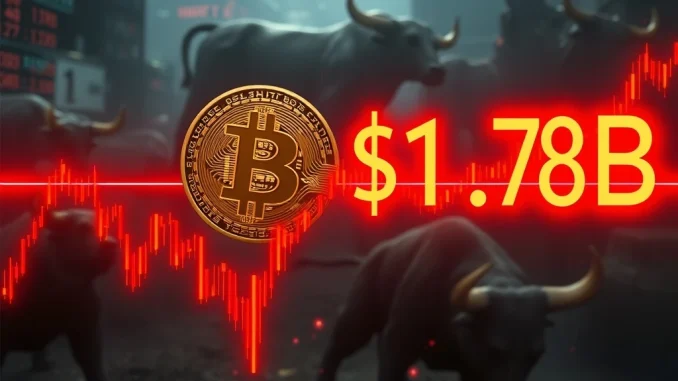
Recent analysis from Coinglass, a leading crypto derivatives data platform, reveals a concerning threshold for the Bitcoin price. A drop below $114,000 could unleash a staggering $1.78 billion in long liquidations across major centralized exchanges. This isn’t just a hypothetical figure; it represents the concentrated risk of leveraged positions, signaling a potential cascade that could intensify downward pressure on the market. This critical level aligns closely with a key technical support zone that has been closely watched by market participants, adding to the tension surrounding institutional and retail positioning within the $110,000–$120,000 range.
The intensity of these potential liquidations is a significant concern. For context, the $1.78 billion figure is 62% higher than the short liquidation intensity threshold at the $117,000 level, where short positions at risk amount to $1.09 billion. This asymmetry points to stronger near-term pressure from long positions, a common characteristic during extended bullish trends. However, this strength can quickly turn into a vulnerability if the price reverses, potentially acting as a major headwind.
What Exactly is Crypto Liquidation, and Why Should You Care?
Crypto liquidation is a forced closure of a trader’s leveraged position due to insufficient margin to cover potential losses. In simpler terms, when you engage in leveraged trading, you borrow funds to amplify your potential gains. However, this also amplifies your potential losses. If the market moves against your position, and your collateral falls below a certain threshold (the maintenance margin), the exchange will automatically close your position to prevent further losses to both you and the exchange.
Here’s why liquidations are crucial:
- Amplified Price Movements: Large liquidation clusters can create a domino effect. As positions are forcibly closed, they add selling pressure to the market, which can drive prices down further, triggering more liquidations.
- Market Instability: Significant liquidation events can lead to rapid price swings and increased market volatility, making it challenging for even experienced traders to navigate.
- Risk to Capital: For individual traders, liquidation means losing their initial margin and potentially more, depending on the terms of their leveraged position.
Understanding these dynamics is vital for anyone participating in the crypto market, especially those considering or already involved in leveraged positions. It highlights the inherent risks and the importance of robust risk management strategies.
Unpacking Coinglass Data: The $1.78 Billion Long Liquidation Threshold Explained
Coinglass’s methodology for tracking liquidation intensity is a powerful tool for market analysis. The data does not reflect exact contract values but rather the relative magnitude of leveraged positions clustered at specific price levels. A taller bar on their liquidation chart indicates a higher probability of price acceleration at that level due to forced liquidation activity.
The $1.78 billion figure, while substantial, is a normalized representation of position concentration relative to adjacent price clusters. This means it signals significant potential for market-moving activity, but it does not equate to an immediate $1.78 billion sell-off. The actual impact will depend on the pace and depth of any price decline, as well as counterbalancing buying interest from longs or new market entrants.
Key insights from the Coinglass data:
- Concentrated Risk: The $114,000 level is particularly sensitive because it sits just below Bitcoin’s 200-day moving average, a widely recognized technical benchmark used by algorithmic trading strategies.
- Self-Reinforcing Dynamics: If the Bitcoin price closes below this threshold, the subsequent unwinding of leveraged trading longs could create a feedback loop where falling prices trigger more liquidations, leading to further price drops.
- Asymmetrical Pressure: The higher long liquidation intensity compared to short liquidation intensity indicates that the market has more exposure to downside risk from long positions at this juncture.
Market participants are closely monitoring how exchanges manage this liquidity event. Historically, large liquidation clusters have often exacerbated market volatility, as margin calls lead to further selling pressure.
How Can Traders Navigate This Market Volatility?
Given the potential for increased market volatility, traders need to adopt a cautious and well-informed approach. Here are some actionable insights:
- Monitor Key Levels: Keep a close eye on the $114,000 level. A decisive break below it could signal further downside. Conversely, a strong bounce from this level could indicate resilience.
- Risk Management is Paramount: For those engaged in leveraged trading, re-evaluate your positions. Consider reducing leverage, setting tighter stop-loss orders, or taking partial profits to mitigate potential losses.
- Observe Volume: Pay attention to trading volume around the $114,000 level. High selling volume accompanying a break down would confirm the bearish momentum.
- Diversify and Hedge: Consider diversifying your portfolio or exploring hedging strategies to protect against significant downside.
- Study the Bitcoin-to-Ether Ratio: The Bitcoin-to-ether ratio can serve as a proxy for altcoin liquidity and broader market sentiment. A declining ratio might suggest a shift of capital towards altcoins, while a rising one could indicate a flight to Bitcoin as a perceived safer asset, especially during periods of uncertainty.
- Stay Informed: Regularly check data from platforms like Coinglass data for updated liquidation maps and open interest metrics.
Remember, the crypto market is highly reactive. Being prepared for different scenarios is essential for preserving capital and identifying potential opportunities.
Beyond the Numbers: Broader Market Implications and Macroeconomic Headwinds
The implications for market stability extend beyond just the immediate liquidation event. In past bullish cycles, sharp liquidation events have sometimes acted as catalysts for renewed buying, especially from institutional players looking for discounted entry points. However, the current macroeconomic environment presents a different backdrop.
We are operating in a period marked by cautious risk appetite and tightening monetary policy from central banks globally. High inflation, rising interest rates, and geopolitical uncertainties contribute to an environment where investors are less likely to jump into risky assets immediately after a price dip. This limits the likelihood of immediate relief rallies following a significant liquidation event.
The interplay between global economics and crypto liquidation risks is becoming increasingly apparent. As traditional markets face pressures, so too does the highly correlated crypto space. Traders and investors must consider these broader forces when assessing the potential impact of a break below $114,000 on the Bitcoin price and the wider digital asset ecosystem.
The current market setup for Bitcoin price demands vigilance. While the $1.78 billion long liquidation threshold at $114,000 is a significant warning, it also highlights the transparent nature of on-chain and derivatives data in the crypto space. Understanding these metrics, coupled with sound risk management and awareness of the broader macroeconomic landscape, will be key for navigating the potential market volatility ahead. Whether Bitcoin holds this critical level or experiences a significant shake-out, the coming days will undoubtedly shape its near-term trajectory.
Frequently Asked Questions (FAQs)
What does Bitcoin long liquidation mean?
Bitcoin long liquidation occurs when a trader who has taken a long (buy) position using leverage sees the Bitcoin price drop significantly, causing their collateral to fall below the required maintenance margin. The exchange then automatically closes their position to prevent further losses.
How does Coinglass data help traders?
Coinglass data provides insights into liquidation levels, open interest, and funding rates across exchanges. This helps traders identify price levels where large amounts of leveraged positions are concentrated, indicating potential support or resistance zones and areas where forced selling or buying could occur.
Why is the $114,000 level so important for Bitcoin?
The $114,000 level is critical for Bitcoin because Coinglass data shows a significant cluster of long positions that would be liquidated if the price falls below it. Additionally, it sits just below Bitcoin’s 200-day moving average, a key technical indicator that many algorithmic trading strategies monitor.
What is the difference between long and short liquidation?
Long liquidation happens when the price falls and closes a leveraged ‘buy’ position. Short liquidation happens when the price rises and closes a leveraged ‘sell’ position. The article highlights that current long liquidation risk is significantly higher than short liquidation risk, indicating more downside vulnerability.
How can traders prepare for potential Bitcoin price volatility?
Traders can prepare by monitoring key price levels, implementing strict risk management (like stop-loss orders and reduced leverage), diversifying portfolios, observing trading volume, and staying informed about market sentiment and macroeconomic factors.
Does a large liquidation always lead to a market crash?
Not necessarily. While large liquidations can exacerbate downward price movements and increase volatility, they don’t always lead to a sustained market crash. Sometimes, these events can clear out excessive leverage, making the market healthier, and institutional buyers might step in at discounted prices. The outcome depends on overall market sentiment and macroeconomic conditions.