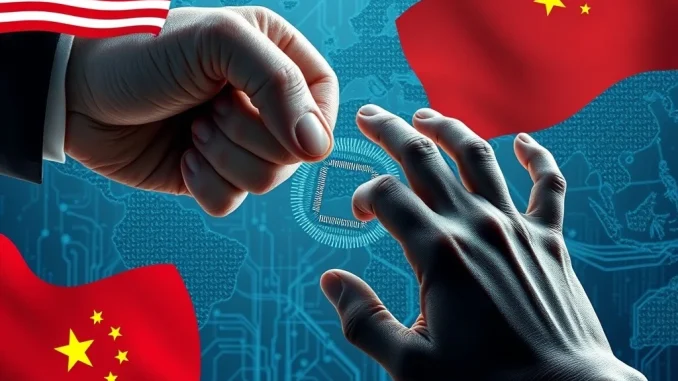
In the rapidly evolving world of technology and geopolitics, shifts in policy can send ripples across global markets, including the volatile cryptocurrency space. The recent unveiling of the Trump AI Plan signals a significant strategic pivot for the United States, aiming to fortify its technological leadership by tightening control over advanced artificial intelligence (AI) capabilities. For crypto enthusiasts, understanding these macro shifts is crucial, as they can impact everything from infrastructure development to market sentiment. This plan specifically targets the critical domain of chip export controls, a move directly aimed at curbing China’s burgeoning tech influence.
What is the Core of the Trump AI Plan?
At its heart, the Trump AI Plan is a bold declaration of intent: to maintain American supremacy in AI. This isn’t just about innovation; it’s deeply intertwined with national security. The plan seeks to address the ‘dual-use’ nature of AI technologies – their potential for both civilian and military applications. A cornerstone of this strategy is the reinforcement of export controls on vital components, particularly advanced semiconductors. The goal? To prevent rival nations from accessing cutting-edge innovations that could enhance their military capabilities or undermine U.S. interests.
Key aspects highlighted in the plan include:
- Enhanced Export Controls: Focusing on advanced semiconductors and related technologies.
- Chip Location Verification: Developing mechanisms to ensure exported chips are not diverted to unauthorized end-users.
- Component Sub-systems: Expanding restrictions to smaller, often less regulated, parts crucial for chip manufacturing.
- Global Alignment: Pressuring allies to adopt similar export control standards, potentially through economic penalties like secondary tariffs.
Why are Chip Export Controls So Critical in the US China Tech Rivalry?
The intensifying US China Tech competition forms the backdrop for these aggressive export control measures. AI is often called the ‘new oil,’ powering everything from advanced computing to military defense systems. And the ‘engines’ that run AI are sophisticated chips. By limiting China’s access to these crucial components, the U.S. aims to slow down its advancements in key areas like AI, supercomputing, and advanced weaponry.
The plan emphasizes the intricate, globalized nature of semiconductor production. A single chip’s journey from design to fabrication and assembly spans multiple countries. This complexity makes enforcement challenging but also highlights potential choke points the U.S. seeks to leverage. The Foreign Direct Product Rule (FDPR), a powerful tool, allows the U.S. to restrict foreign-produced goods that rely on American technology, giving it significant leverage.
Navigating the Complexities of the Global Semiconductor Supply Chain
The semiconductor supply chain is a marvel of global collaboration and specialization. From design in the U.S., fabrication in Taiwan (and increasingly China), to assembly in Malaysia, it’s a multi-national effort. This inherent complexity makes the enforcement of stringent export controls incredibly difficult. Advanced AI Chips are inherently dual-use, making it hard to differentiate between legitimate commercial use and illicit military applications. The administration’s focus on targeting supply chain choke points is innovative but requires unprecedented coordination across nations and companies, a feat that remains largely unproven.
Challenges to effective implementation include:
- Industry Complexity: The vast, interconnected network of designers, manufacturers, and assemblers.
- Dual-Use Nature: Difficulty in distinguishing between civilian and military applications of advanced chips.
- Allied Consensus: Conflicting economic interests and geopolitical priorities among allies complicate coordinated action.
- Policy Inconsistencies: Past reversals (like sudden approvals for Nvidia and AMD to sell AI chips to China) create uncertainty for businesses and raise questions about policy continuity.
What Does This Mean for AI Chips and the Future of Innovation?
The direct impact on AI Chips is clear: reduced access for certain markets, particularly China. This could compel China to accelerate its domestic chip manufacturing capabilities, potentially leading to a more fragmented global tech ecosystem. While the U.S. aims to maintain its lead, restricting access could also slow down overall innovation by limiting market size for U.S. companies and reducing global collaboration on cutting-edge research.
For the cryptocurrency sector, these policies could introduce new layers of market volatility. Supply chain disruptions in semiconductors, essential for mining hardware and blockchain infrastructure, could impact development and operational costs. Heightened geopolitical tensions might also affect investor confidence, leading to broader market shifts. Balancing national security with fostering innovation is the administration’s tightrope walk, and its success will depend on its ability to translate broad objectives into actionable, sustainable policies.
The Economic Ripples and What Comes Next
The economic implications of these policies are far-reaching. U.S. semiconductor companies, while benefiting from domestic investment incentives, may face revenue losses from restricted access to the lucrative Chinese market. Globally, increased trade friction could lead to a ‘decoupling’ of tech ecosystems, potentially slowing down the pace of innovation as companies adapt to disparate regulations and national standards.
While the Trump AI Plan sets ambitious goals, it currently lacks granular details on implementing global alliances or coordinating with domestic companies. It appears to serve as a foundational framework, with concrete actions likely to be delayed. Future executive orders are expected to prioritize convening stakeholders rather than imposing immediate, sweeping restrictions. This incremental approach acknowledges the technical and diplomatic intricacies involved, but also risks prolonging the development of truly effective controls.
In conclusion, the Trump AI Plan represents a determined effort to safeguard American technological leadership through strategic chip export controls. This move intensifies the ongoing US China Tech rivalry, with profound implications for the global semiconductor supply chain and the future development of AI Chips. While the ambition is clear, the path forward is fraught with challenges, from securing international buy-in to navigating the complex dual-use nature of advanced technologies. The ultimate impact will hinge on the ability to transform these broad objectives into coherent, sustainable policies that can withstand the pressures of a highly interconnected global economy and technology landscape.
Frequently Asked Questions (FAQs)
Q1: What is the primary goal of the Trump AI Plan regarding chip exports?
The primary goal is to strengthen U.S. control over advanced artificial intelligence technologies, particularly by tightening chip export controls to China, aiming to maintain American leadership in AI and address national security concerns.
Q2: How do ‘chip location verification’ and ‘component sub-systems’ fit into the new plan?
These are key mechanisms to address vulnerabilities. ‘Chip location verification’ aims to prevent diversion of exported chips to unauthorized users, while expanding restrictions to ‘component sub-systems’ targets smaller, vital parts of chip manufacturing that are currently less regulated, acknowledging the globalized nature of semiconductor production.
Q3: What role do U.S. allies play in the implementation of these export controls?
Securing global alignment with allies is a critical element. The administration aims to persuade nations to adopt U.S. export control standards, potentially using tools like the Foreign Direct Product Rule (FDPR) and warning of economic penalties for non-compliance. However, achieving consensus remains a significant hurdle due to conflicting economic interests.
Q4: How might these policies impact the cryptocurrency market?
While not directly targeted, these policies could introduce market volatility for cryptocurrencies. Supply chain disruptions in semiconductors, which are essential for mining hardware and blockchain infrastructure, could affect operational costs and development. Heightened geopolitical tensions could also influence overall investor confidence.
Q5: What are some of the main challenges in enforcing these new chip export controls?
Key challenges include the dual-use nature of advanced AI chips (making it hard to distinguish legitimate from illicit use), the intricate globalized semiconductor supply chain, difficulty in securing full consensus among allies, and past policy inconsistencies that create uncertainty for businesses.