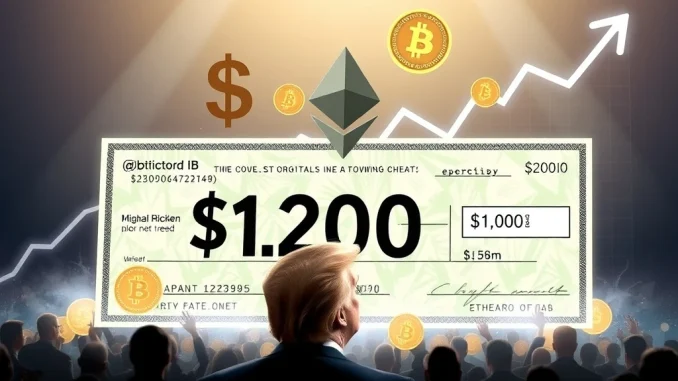
The cryptocurrency world is abuzz with the latest speculation: Could a new round of direct payments from the government, reminiscent of the 2020 era, once again send the crypto market soaring? Recent Bitcoin news suggests that former President Donald Trump is reportedly weighing the possibility of new $1,200 stimulus checks for low-income Americans. This potential move is generating significant excitement, as many believe it could reignite retail crypto interest and provide a much-needed liquidity injection, especially as institutional flows into Bitcoin ETFs have slowed.
Bitcoin News Today: The Stimulus Buzz
The prospect of a fresh wave of government-issued direct payments has captured the attention of investors across the financial spectrum. President Donald Trump is reportedly considering a new round of $1,200 payments, aiming to address ongoing economic challenges. This isn’t just a political talking point; it’s a potential economic lever that could have profound effects on various markets, including the dynamic world of cryptocurrencies. For many, the memory of the 2020 CARES Act, which saw similar payments distributed, is still fresh, and its impact on digital assets was undeniable. A new round of checks could provide a significant liquidity boost to the crypto market, potentially offsetting the recent deceleration in institutional flows into Bitcoin ETFs.
The interplay between fiscal policy and digital asset adoption is becoming an increasingly critical focus in 2025. As market dynamics continue to evolve, understanding how government spending might influence investor behavior, particularly among retail participants, is key. Will history repeat itself, or will the unique landscape of 2025 lead to different outcomes? The potential for these checks to spark a renewed crypto market rally is a topic of intense discussion among analysts and enthusiasts alike.
The 2020 Precedent: How Stimulus Checks Fueled a Crypto Market Rally
To truly grasp the potential impact of new stimulus checks, it’s essential to look back at the historical precedent set in 2020. The CARES Act provided $1,200 for individuals and $2,400 for joint filers, injecting substantial capital directly into the hands of American citizens. What followed was a remarkable surge in retail crypto activity. Platforms like Coinbase and Binance reported a noticeable spike in Bitcoin transactions precisely around the $1,200 mark shortly after these funds were disbursed.
The data from that period is compelling:
- Bitcoin’s Ascendance: Bitcoin, which was trading around $7,000 in early 2020, began an impressive climb, eventually reaching a peak of over $60,000 by April 2021.
- Altcoin Explosion: The rally wasn’t limited to Bitcoin. Altcoins such as Ethereum, Dogecoin, and Uniswap experienced exponential growth. Ethereum, the backbone of decentralized finance (DeFi), saw its value skyrocket, while Dogecoin, initially a meme coin, gained unprecedented traction. Uniswap, a leading decentralized exchange, also benefited immensely from the increased liquidity and user engagement.
- DeFi and NFT Boom: The influx of retail capital coincided with and fueled broader trends in decentralized finance (DeFi) and non-fungible token (NFT) speculation, creating entirely new ecosystems within the crypto space.
This period showcased a powerful synergy between government fiscal policy and individual investment choices. Many recipients, looking for higher returns in a low-interest-rate environment, channeled a portion of their stimulus funds into the nascent, yet promising, crypto market, directly contributing to the historic crypto market rally.
What’s Different in 2025 for Retail Crypto Interest?
While the 2020 experience provides a strong historical context, the 2025 landscape for retail crypto interest is notably different and, arguably, more conducive to rapid adoption. The advancements in crypto accessibility have been significant, lowering the barriers for entry for everyday individuals looking to convert fiat currency into digital assets.
Key improvements include:
- Improved Onramps: Converting traditional currency into crypto is now far more streamlined, with user-friendly interfaces, faster transaction times, and a wider array of payment options.
- Tokenized Assets: The proliferation of tokenized assets, including stablecoins, offers more familiar and less volatile entry points for new users.
- Mobile-First Platforms: The rise of intuitive, mobile-first applications has made trading, staking, and managing cryptocurrencies as simple as using any other banking app, bringing crypto to the fingertips of millions.
COINOTAG experts suggest that these developments could facilitate an even fresher and broader wave of retail participation than seen previously. With easier access, stimulus funds could quickly find their way into stablecoins for quick transfers, or directly into trending tokens and established cryptocurrencies, attracting short-term capital and potentially fueling another crypto market rally. The increased mainstream awareness and acceptance of digital assets also mean that more people are now familiar with crypto as a legitimate investment option, rather than a niche curiosity.
Trump Crypto Policy and Broader Economic Implications
The potential for new Trump crypto policies, specifically the reintroduction of stimulus checks, extends beyond just the crypto market. Their broader economic implications remain uncertain and are subject to various macroeconomic conditions. While such checks could signal government efforts to address critical issues like inflation, unemployment, or consumer confidence, their ultimate impact on traditional financial markets—including equities and bonds—will depend on a complex interplay of factors.
Market observers caution that while stimulus checks may temporarily inject liquidity into the crypto space, long-term growth in both digital assets and traditional markets fundamentally hinges on robust economic fundamentals and clear regulatory frameworks. The absence of comprehensive regulatory clarity, for instance, could dampen sustained institutional investment and broader adoption, regardless of short-term liquidity boosts.
COINOTAG emphasizes that the dynamic relationship between fiscal policy and digital asset adoption will be a critical area of focus as 2025 progresses. Investors and analysts will be closely watching for signs of how these payments might influence inflation rates, consumer spending patterns, and the overall health of the economy, all of which indirectly affect the crypto market’s trajectory.
Benefits and Challenges of a Stimulus-Driven Rally
Understanding the dual nature of a stimulus-fueled market is crucial for investors.
Potential Benefits:
- Liquidity Surge: A direct infusion of capital into the economy can find its way into crypto, increasing trading volumes and market capitalization.
- Renewed Retail Enthusiasm: Lower barriers to entry and disposable income could bring new retail investors into the market, driving demand for Bitcoin and altcoins.
- Positive Market Sentiment: The expectation of new money can create a self-fulfilling prophecy, boosting confidence and encouraging further investment.
- Wider Adoption: More people engaging with crypto for the first time can accelerate mainstream adoption and understanding of digital assets.
Potential Challenges:
- Temporary Nature: The impact of stimulus checks might be short-lived, with the market potentially cooling off once the initial liquidity boost dissipates.
- Volatility Risk: An influx of new, potentially less experienced retail investors can sometimes lead to increased market volatility and speculative bubbles.
- Dependence on Fundamentals: Sustainable long-term growth still requires strong underlying economic conditions, technological innovation within crypto, and regulatory certainty, rather than just external cash injections.
- Inflationary Concerns: Large-scale stimulus could contribute to inflation, which might erode purchasing power and impact investment strategies in the long run.
Conclusion: Will History Repeat for the Crypto Market Rally?
The prospect of new $1,200 stimulus checks under President Trump’s consideration has undeniably injected a fresh wave of anticipation into the crypto community. The historical precedent of 2020 clearly demonstrates how such direct payments can significantly boost retail crypto interest, leading to a substantial crypto market rally. With improved accessibility and mainstream awareness in 2025, the stage might be set for an even more widespread adoption if these checks materialize.
However, it’s vital to temper this enthusiasm with a dose of realism. While a liquidity injection could provide a powerful short-term catalyst, the long-term health and sustainable growth of the crypto market, including Bitcoin news, will ultimately depend on fundamental economic strength, technological innovation within the blockchain space, and the establishment of clear, supportive regulatory frameworks. Investors should remain vigilant, conduct thorough research, and consider a diversified approach, understanding that while stimulus can provide a tailwind, it’s not the sole determinant of market success. The coming months will reveal whether this potential fiscal policy will indeed ignite another historic chapter for digital assets.
Frequently Asked Questions (FAQs)
Q1: What are stimulus checks, and how could they affect the economy?
Stimulus checks are direct payments made by the government to citizens, typically aimed at boosting consumer spending and stimulating economic activity during challenging times. While they can provide immediate financial relief and inject liquidity into the economy, their broader impact on inflation, national debt, and long-term economic growth is a subject of ongoing debate among economists.
Q2: How did the 2020 stimulus checks specifically impact the cryptocurrency market?
The $1,200 stimulus checks issued in 2020 coincided with a significant surge in retail investment in cryptocurrencies. Many recipients, seeking higher returns than traditional savings, allocated a portion of these funds to Bitcoin and various altcoins. This influx of retail capital contributed to Bitcoin’s rise from approximately $7,000 to over $60,000, and also fueled exponential growth in Ethereum, Dogecoin, and other digital assets, driving what became known as the 2020-2021 crypto bull run.
Q3: Why might new stimulus checks boost crypto interest again in 2025?
In 2025, the cryptocurrency landscape features significantly improved accessibility. Easier ‘onramps’ (ways to convert fiat to crypto), more user-friendly mobile platforms, and increased mainstream awareness mean that new stimulus funds could be converted into digital assets more readily than before. This ease of access, combined with potential disposable income, could encourage a fresh wave of retail investors to enter the market, seeking opportunities for growth.
Q4: What are the potential risks or challenges associated with a stimulus-driven crypto rally?
While stimulus checks can inject liquidity, the rally they induce might be temporary, potentially leading to a market cool-off once the initial funds are spent. There’s also a risk of increased market volatility as new, less experienced investors enter. Furthermore, long-term sustainable growth for crypto ultimately depends on fundamental economic health, technological advancements within the blockchain space, and clear regulatory frameworks, rather than just one-off cash injections.
Q5: What role does Donald Trump play in this potential stimulus and crypto market scenario?
The current discussion revolves around reports that former President Donald Trump is considering a new round of direct payments if he were to be in a position to implement such a policy. His previous administration oversaw the 2020 CARES Act, which included similar stimulus checks. Therefore, his potential policy decisions are being closely watched by the crypto community for their possible influence on market liquidity and retail investment behavior.
Q6: How can investors best prepare for potential market shifts driven by stimulus?
Investors should stay informed about economic news and policy discussions. While stimulus can offer short-term opportunities, it’s crucial to conduct thorough research, understand market fundamentals, and consider a diversified investment strategy. Avoiding impulsive decisions based solely on potential stimulus and focusing on long-term goals are key to navigating such market conditions.