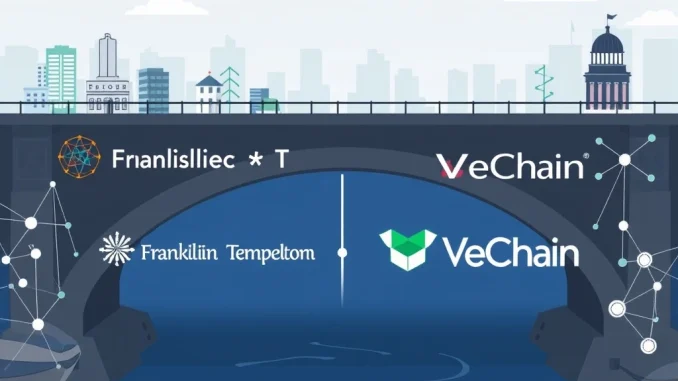
The world of finance is witnessing a groundbreaking shift, as traditional giants embrace blockchain technology. A prime example is Franklin Templeton’s recent announcement: its $780 million BENJI fund is now accessible on the VeChain blockchain. This move is more than just an integration; it’s a strategic expansion that promises to reshape how institutional and corporate clients interact with U.S. Treasury-backed assets, bridging the gap between conventional finance and the decentralized world.
Unlocking Institutional Access: The BENJI Fund on VeChain
Franklin Templeton, a leading global investment firm, has significantly expanded its tokenized finance strategy by bringing its BENJI platform to VeChain, a prominent layer-1 blockchain. This integration empowers institutional and corporate clients with unprecedented access to tokenized U.S. Treasury-backed assets. At its core, the BENJI tokens represent shares in the Franklin OnChain U.S. Government Money Fund (FOBXX), an SEC-registered money market fund with a substantial $780 million under management, designed to maintain a stable $1 value.
This isn’t Franklin Templeton’s first foray into multi-chain tokenization. The BENJI platform has already established a presence on networks like Stellar, Ethereum, and Solana. The addition of VeChain is particularly strategic, leveraging its cost-effective dual-token model and robust real-world asset (RWA) infrastructure. To ensure security and liquidity, BitGo and Keyrock are providing regulated custody and liquidity services, creating a comprehensive ecosystem for these digital assets.
Why Tokenized U.S. Treasury Assets Are a Game Changer
The tokenization of government-backed securities, specifically tokenized U.S. Treasury bills, offers compelling advantages over traditional methods. Imagine a financial world where operational costs are significantly reduced, and transactions settle in minutes rather than days. This is precisely what Franklin Templeton and VeChain aim to achieve:
- Streamlined Workflows: Automating processes that are typically manual and time-consuming in traditional finance.
- Reduced Costs: Lowering overheads associated with intermediaries and lengthy settlement procedures.
- Enhanced Efficiency: Faster settlement times and improved liquidity for institutional clients.
- Global Accessibility: Providing a compliant and interoperable framework for treasury management and payments across borders.
This initiative directly competes with other notable tokenized government securities products, such as BlackRock’s BUIDL and Ondo’s OUSG, highlighting a growing industry trend towards making highly stable, regulated assets available on blockchain networks.
The Expanding Horizon of Real-World Assets (RWA)
The integration of the BENJI fund with VeChain underscores the burgeoning potential of Real-World Assets (RWA) tokenization. This sector is rapidly maturing, driven by institutional demand for stable, regulated digital assets that offer both the security of traditional investments and the efficiency of blockchain technology.
Franklin Templeton has been a proactive leader in the RWA space, demonstrating its commitment through several key milestones:
- Regulatory Approvals: Earlier this year, the firm received approval in Singapore for its first retail-focused tokenized fund, signaling growing regulatory acceptance.
- Strategic Partnerships: The allocation of 35% of ArbitrumDAO’s treasury diversification program to BENJI further illustrates Franklin Templeton’s strategic reach and influence within the decentralized ecosystem.
With BENJI tokens already deployed across 690 wallet addresses on multiple chains, the platform’s expansion onto VeChain signifies a robust, multi-faceted approach to meeting institutional needs in the evolving digital asset landscape.
VeChain’s Strategic Leap in Institutional Adoption
For VeChain, this partnership marks a significant milestone, strengthening its position as a go-to blockchain for institutional-grade solutions. VeChain’s focus on enterprise-level applications, coupled with its efficient dual-token economy, makes it an attractive platform for traditional finance giants looking to bridge into the digital asset space.
This collaboration provides enterprises with access to compliant, interoperable solutions for critical functions like treasury management and payments. It validates VeChain’s commitment to building infrastructure that can support the rigorous demands of large-scale financial operations, positioning it as a key player in the future of tokenized finance.
Competing in the Tokenized Treasury Space
The entry of the BENJI fund onto VeChain intensifies competition in the rapidly expanding tokenized U.S. Treasury market. With existing players like BlackRock’s BUIDL and Ondo’s OUSG already active, Franklin Templeton’s move signals a clear intent to capture a significant share of this emerging market. The fund’s existing $430 million in assets on Stellar alone highlights the substantial demand for tokenized liquidity solutions, demonstrating the market’s readiness for such innovative financial products.
This competitive landscape is a positive sign for the broader blockchain ecosystem, pushing innovation and driving the development of more robust, compliant, and user-friendly solutions for institutional adoption.
A Glimpse into the Future of Finance
The integration of Franklin Templeton’s BENJI fund with VeChain is a powerful testament to the growing convergence of traditional finance and blockchain technology. It represents a significant step towards a future where institutional players can seamlessly leverage decentralized infrastructure while adhering to strict regulatory compliance. By offering liquid, stable, and regulated tokenized government securities, Franklin Templeton and VeChain are not just addressing an immediate need but are also laying down a foundational framework for how enterprises will manage payments, liquidity, and treasury operations in the digital age. As the RWA market continues to evolve, such strategic integrations will undoubtedly define the next phase of institutional-grade digital asset offerings, blending the best of traditional financial tools with the unparalleled efficiency of blockchain.
Frequently Asked Questions (FAQs)
Q1: What is the Franklin OnChain U.S. Government Money Fund (FOBXX)?
A1: The Franklin OnChain U.S. Government Money Fund (FOBXX) is an SEC-registered money market fund managed by Franklin Templeton. It has approximately $780 million in assets and underpins the BENJI tokens, which represent shares in the fund and aim to maintain a stable $1 value.
Q2: How does the integration of BENJI with VeChain benefit institutional clients?
A2: This integration provides institutional and corporate clients with direct access to tokenized U.S. Treasury-backed assets on the VeChain blockchain. It aims to streamline financial workflows, reduce operational costs, and accelerate transaction times compared to traditional methods, offering greater efficiency and liquidity.
Q3: What are Real-World Assets (RWA) in the context of this partnership?
A3: Real-World Assets (RWA) refer to tangible and intangible assets from the traditional financial world, like U.S. Treasury bills, that are tokenized and brought onto a blockchain. This allows them to be traded and managed digitally, leveraging the benefits of blockchain technology while maintaining their real-world value and regulatory compliance.
Q4: Why did Franklin Templeton choose VeChain for this integration?
A4: Franklin Templeton chose VeChain due to its robust, enterprise-grade blockchain infrastructure, cost-effective dual-token model, and proven capability in handling real-world asset (RWA) applications. VeChain’s focus on institutional solutions aligns well with Franklin Templeton’s strategic goals for tokenized finance.
Q5: How does BENJI compare to other tokenized Treasury products like BlackRock’s BUIDL?
A5: The BENJI fund, BlackRock’s BUIDL, and Ondo’s OUSG are all products that tokenize U.S. government securities to offer stable, liquid assets on blockchain networks. They compete in the growing market for tokenized government-backed assets, each leveraging different blockchain ecosystems and aiming to attract institutional demand for digital, compliant financial products.