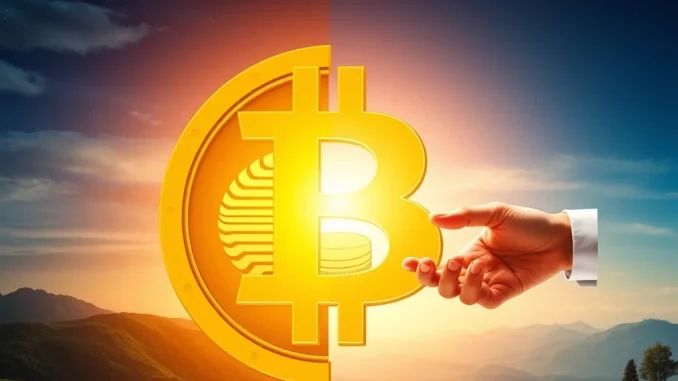
For many, Bitcoin conjures images of digital gold – a secure, scarce asset held for long-term gains, a bulwark against inflation. Yet, its original blueprint, laid out in Satoshi Nakamoto’s white paper, envisioned something different: a ‘peer-to-peer electronic cash system.’ This fundamental divergence sparks a fascinating and crucial debate: can Bitcoin truly embody both the stability of a store of value and the fluidity of a medium of exchange? Understanding Bitcoin’s dual role is essential for anyone tracking the trajectory of the world’s leading cryptocurrency.
Unpacking Bitcoin’s Dual Role: A Foundational Debate
At its core, Bitcoin was designed to be transactional. It aimed to provide a decentralized alternative to traditional financial systems, enabling direct value transfers without intermediaries. However, over its 15-year history, market dynamics, technological advancements, and shifting perceptions have led to its prominent position as ‘digital gold.’ This narrative has been amplified by institutional investors and treasury firms who prioritize Bitcoin’s scarcity, censorship resistance, and perceived inflation-hedging properties.
The tension arises because focusing heavily on one aspect can inadvertently sideline the other. If Bitcoin is primarily seen as an asset to ‘hodl’ (hold), the incentive for widespread transactional use diminishes. Conversely, if it were to become a ubiquitous payment method, its volatility might challenge its stability as a long-term asset. This intricate interplay forms the crux of the current discussion around Bitcoin’s future cryptocurrency utility and broader Bitcoin adoption.
The Ascent of Bitcoin as a Premier Store of Value
Why has Bitcoin garnered such widespread recognition as a store of value, akin to gold? Several key characteristics contribute to this perception:
- Scarcity: With a hard cap of 21 million coins, Bitcoin’s supply is finite and predictable, contrasting sharply with fiat currencies susceptible to inflationary printing.
- Decentralization: No single entity controls Bitcoin, making it resistant to government censorship, confiscation, or arbitrary inflation. This decentralization fosters trust and resilience.
- Durability & Portability: Unlike physical assets, Bitcoin is infinitely durable and can be transferred globally in minutes, making it highly portable and secure.
- Divisibility: Bitcoin can be divided into 100 million ‘satoshis,’ allowing for micro-transactions, though its current use as a store of value often involves larger sums.
This ‘digital gold’ narrative has attracted significant institutional capital, with publicly traded companies adding Bitcoin to their balance sheets and major investment firms offering Bitcoin-related products. Proponents argue that in an era of unprecedented monetary expansion and rising inflation concerns, Bitcoin offers a superior alternative to traditional safe-haven assets.
Reclaiming Bitcoin’s Vision as a Medium of Exchange
Despite its digital gold status, the foundational purpose of Bitcoin as a medium of exchange remains a compelling, albeit underexplored, aspect of its potential. Satoshi’s vision was clear: a system for everyday transactions, bypassing traditional banks and payment processors. The question is, can Bitcoin reclaim this original design and become a practical tool for daily commerce?
A recent anecdote, highlighted in a Forbes article, perfectly illustrates this potential. The author recounted purchasing a used bicycle directly using Bitcoin, a transaction that bypassed traditional banking systems and exchanges entirely. This was a classic example of a peer-to-peer trade, demonstrating Bitcoin’s ability to facilitate direct value transfer. What made this particularly noteworthy was that the recipient, a first-time Bitcoin user, did not need to convert the cryptocurrency into fiat currency or interact with complex exchanges to receive and hold the value. This simplicity underscores a crucial point: once a user engages with the network, the asset remains in their wallet, ready for further use, thereby encouraging continued Bitcoin adoption.
While critics might argue about the efficiency or cost-effectiveness of such a transaction compared to fiat alternatives, its significance lies in its demonstration of Bitcoin’s utility as a decentralized exchange mechanism. By enabling direct transactions without intermediaries, Bitcoin reduces reliance on traditional financial infrastructure. This could be transformative for unbanked populations or regions with unstable national currencies, offering a more accessible and resilient financial tool.
Driving Bitcoin Adoption Through Real-World Use Cases
The path to widespread Bitcoin adoption hinges significantly on its ability to function effectively as a medium of exchange. While institutional interest as a store of value is vital, grassroots usage for transactions creates a powerful network effect. When more people use Bitcoin for payments, its utility grows, reinforcing its legitimacy as a currency and potentially enhancing its perceived value.
Consider the historical parallels with gold. While gold served as a store of value, its physical exchange properties and its role in backing banknotes ultimately drove monetary innovation. The ability to easily exchange value, whether through gold-backed notes or Bitcoin, has historically propelled the evolution of monetary systems. For Bitcoin, robust usage as a payment method could strengthen its value proposition, creating a self-reinforcing cycle where utility enhances its perceived worth.
To bridge the gap between holding and spending, advancements in scaling solutions like the Lightning Network are crucial. The Lightning Network enables faster, cheaper off-chain transactions, making Bitcoin more viable for everyday purchases. As merchant adoption increases and user-friendly wallets become more prevalent, the friction associated with using Bitcoin for payments will decrease, further accelerating its practical use.
| Feature | Bitcoin as Store of Value | Bitcoin as Medium of Exchange |
|---|---|---|
| Primary Goal | Wealth preservation, long-term growth, inflation hedge | Facilitating transactions, daily payments, remittances |
| Typical User | Institutional investors, long-term holders, treasury firms | Everyday consumers, merchants, unbanked populations |
| Transaction Frequency | Low (infrequent large transfers) | High (frequent small-to-medium transfers) |
| Key Drivers | Scarcity, decentralization, macro-economic stability | Speed, low fees, ease of use, merchant acceptance |
| Ideal Network Layer | Bitcoin main chain (for security) | Lightning Network (for scalability) |
Navigating the Future of Cryptocurrency Utility
The interplay between Bitcoin’s roles as a store of value and a medium of exchange is not mutually exclusive; in fact, they can be complementary. However, an overemphasis on one at the expense of the other carries risks. If Bitcoin becomes solely a speculative asset, its transactional network may atrophy, diminishing its relevance as a currency. Conversely, robust usage as a payment method could strengthen its value proposition, creating a self-reinforcing cycle that enhances its overall cryptocurrency utility.
The historical journey of gold offers valuable insights. Its inherent scarcity and durability justified its use as a backing for currencies, while its physical exchange properties enabled commerce. Similarly, Bitcoin’s scarcity and security make it a compelling store of value, which in turn lends credibility to its potential as a transactional currency. The key is to find a balance where both functions can thrive.
For Bitcoin to fully realize its potential, several challenges must be addressed, including scalability, regulatory clarity, and user education. Solutions like the Lightning Network are crucial for enhancing its capacity for everyday transactions. Regulatory frameworks that foster innovation while protecting consumers will also be vital. Ultimately, the organic growth stemming from practical use cases, like the bicycle purchase, serves as a powerful entry point for new users, fostering broader acceptance and solidifying Bitcoin’s place as a foundational monetary system.
Conclusion
Bitcoin’s journey is a fascinating exploration of its evolving identity. While its role as a robust store of value has dominated recent years, its original vision as a medium of exchange remains a powerful and essential component for its long-term viability. The debate around Bitcoin’s dual role highlights the dynamic nature of this revolutionary technology. As the digital asset ecosystem matures, fostering both institutional adoption for wealth preservation and grassroots usage for everyday transactions will be paramount. Only by embracing and developing both facets can Bitcoin truly unlock its full potential, becoming not just digital gold, but also the decentralized cash system it was always meant to be, thereby ensuring its enduring cryptocurrency utility and accelerating global Bitcoin adoption.
Frequently Asked Questions (FAQs)
What is Bitcoin’s primary purpose, according to its white paper?
According to Satoshi Nakamoto’s white paper, Bitcoin was designed as a “peer-to-peer electronic cash system,” primarily intended to facilitate direct, decentralized transactions without the need for financial intermediaries.
Why is Bitcoin often referred to as “digital gold” or a “store of value”?
Bitcoin is considered a “digital gold” due to its finite supply (21 million coins), decentralization, and resistance to inflation, making it an attractive asset for wealth preservation, similar to how gold has historically functioned.
How can Bitcoin function as a “medium of exchange” for everyday transactions?
Bitcoin can function as a medium of exchange by enabling direct payments between individuals or with merchants. Technologies like the Lightning Network enhance this capability by allowing for faster and cheaper transactions off the main blockchain, making it more practical for daily use.
What are the main challenges for Bitcoin to achieve widespread adoption as a medium of exchange?
Key challenges include scalability (though solutions like Lightning Network are addressing this), price volatility, regulatory uncertainties, high transaction fees on the main chain, and the need for greater merchant acceptance and user education.
Can Bitcoin effectively be both a store of value and a medium of exchange simultaneously?
Yes, Bitcoin can be both. These roles are not mutually exclusive but rather complementary. Its inherent scarcity and security underpin its value, while advancements in scaling solutions allow for its practical use in transactions. The balance between these two roles is crucial for its long-term success.
What is the significance of real-world examples like buying a bicycle with Bitcoin?
Such examples are significant because they demonstrate Bitcoin’s practical utility as a direct, peer-to-peer payment system, bypassing traditional finance. They serve as powerful entry points for new users, fostering organic growth and reinforcing Bitcoin’s legitimacy as a functional currency beyond mere speculation.