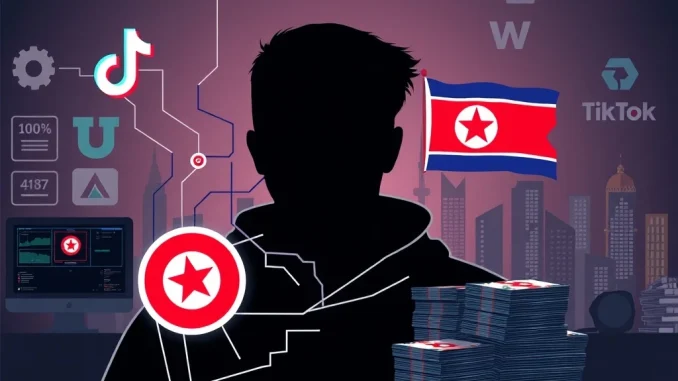
In an era where digital influence can translate into significant real-world impact, a recent federal sentencing has sent shockwaves through the online community and corporate world alike. The case of a U.S. TikTok influencer, now serving a substantial prison term, exposes a sinister $17 million North Korea cyber scheme that leveraged remote work vulnerabilities to funnel illicit funds to Pyongyang. For those in the cryptocurrency space, this story resonates deeply, underscoring the interconnectedness of digital finance, cyber security, and geopolitical threats.
TikTok Influencer Fraud: A Digital Deception Unveiled
Christina Marie Chapman, a 50-year-old U.S. TikTok influencer, marketed herself as a tech recruitment expert. However, behind this facade, she orchestrated an elaborate scheme that enabled North Korean operatives to secure remote positions at over 300 U.S. companies. This sophisticated operation, active from 2020 to 2024, generated a staggering $17 million in illicit revenue for the North Korean regime.
- Chapman managed a network that connected North Korean workers, many operating under diplomatic protections, to U.S. corporate systems.
- The Department of Justice (DOJ) alleges the operation exploited stolen U.S. identities and remote hiring vulnerabilities.
- Targets included Fortune 500 firms and a major television network, with many companies unaware of the operatives’ true affiliations.
- A 2023 search of Chapman’s Arizona home uncovered over 90 laptops linked to fraudulent identities, used to facilitate payroll checks, launder funds through U.S. banks, and falsify reports to the IRS and Social Security Administration [1].
Prosecutors stated that Chapman forged 68 stolen identities to deceive 309 U.S. businesses and two international companies, demonstrating the extensive nature of this TikTok Influencer Fraud.
Navigating Remote Work Security Risks in a Digital Age
The core vulnerability exploited in this extensive operation was the reliance on remote work arrangements. North Korean operatives, often based in China or near the China–North Korea border, gained access to sensitive corporate infrastructure while evading detection. This highlights significant Remote Work Security Risks that businesses face today.
The case underscores how easily corporate due diligence can be circumvented when third-party recruiters or seemingly legitimate influencers are involved. The ease with which these operatives infiltrated systems without detection leaves companies vulnerable to foreign exploitation.
This incident serves as a stark reminder for organizations to:
- Implement stricter verification protocols for remote hiring, especially when engaging third-party recruiters.
- Enhance identity verification processes beyond standard checks.
- Regularly audit remote access points and user activities for unusual patterns.
A Landmark in Cybercrime Enforcement: DOJ’s Stance
Christina Marie Chapman received a sentence of 102 months in federal prison, along with three years of supervised release. She must also forfeit $284,000 and pay $176,850 in restitution. This substantial sentence reflects a significant shift in U.S. enforcement priorities toward targeting intermediaries in transnational schemes, emphasizing robust Cybercrime Enforcement.
The DOJ noted that Chapman’s operation exemplified how state actors co-opt individuals in the digital space to infiltrate Western economies. This legal action sends a clear message: those enabling foreign adversaries to exploit domestic economic systems will face severe legal consequences, even when operating under the guise of social media influence [1]. The financial dimensions of such operations, which often bypass traditional smuggling or hacking methods, are a key focus for authorities.
Beyond the Scheme: North Korea’s Reliance on Cryptocurrency Cyber Theft
While Chapman’s scheme primarily involved identity theft and remote job fraud, it exists within a broader context of North Korea’s illicit financial activities. North Korea has increasingly relied on cyber-enabled tactics, including extensive Cryptocurrency Cyber Theft, to fund its nuclear program and circumvent international sanctions.
A 2024 Chainalysis report estimated that North Korea-linked hackers stole an astonishing $1.34 billion in crypto that year alone [1]. These actors exploit the crypto sector’s decentralized nature and, at times, lax security or hiring protocols within the ecosystem. The connection between this influencer scheme and North Korea’s broader cyber strategy is crucial for understanding the multifaceted threats posed by state-backed actors.
The case highlights the adaptability of state-backed actors in leveraging various digital platforms for recruitment and infiltration, from social media to the crypto world. Pressure is mounting on social media platforms like TikTok, which has faced scrutiny for its content moderation policies, to monitor recruitment-related content and verify user legitimacy. The incident adds to calls for platforms to flag or disclose high-risk recruitment activity, particularly from users with ties to sanctioned countries.
Conclusion
The sentencing of U.S. TikTok influencer Christina Marie Chapman for orchestrating a $17 million North Korea cyber scheme is a landmark case that underscores the evolving landscape of global cyber threats. It reveals how easily digital platforms and remote work models can be exploited by state actors for illicit financial gain and espionage. This incident serves as a critical warning to businesses about the urgent need for enhanced vigilance in hiring practices and digital security. For the broader digital community, it highlights the ethical responsibilities of online influencers and the ongoing battle against sophisticated transnational cybercrime. As North Korea continues to innovate its funding methods, including significant Cryptocurrency Cyber Theft, the collaborative efforts of law enforcement, technology companies, and individuals will be paramount in safeguarding our economic systems and national security.
Frequently Asked Questions (FAQs)
1. What was Christina Marie Chapman’s role in the North Korea cyber scheme?
Christina Marie Chapman, a U.S. TikTok influencer, orchestrated a scheme that connected North Korean operatives to remote jobs at over 300 U.S. companies. She used stolen U.S. identities to facilitate the employment, managing a network that generated $17 million in illicit revenue for North Korea.
2. How did the North Korean operatives gain access to U.S. companies?
The operatives gained access by leveraging stolen U.S. identities and exploiting vulnerabilities in remote hiring processes. Chapman’s network enabled them to secure remote positions, allowing them to access corporate systems without detection, often while operating from China or near the China-North Korea border.
3. What were the financial implications of this scheme?
The scheme generated $17 million in illicit revenue for the North Korean government. Chapman was sentenced to 102 months in federal prison, three years of supervised release, and ordered to forfeit $284,000 and pay $176,850 in restitution.
4. How does this case relate to North Korea’s broader cyber activities?
This case exemplifies how North Korea uses various cyber-enabled tactics, including leveraging individuals like Chapman, to fund its nuclear program and circumvent sanctions. It complements their well-documented reliance on direct cyberattacks, such as large-scale cryptocurrency cyber theft, which reportedly amounted to $1.34 billion in 2024 alone.
5. What are the key takeaways for companies regarding remote work security?
Companies should implement stricter verification protocols for remote hiring, especially when working with third-party recruiters. Enhancing identity verification processes, regularly auditing remote access points, and being vigilant about unusual user activities are crucial steps to mitigate remote work security risks and prevent similar infiltrations.