The world of global finance is on the cusp of a significant transformation. Traditional systems, long reliant on slow and costly methods, are now embracing innovation. At the heart of this shift is SWIFT’s monumental migration to the ISO 20022 messaging standard, a move that is putting a spotlight on several cryptocurrencies, including XRP, as potential game-changers for cross-border payments. If you’re invested in the future of finance or just curious about how digital assets are reshaping our world, this development is critical.
What is ISO 20022 and Why is SWIFT Embracing It?
For decades, SWIFT (Society for Worldwide Interbank Financial Telecommunication) has been the backbone of international financial messaging. However, its legacy systems often lead to inefficiencies. Enter ISO 20022, a universal financial messaging standard that promises richer data, better automation, and enhanced interoperability. It’s designed to bring global finance into the 21st century.
SWIFT’s adoption of ISO 20022 is not just an upgrade; it’s a strategic pivot. This new standard mandates more detailed data structures and supports real-time processing, addressing critical shortcomings like slow settlement times, high operational costs, and limited transparency in the traditional network [1]. But where do cryptocurrencies fit into this picture?
Eight Cryptocurrencies for Next-Gen Cross-Border Payments
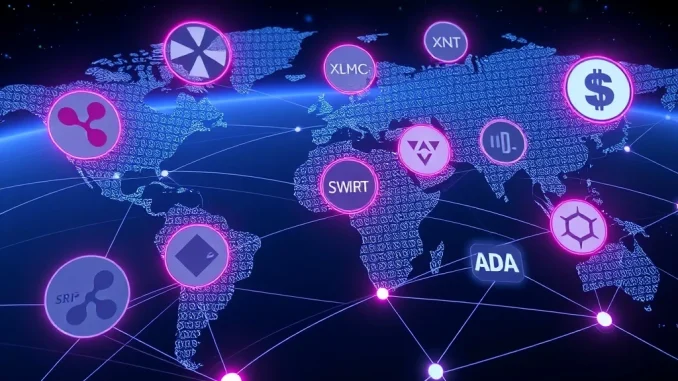
A report, cited by crypto researcher SMQKE and based on an ASOBANCA Law Journal edition (November 2022), highlights eight specific cryptocurrencies that align with ISO 20022’s goals. These digital assets are recognized for their potential to tackle the very inefficiencies the new standard aims to resolve:
- XRP (Ripple)
- XLM (Stellar)
- XDC (XinFin)
- QNT (Quant)
- HBAR (Hedera)
- ALGO (Algorand)
- MIOTA (IOTA)
- ADA (Cardano)
These assets were selected due to their technological compatibility with ISO 20022’s requirements for richer data and real-time capabilities. They offer a pathway to more efficient cross-border payments.
XRP: A Frontrunner in Revolutionizing Global Payments
Among the highlighted cryptocurrencies, XRP, developed by Ripple, holds a particularly notable position. Ripple became the first member of the ISO 20022 Standards Body focused on Distributed Ledger Technology (DLT) in 2020. This early involvement signals a deep integration into the evolving financial landscape.
Why is XRP so compelling for cross-border payments?
- Speed: XRP transactions settle in under 5 seconds.
- Cost: Fees are minimal, often around $0.0002 per transaction.
- Efficiency: RippleNet, combined with XRP’s utility, offers financial institutions a competitive alternative to traditional systems.
- Liquidity: Ripple’s On-Demand Liquidity (ODL) service uses XRP as a bridge currency, allowing banks to bypass pre-funded nostro accounts. This means transactions can settle instantly without tying up capital in multiple currencies [1].
Partnerships with major financial players like Santander and SBI Holdings further underscore XRP’s growing role in bridging liquidity gaps and reducing intermediaries in global transactions [1]. It’s not about replacing SWIFT entirely, but enhancing its infrastructure.
How DLT Enhances Traditional Financial Systems
The ASOBANCA publication emphasizes that blockchain-based platforms, including Ripple’s XRP and Stellar’s XLM, are not just compliant with ISO 20022; they are actively integrated into financial infrastructure upgrades. This integration leverages the power of DLT to enable programmable logic and real-time reconciliation, traits crucial for next-generation payment systems.
This approach represents a hybrid model where traditional and decentralized technologies coexist. DLT platforms provide:
- Faster, more transparent settlement.
- Reduced operational costs.
- Enhanced data flow and reconciliation.
This strategic shift underscores the evolving role of DLT in financial ecosystems, where it addresses long-standing inefficiencies without requiring a complete overhaul of existing infrastructure [1].
Navigating the Future: Market Forecasts and Regulatory Realities
The future trajectory of these digital assets will be shaped by macroeconomic trends and regulatory developments. While some analysts are bullish, predicting significant growth for assets like XRP, others offer more conservative outlooks.
- Bullish Outlook: CoinPedia, for instance, forecasts XRP reaching $5.81 in 2025, contingent on widespread institutional adoption [2].
- Bearish Outlook: Changelly projects XRP at $2.05, highlighting risks from regulatory hurdles or competition from stablecoins [2].
The regulatory landscape, including legislative momentum like the GENIUS Act, has already influenced market sentiment, with XRP and XLM showing strong performance in recent months [4]. However, the ASOBANCA report clarifies that the integration of these tokens is not speculative, but a documented strategic shift towards blockchain-enhanced systems [1]. This isn’t just hype; it’s a planned evolution.
A Strategic Pivot in Global Finance
SWIFT’s migration to ISO 20022, coupled with the spotlight on these eight cryptocurrencies, signals a profound change in global finance. Financial institutions are increasingly adopting blockchain platforms as foundational tools for payment modernization. These selected cryptocurrencies are not designed to replace SWIFT but to enhance its capabilities, offering faster, more cost-efficient alternatives for cross-border payments.
While challenges like regulatory scrutiny and market volatility persist, the chosen tokens demonstrate tangible value in solving critical pain points in international finance. This development could catalyze further innovation, bridging legacy systems with decentralized solutions to reshape the entire international financial infrastructure [1]. The journey towards a more efficient and interconnected global payment system is well underway, with XRP and its peers leading the charge.
Frequently Asked Questions (FAQs)
1. What is ISO 20022 and why is it important for global payments?
ISO 20022 is a global standard for financial messaging that provides a richer, more structured, and detailed format for payment data. It’s crucial for global payments because it enables greater automation, improves compliance, reduces errors, and facilitates faster, more transparent cross-border transactions, ultimately modernizing the financial system.
2. How does SWIFT’s ISO 20022 migration relate to cryptocurrencies like XRP?
SWIFT’s migration to ISO 20022 requires more advanced messaging capabilities. Cryptocurrencies built on Distributed Ledger Technology (DLT) like XRP, XLM, and others are seen as complementary solutions because they inherently offer features like real-time settlement, low costs, and rich data handling, which align with the goals of ISO 20022 to improve cross-border payments.
3. Why is XRP specifically highlighted for cross-border payment solutions?
XRP is highlighted due to Ripple’s early involvement with the ISO 20022 Standards Body for DLT and its platform, RippleNet. XRP facilitates near-instant, low-cost international transactions through services like On-Demand Liquidity (ODL), which uses XRP as a bridge currency to eliminate the need for pre-funded nostro accounts, significantly improving liquidity and efficiency for financial institutions.
4. Are these cryptocurrencies replacing SWIFT?
No, the current trend suggests these cryptocurrencies are not replacing SWIFT. Instead, they are enhancing its infrastructure. The approach is often a hybrid one, where DLT-based solutions work alongside existing SWIFT networks to address specific inefficiencies, offering faster and more cost-effective alternatives for certain types of cross-border transactions.
5. What are the main benefits of using DLT for cross-border payments?
The main benefits include significantly faster settlement times (often seconds instead of days), lower transaction fees, increased transparency due to immutable ledgers, reduced operational costs, and improved liquidity management for financial institutions. DLT also enables richer data exchange and programmable payments.
6. What are the main challenges for the widespread adoption of these cryptocurrencies in finance?
Key challenges include regulatory uncertainty across different jurisdictions, market volatility of digital assets, scalability concerns for some networks, and the need for greater interoperability between diverse blockchain platforms and traditional financial systems. Institutional adoption also depends on clear legal frameworks and robust security measures.