Are you ready for some exciting Ethereum news that’s sending ripples across the crypto market? A groundbreaking development from Particle Network is not only simplifying decentralized application (dApp) creation but also sparking significant gains for its native token. The recent launch of Particle Network’s Universal SDK is being hailed as a game-changer for cross-chain development, promising a more integrated and user-friendly blockchain ecosystem. And the market has taken notice: the PARTI token has experienced an impressive surge, catching the attention of investors and developers alike.
Unpacking Particle Network’s Universal SDK: A Game Changer for Cross-Chain Development
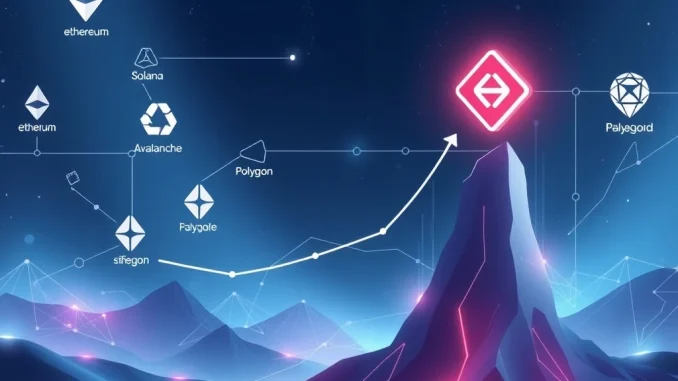
The blockchain world has long grappled with the complexities of isolated networks. Each chain often requires specific tools, languages, and user experiences, creating significant barriers for both developers and users. Enter Particle Network’s Universal SDK, a revolutionary tool designed to bridge these gaps. This Software Development Kit is built on a foundation of ‘chain abstraction,’ a concept that essentially hides the underlying complexities of different blockchains, allowing for a smoother, more unified experience.
Here’s what makes the Universal SDK a pivotal advancement:
- Seamless Multi-Chain Integration: Developers can now build chain-agnostic applications using Universal Accounts. This means a single integration can deploy dApps across Ethereum, Solana, and over a dozen EVM-compatible networks, drastically reducing development time and effort.
- Simplified User Experience: One of the biggest headaches for users is managing different tokens for gas fees across various chains. The Universal SDK addresses this by allowing gas fees to be paid in common tokens like USDT, ETH, BNB, or SOL, eliminating the need for complex asset conversions. Imagine interacting with any dApp without worrying about which specific token you need for gas!
- Backend Abstraction: The SDK handles the intricate backend logic and token conversions, freeing developers to focus on the core functionality and user interface of their dApps. This ‘single-integration access’ to multiple networks is a massive leap forward for efficiency.
This innovation directly tackles the fragmentation issue plaguing the decentralized space, paving the way for a truly interoperable future. It’s not just about building faster; it’s about building smarter and more accessibly.
The Remarkable Surge of the PARTI Token
Coinciding with the highly anticipated launch of the Universal SDK, Particle Network’s native token, PARTI, witnessed an explosive market reaction. The PARTI token surged by an impressive 45%, breaking out from a descending channel that had constrained its price action since early June. This significant move underscores renewed investor confidence and market enthusiasm for Particle Network’s ecosystem and its potential.
Let’s look at the key market dynamics:
| Metric | Details |
|---|---|
| Price Movement | Climbed from approximately $0.20 to an intraday high of $0.29. |
| Trading Volume | Accompanied by a sharp spike, indicating strong buying interest. |
| Technical Breakout | Broke above a descending channel and the 20-day Exponential Moving Average (EMA). |
| Current Status | Consolidated within the $0.20–$0.22 support zone, which is critical for confirming upward momentum sustainability. |
Analysts are closely watching the $0.20-$0.22 support zone. If the PARTI token can successfully hold this range, it could signal a strong foundation for further gains, potentially targeting resistance levels at $0.25 and $0.30. This price action is a clear reflection of the market’s positive reception to Particle Network’s expanding infrastructure and its commitment to solving real-world blockchain challenges.
Strategic Collaborations Fueling Ecosystem Growth
The success of a groundbreaking technology often hinges on its adoption, and Particle Network is strategically positioning itself for widespread integration. The launch of the Universal SDK is being amplified through co-marketing initiatives and educational workshops with major blockchain ecosystems. These include:
- Avalanche: A high-performance, scalable blockchain platform.
- Polygon: A leading Ethereum scaling solution.
- Berachain: A new EVM-compatible blockchain focusing on DeFi and liquidity.
These collaborations are crucial for accelerating the adoption of chain-agnostic applications. Furthermore, Particle Network’s earlier incentivized testnet, which attracted over 1.3 million accounts this year, provides tangible proof of demand for solutions that simplify cross-chain interactions. This impressive uptake validates Particle Network’s vision and positions it as a key player in the evolving landscape of cross-chain development.
Implications for Ethereum News and the Broader Crypto Landscape
While the focus is on Particle Network and its PARTI token, the implications of the Universal SDK extend far beyond its immediate ecosystem, particularly for Ethereum news and the wider blockchain space. As the leading smart contract platform, Ethereum benefits immensely from advancements in interoperability. The ability to seamlessly integrate dApps and user experiences across Ethereum and other EVM-compatible chains, thanks to solutions like the Universal SDK, fosters a more cohesive and accessible decentralized web.
For developers, it means less time wrestling with chain-specific nuances and more time innovating. For users, it means a frictionless experience, regardless of which blockchain their favorite dApp resides on. This push towards chain abstraction and enhanced interoperability is a significant trend that will shape the future of crypto, making it more user-friendly and scalable. The success of Particle Network in this area will undoubtedly inspire further innovation and collaboration across the entire blockchain industry.
Conclusion: A New Era for Decentralized Applications
Particle Network’s Universal SDK represents a pivotal step in the evolution of cross-chain development. By effectively addressing technical barriers and fostering robust ecosystem collaboration, the project is significantly lowering the entry threshold for developers while dramatically enhancing the user experience. The remarkable 45% surge of the PARTI token underscores the market’s recognition of this innovation and its potential impact. As the token’s price consolidates, market participants will keenly observe whether the $0.20–$0.22 support holds and if trading volume sustains the upward momentum. This development isn’t just a win for Particle Network; it’s a significant leap forward for the entire decentralized application space, promising a more connected, efficient, and user-friendly future for blockchain technology and exciting Ethereum news for its community.
Frequently Asked Questions (FAQs)
What is Particle Network’s Universal SDK?
Particle Network’s Universal SDK (Software Development Kit) is a cross-chain development tool designed to streamline the creation of decentralized applications (dApps). It uses ‘chain abstraction’ to allow developers to build applications that operate seamlessly across multiple blockchains, including Ethereum, Solana, and various EVM-compatible networks, with a single integration.
How does the Universal SDK simplify dApp development?
It simplifies development by abstracting chain-specific complexities. Developers no longer need to manage separate backend logic or token conversions for different chains. They can use Universal Accounts to deploy applications across multiple networks, significantly reducing development time and effort.
What caused the PARTI token’s recent surge?
The PARTI token’s 45% surge coincided directly with the official launch of Particle Network’s Universal SDK. The market reacted positively to this significant product release, which promises to revolutionize cross-chain development and improve user experience, leading to increased investor confidence and trading volume.
Can users pay gas fees with different tokens using the Universal SDK?
Yes, one of the key benefits for users is the flexibility in paying gas fees. The Universal SDK allows gas fees to be paid in common tokens like USDT, ETH, BNB, or SOL, eliminating the need for users to convert assets or hold specific native tokens for each blockchain they interact with.
What role do partnerships play in Particle Network’s strategy?
Strategic partnerships with major blockchain ecosystems like Avalanche, Polygon, and Berachain are crucial for Particle Network. These collaborations involve co-marketing and educational workshops, aiming to accelerate the adoption of chain-agnostic applications and expand the Universal SDK’s developer and user base across diverse networks.