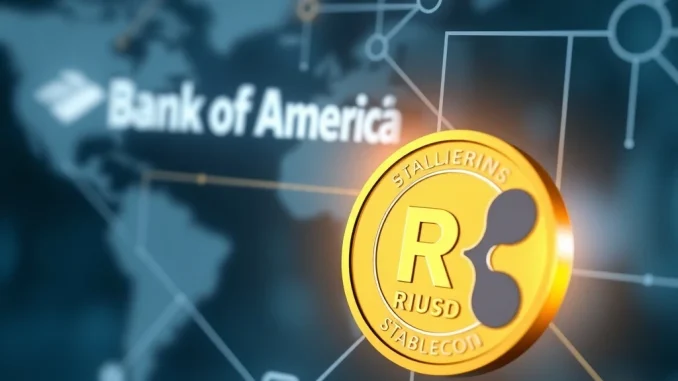
A seismic shift is underway in the financial world. Bank of America, a titan of traditional banking, is making headlines with its bold move to integrate Ripple’s RLUSD stablecoin. This isn’t just another tech upgrade; it’s a profound commitment to leveraging blockchain for the future of finance, specifically targeting the often-complex realm of cross-border payments. For anyone tracking the convergence of traditional finance and digital assets, this development signals a pivotal moment, ushering in an era of faster, more efficient, and secure global transactions.
Bank of America’s Bold Digital Asset Strategy Unveiled
Bank of America is not just dipping its toes into the digital asset space; it’s diving in headfirst with a well-defined digital asset strategy. The integration of Ripple’s RLUSD stablecoin marks a significant strategic pivot toward blockchain-driven financial solutions. This move highlights the bank’s proactive approach to modernizing its infrastructure and staying ahead in an evolving global economy. The primary focus is on enhancing operational efficiency and streamlining the flow of funds across international borders.
The decision to prioritize stablecoins like RLUSD is rooted in their potential to offer the stability of traditional fiat currencies combined with the speed and transparency of blockchain technology. Bank of America officials have hinted at future stablecoin projects, consistently emphasizing their commitment to adhering to evolving legal frameworks. This dedication to regulatory compliance is crucial, building trust and paving the way for broader institutional adoption in the digital asset landscape.
Why Ripple RLUSD Was the Chosen Stablecoin for Integration
Among the growing number of stablecoins, Ripple’s Ripple RLUSD stands out for its robust design and increasing credibility among financial institutions. RLUSD is a fully collateralized U.S. dollar-backed stablecoin, designed with institutional-grade security and transparency at its core. Its transparent reserve structure and proactive collaboration with regulators have addressed key concerns about stability and oversight in the digital asset space, making it an attractive option for a major financial player like Bank of America.
A recent Skynet Stablecoin Spotlight Report for H1 2025 underscored RLUSD’s impressive performance, awarding it an 89.89 score—among the highest in the industry. The report also highlighted its flawless security record since launch, a critical factor aligning with Bank of America’s risk-mitigation priorities as it navigates a complex regulatory environment. Further solidifying RLUSD’s institutional legitimacy, BNY Mellon, the oldest bank in the U.S., has become its primary custodian. This partnership reinforces confidence in the stablecoin’s underlying infrastructure, recognizing that robust custodianship is a critical factor for large-scale adoption by financial institutions.
Transforming Cross-Border Payments with Blockchain Innovation
Traditional cross-border payments have long been plagued by inefficiencies, high costs, and slow settlement times. The current system often involves multiple intermediaries, leading to delays, opaque fees, and a lack of real-time visibility. Bank of America’s integration of Ripple RLUSD aims to directly address these pain points by leveraging blockchain technology to create a more direct, transparent, and efficient payment rail.
Here’s how RLUSD is poised to revolutionize international transactions:
- Faster Settlements: Transactions can settle in minutes, not days, significantly reducing the time funds spend in transit.
- Reduced Costs: By minimizing the need for multiple intermediaries and their associated fees, the cost of sending and receiving international payments can be substantially lowered.
- Enhanced Transparency: Blockchain’s immutable ledger provides real-time tracking and visibility of transactions, improving reconciliation and reducing errors.
- Improved Liquidity Management: Financial institutions can manage their liquidity more effectively across different corridors, optimizing capital allocation.
- Increased Security: The cryptographic security inherent in blockchain technology offers a robust defense against fraud and unauthorized access.
Ripple’s recent announcements, including an EVM sidechain for the XRP Ledger and expanded utility for RLUSD in applications like Ondo treasuries, further highlight its technical advancements. These developments position RLUSD to support a broader range of tokenized assets and treasury tokens, effectively bridging traditional finance with cutting-edge blockchain innovation.
The Surge in Stablecoin Integration and Institutional Adoption
Bank of America’s move is a clear response to the surging demand for regulated digital assets within the financial sector. The stablecoin market has experienced significant growth, with its total supply reaching an impressive $252 billion in H1 2025. This growth is largely driven by projects like RLUSD that prioritize institutional standards, regulatory compliance, and robust security.
Regulatory frameworks globally are also playing a crucial role in shaping the landscape. The EU’s Markets in Crypto-Assets (MiCA) regulation and the proposed U.S. GENIUS Act are reshaping the sector, creating a preference for compliant stablecoins over non-regulated alternatives. This regulatory clarity provides a more secure environment for financial institutions to engage with digital assets, fostering greater stablecoin integration into mainstream financial services. The trend suggests that as regulatory frameworks mature, compliant and resilient stablecoins will likely dominate the market, fostering a more standardized and reliable digital asset ecosystem.
Navigating Challenges and Future Prospects in Digital Assets
While the potential of stablecoins and blockchain is immense, challenges persist. Operational risks, such as vulnerabilities in liquidity pools and failures in key management, remain concerns for institutions. The Bybit hack in February 2025, for example, highlighted the critical importance of robust security protocols and risk mitigation strategies in the digital asset space.
Despite these challenges, the outlook for stablecoins and institutional adoption remains positive. Analysts anticipate the stablecoin market to exceed $300 billion by year-end, with compliant stablecoins poised to lead this expansion. Bank of America’s collaboration with Ripple, combined with increasing regulatory clarity and continuous security enhancements, could significantly accelerate mainstream adoption of blockchain-based financial solutions. This strategic digital asset strategy from a major bank signals a future where digital currencies play a central role in global finance.
Conclusion
Bank of America’s integration of Ripple’s RLUSD stablecoin marks a transformative step in the modernization of global finance. By embracing blockchain technology, the bank is setting a new standard for efficiency, security, and transparency in cross-border payments. This move not only validates the growing maturity of digital assets but also signals a future where traditional financial institutions and innovative blockchain solutions work hand-in-hand. As the regulatory landscape continues to evolve and technology advances, compliant stablecoins like RLUSD are poised to redefine how money moves around the world, making global transactions faster, cheaper, and more accessible for everyone.
Frequently Asked Questions (FAQs)
What is Ripple RLUSD and why is Bank of America integrating it?
Ripple RLUSD is a fully collateralized U.S. dollar-backed stablecoin. Bank of America is integrating it to modernize its cross-border payments system, aiming for faster, more efficient, and more secure international transactions by leveraging blockchain technology.
How will this integration impact cross-border payments?
The integration is expected to significantly improve cross-border payments by reducing settlement times from days to minutes, lowering transaction costs, increasing transparency, and enhancing overall operational efficiency for Bank of America and its clients.
What makes RLUSD a credible choice for institutional adoption?
RLUSD’s credibility stems from its transparent reserve structure, strong regulatory compliance, and institutional-grade security. Its high performance score in industry reports and its custodianship by BNY Mellon further solidify its standing among financial institutions.
Are there any risks associated with this digital asset strategy?
While the benefits are substantial, operational risks such as liquidity pool vulnerabilities and key management failures exist, as highlighted by past incidents in the digital asset space. Bank of America, however, emphasizes its focus on risk mitigation and adherence to evolving legal frameworks.
What is the broader outlook for stablecoin integration in traditional finance?
Analysts anticipate significant growth in the stablecoin market, with compliant stablecoins increasingly dominating. Regulatory frameworks like MiCA and the GENIUS Act are driving demand for regulated digital assets, accelerating their mainstream adoption in traditional finance.