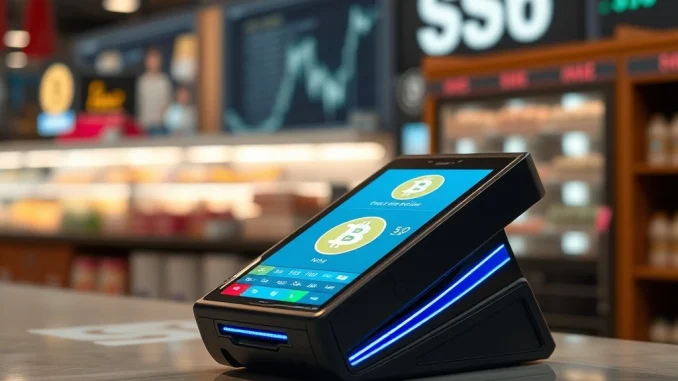
Get ready for a significant shift in how we think about digital transactions! Bitcoin payments are taking a monumental leap forward, thanks to Block Inc., the company formerly known as Square. They’ve just launched a pilot program allowing merchants to accept Bitcoin via the Lightning Network, a move that coincides perfectly with their recent inclusion in the prestigious S&P 500 index. This isn’t just about a new payment option; it’s a strategic play that could redefine mainstream crypto adoption and accelerate Bitcoin’s journey from a speculative asset to a practical, everyday currency.
The Dawn of Seamless Bitcoin Payments for Merchants
Imagine a world where accepting Bitcoin is as simple as swiping a card. Block Inc. is making this a reality. Their new pilot program allows businesses using Square’s Point of Sale (POS) system to accept Bitcoin payments directly. The beauty of this system is its flexibility: merchants can choose to retain the Bitcoin or instantly convert it to U.S. dollars through their existing hardware. This dual option is crucial for businesses, mitigating exposure to Bitcoin’s price volatility while still offering the benefits of crypto transactions.
- Direct Integration: Merchants can use their current Square POS systems, requiring minimal new setup.
- Instant Conversion: Option to convert Bitcoin to fiat currency immediately at checkout, reducing price risk.
- Lower Transaction Costs: Leveraging the Lightning Network for more economical transactions.
Owen Jennings, a Block executive, confirmed the onboarding of early adopters for this ‘native Bitcoin acceptance experience,’ emphasizing its potential to empower small businesses globally. This initiative aligns perfectly with co-founder Jack Dorsey’s long-held vision of Bitcoin becoming the ‘currency of the internet,’ making it more accessible and practical for daily commerce.
Unlocking Speed and Efficiency with the Lightning Network
At the heart of Block’s new initiative is the Lightning Network. This innovative Layer-2 solution is designed to address Bitcoin’s traditional challenges of scalability and transaction speed. While Bitcoin’s main blockchain processes transactions relatively slowly and with higher fees, the Lightning Network creates off-chain channels that enable near-instantaneous and significantly cheaper transactions.
Think of it like this: Instead of every single small purchase needing to be recorded on the main public ledger (which can get congested), the Lightning Network allows many small transactions to occur rapidly off-chain, with only the final net result settled on the main blockchain. This efficiency is a game-changer for everyday retail transactions, where speed and low fees are paramount.
- Near-Instant Transactions: Drastically reduces confirmation times compared to the main Bitcoin network.
- Lower Fees: Makes micro-transactions economically viable for merchants and customers.
- Enhanced Scalability: Allows the Bitcoin network to handle a much larger volume of transactions.
The implementation of the Lightning Network could significantly lower the barriers for small businesses that have been hesitant to adopt crypto due to concerns about transaction costs and processing times.
Block Inc.: Paving the Way for Mainstream Crypto
The company formerly known as Square, now Block Inc., is not a newcomer to the financial technology space. With over 4 million merchants in its network and processing an astonishing $200 billion annually in payments, Block provides a robust and scalable infrastructure for this new Bitcoin initiative. This extensive merchant network is a critical asset, offering a vast foundation for the widespread adoption of Bitcoin as a payment method.
Jack Dorsey, a vocal Bitcoin advocate, has consistently championed Bitcoin’s role in a decentralized future. Block’s strategic move to integrate Bitcoin payments via Lightning is a tangible step towards realizing this vision. It’s not just about enabling transactions; it’s about empowering small and medium-sized businesses with a new, efficient, and potentially cost-effective payment rail.
While Block’s shares have seen an 8% dip since January 1, 2025, Bitcoin itself has enjoyed a robust 26% year-to-date gain, currently trading around $118,620. This divergence highlights the ongoing journey of integrating volatile assets into traditional financial systems, yet Block’s commitment remains strong.
The S&P 500 Effect: Boosting Confidence and Visibility
Block Inc.’s recent inclusion in the S&P 500 index has sent a clear signal to the market. This prestigious addition, announced earlier, triggered a notable stock rally, with shares surging over 8% immediately and climbing 14% in the past week. Inclusion in the S&P 500 means that index funds and ETFs tracking the S&P 500 must now purchase Block shares, creating significant demand and boosting the company’s legitimacy and visibility among institutional investors.
What does this mean for Bitcoin’s future as a payment method? It means that a major player, now part of a benchmark index, is actively investing in and promoting Bitcoin’s utility. This institutional validation, combined with Block’s user-friendly approach and vast merchant network, could significantly accelerate Bitcoin’s transition from a purely speculative asset to a practical payment method.
Navigating the Future of Crypto Adoption
While Block Inc.’s pilot program is a huge step, the broader implications for crypto adoption remain a topic of discussion. Analysts suggest that the success of this initiative hinges on several key factors:
- Macroeconomic Stability: A stable economic environment is crucial for consumer and merchant confidence in new payment methods.
- Regulatory Clarity: Clear and consistent regulations around cryptocurrencies are essential for widespread institutional and commercial adoption.
- Merchant Confidence: Businesses need to feel secure and understand the benefits of accepting Bitcoin, including managing volatility and tax implications.
The current rollout is limited to a small group of early adopters, with a wider deployment anticipated in 2026. If this technology proves viable and beneficial in real-world use cases, Block’s initiative could set a powerful precedent for other payment providers, effectively embedding Bitcoin into daily commerce. Furthermore, ongoing regulatory developments and increasing institutional interest in Bitcoin ETFs could further shape its trajectory as a payment tool, making the crypto ecosystem more robust and integrated into global finance.
Block Inc.’s foray into Lightning Network-powered Bitcoin payments, bolstered by its S&P 500 inclusion, marks a pivotal moment for cryptocurrency. This strategic move not only enhances Bitcoin’s utility but also paves the way for a more decentralized and efficient global payment landscape. As the pilot expands, we’ll be watching closely to see how this innovative approach transforms the future of commerce.
Frequently Asked Questions (FAQs)
Q1: What is the Lightning Network and why is it important for Bitcoin payments?
The Lightning Network is a ‘Layer-2’ payment protocol built on top of Bitcoin’s blockchain. It allows for near-instant, low-cost transactions by creating off-chain payment channels between users. This is crucial for Bitcoin payments because it significantly improves scalability and speed, making Bitcoin practical for everyday retail transactions that require quick confirmations and minimal fees.
Q2: How does Block Inc.’s new pilot program work for merchants?
Block Inc.’s pilot program enables merchants using Square’s Point of Sale (POS) system to accept Bitcoin payments. Merchants can choose to either receive Bitcoin directly and hold it, or instantly convert it to U.S. dollars at the time of the transaction through their existing Square hardware. This flexibility helps merchants manage price volatility while still offering a crypto payment option.
Q3: What impact does Block Inc.’s inclusion in the S&P 500 have on this initiative?
Block Inc.’s inclusion in the S&P 500 index boosts its credibility and visibility among institutional investors. This legitimization means that a major, recognized financial technology company is actively promoting and integrating Bitcoin as a payment method. It signals growing mainstream acceptance and could encourage other companies and investors to explore crypto solutions, further accelerating crypto adoption.
Q4: What are the main benefits for small businesses accepting Bitcoin via Block’s system?
Small businesses can benefit from lower transaction fees compared to traditional payment processors, faster settlement times thanks to the Lightning Network, and access to a growing base of cryptocurrency users. The option to instantly convert Bitcoin to fiat also helps mitigate price volatility, making it a less risky proposition for day-to-day operations.
Q5: What are the challenges to widespread crypto adoption, despite these advancements?
Despite Block’s advancements, widespread crypto adoption still faces challenges. These include the need for greater macroeconomic stability, clearer and more consistent regulatory frameworks globally, and building higher merchant and consumer confidence. Concerns about price volatility, security, and ease of use also need to be continuously addressed for truly mainstream acceptance.