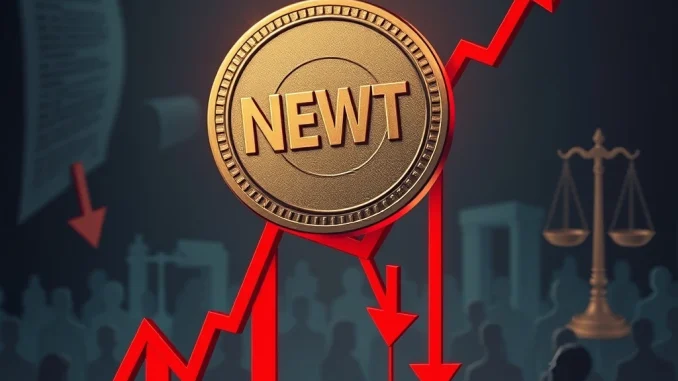
The cryptocurrency world is no stranger to volatility, but the recent dramatic fall of NEWT crypto has sent shockwaves through the market. In an astonishing 24-hour period, NEWT witnessed a staggering 2102.35% plunge, leaving investors reeling and prompting urgent questions about its future. What triggered this precipitous decline, and what does it signal for the broader decentralized finance (DeFi) ecosystem?
What’s Behind the Shocking NEWT Token Price Drop?
The immediate catalyst for the unprecedented drop in NEWT token price appears to be a confluence of intensifying regulatory scrutiny, internal governance disputes, and severe liquidity pressures. As of July 25, 2025, the token’s value evaporated at an alarming rate, highlighting the fragile nature of digital assets, especially those operating in the less-defined regulatory landscapes of DeFi.
Authorities in several key jurisdictions have reportedly escalated their review of decentralized finance protocols. While no formal enforcement actions have been announced specifically against NEWT, the platform is among those under examination. The mere perception of increased oversight, particularly concerning governance structures and smart contract transparency, has been enough to trigger a sharp sell-off. Investors, wary of potential future restrictions or legal challenges, opted to divest, leading to a cascading effect on the token’s value.
Escalating Regulatory Scrutiny and Its Impact on DeFi
The broader context for NEWT’s downturn is the growing concern over DeFi regulatory uncertainty. Governments worldwide are grappling with how to classify, monitor, and regulate the rapidly evolving DeFi space. This includes everything from yield farming protocols to decentralized exchanges and lending platforms. The lack of clear guidelines creates an environment ripe for sudden market shifts when even a hint of increased oversight emerges.
For projects like NEWT, which often rely on complex smart contracts and a degree of decentralization, the regulatory spotlight can expose vulnerabilities. Questions around compliance, user protection, and systemic risk are becoming central to regulators’ discussions. This intensified scrutiny is not unique to NEWT but represents a growing challenge for the entire DeFi sector, pushing projects to re-evaluate their operational frameworks and transparency levels.
Unpacking NEWT Governance Issues: A Community Divided
Beyond external pressures, the internal dynamics within the NEWT community have also played a significant role in its recent struggles. Reports indicate a deepening rift over NEWT governance issues. Developers and token holders have reportedly clashed over proposed protocol upgrades, with some stakeholders advocating for a more transparent and truly decentralized decision-making process.
Critics argue that NEWT’s current governance structure lacks sufficient checks and balances, potentially increasing the risk of centralization and making the protocol vulnerable to internal disagreements. Such disputes can erode confidence in a project’s long-term viability, as investors look for stability and clear leadership. A divided community, unable to align on critical updates or future direction, often signals deeper foundational problems that can deter new investment and encourage existing holders to exit.
Liquidity Pressures: Exacerbating the Cryptocurrency Market Crash
The rapid descent of NEWT was further compounded by severe liquidity constraints, a common amplifier during a cryptocurrency market crash. As the price began to fall, several major exchanges reportedly reduced trading pairs for NEWT or imposed withdrawal limits. This effectively trapped some investors, limiting their ability to offload their positions quickly.
When investors cannot easily sell their assets, it creates a self-reinforcing cycle of panic. Those who can sell do so rapidly, pushing the price down further, which in turn triggers more selling pressure. The restricted liquidity meant that even small sell orders could have a disproportionately large impact on the price, accelerating the downward spiral and making a recovery more challenging in the short term. Analysts suggest that the situation could stabilize only if the project’s team introduces clear governance reforms and demonstrates enhanced transparency to restore market confidence.
A Look Back: NEWT’s Long-Term Gains vs. Recent Volatility
While the recent 24-hour plunge is alarming, it’s important to put NEWT’s performance into a broader context. Despite this sharp drop, NEWT had experienced substantial gains over the past year, rising a remarkable 5226.67% since July 2024. This long-term trend reflects the token’s initial adoption in promising DeFi use cases, particularly in yield farming and cross-chain interoperability, which saw significant interest throughout 2024 and early 2025.
However, the recent volatility has undeniably raised critical questions about the sustainability of such rapid growth. Can the project retain its user base and appeal amid ongoing regulatory and internal challenges? The ability to navigate these turbulent waters will be key to whether NEWT can ever recapture its previous upward momentum.
The Path Forward for NEWT Crypto: Can It Recover?
With regulatory scrutiny intensifying and governance disputes unresolved, the future of NEWT crypto remains highly uncertain. While the token has demonstrated strong long-term performance, its recent plunge underscores the fragility of market sentiment in the DeFi space. For NEWT to regain its footing and rebuild investor trust, several critical steps are imperative:
- Address Governance Transparency: The development team must proactively engage with the community to establish a more transparent and truly decentralized decision-making process. This could involve clear roadmaps for protocol upgrades and robust mechanisms for token holder voting.
- Enhance Regulatory Alignment: While the DeFi space evolves, projects that proactively engage with regulatory bodies and demonstrate a commitment to compliance are more likely to thrive. NEWT may need to explore ways to adapt its operations to anticipated regulatory frameworks.
- Restore Liquidity: Working with exchanges to stabilize trading pairs and remove withdrawal limits will be crucial for rebuilding market confidence and allowing for more orderly price discovery.
- Independent Audits: Responding to community calls for independent audits of smart contracts and governance mechanisms could significantly bolster trust and demonstrate a commitment to security and fairness.
The coming weeks will be crucial for NEWT. Its ability to navigate these complex challenges and demonstrate resilience will determine whether it can recover from this significant setback and continue to play a role in the evolving DeFi landscape.
Frequently Asked Questions (FAQs)
Q1: What caused the NEWT token’s dramatic price drop?
The NEWT token experienced a sharp decline primarily due to intensified regulatory scrutiny, internal governance disputes within its community, and severe liquidity pressures on exchanges, all contributing to a rapid sell-off.
Q2: How does regulatory scrutiny impact NEWT and other DeFi projects?
Regulatory scrutiny creates uncertainty around compliance, governance, and smart contract transparency. For NEWT and other DeFi projects, this can lead to investor apprehension, sell-offs, and a need to adapt operations to potential future regulations, affecting market sentiment and value.
Q3: What are the main NEWT governance issues?
The NEWT community has reportedly faced internal disputes over proposed protocol upgrades. Critics argue the current governance structure lacks sufficient transparency and checks, raising concerns about centralization and effective decision-making, which erodes investor confidence.
Q4: Has NEWT always performed poorly?
No. Despite the recent dramatic drop, NEWT had experienced substantial gains over the past year, rising over 5200% since July 2024. This long-term performance was driven by its initial adoption in DeFi yield farming and cross-chain interoperability use cases.
Q5: What needs to happen for NEWT crypto to recover?
For NEWT to recover, the project team needs to address governance transparency through reforms, demonstrate enhanced regulatory alignment, work to restore liquidity on exchanges, and potentially conduct independent audits of its smart contracts and governance mechanisms to rebuild trust.