The crypto world is buzzing with a significant shift in investor sentiment, as the Bitcoin Greed Index recently experienced a notable drop. This isn’t just a number; it’s a barometer reflecting a cooling off in the speculative frenzy that often characterizes digital asset markets. What does this mean for your portfolio, and why are seasoned investors suddenly exercising more caution?
Unpacking the Bitcoin Greed Index Drop: What Does 67 Signify?
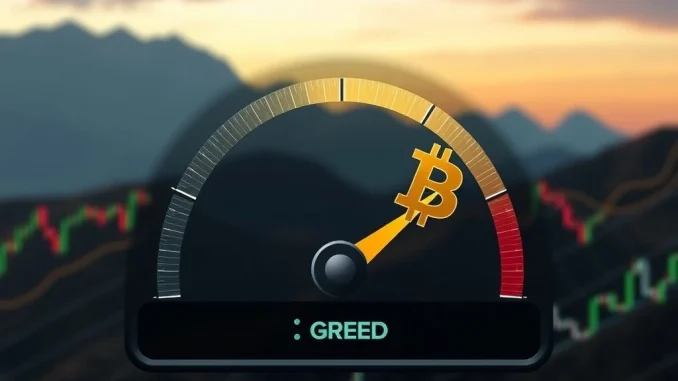
The Bitcoin Greed Index, a key indicator of investor sentiment, recently fell to 67 on July 24, 2025, from a previous level of 70. This decline signals a cooling of speculative fervor after approaching ‘extreme greed’ levels. The index, which measures sentiment through metrics like price momentum and on-chain activity, now suggests a shift toward a more measured stance. For context, it had briefly spiked to 74 in late July, a level close to ‘extreme greed’ according to CoinGlass data. However, the subsequent drop indicates that investors are adopting a more cautious approach, potentially locking in gains after recent price rallies.
This moderation contrasts with earlier optimism and underscores reduced market participation, as trading volume for Bitcoin dipped below average levels on July 24. The shift is attributed to liquidity-driven moves and short-term trends, highlighting the dynamic nature of crypto market psychology.
Decoding Crypto Market Sentiment: A Shift Towards Caution
The decline in the Crypto Market Sentiment, as reflected by the Greed Index, aligns with broader market dynamics. Bitcoin and Ether have seen slower price gains, with technical factors like profit-taking and waning momentum overshadowing macroeconomic influences. This suggests that while external economic factors are always at play, internal market mechanics are currently driving sentiment. The index’s retreat from higher levels indicates that the collective investor mood is moving away from aggressive bets towards more conservative positioning. This doesn’t necessarily signal a bearish reversal but rather a natural correction following rapid gains.
Investors appear to be recalibrating their positions in anticipation of upcoming central bank decisions on interest rates, further contributing to this cautious sentiment. The interplay between Bitcoin’s performance and the Fear & Greed Index highlights the interconnected nature of crypto markets, where sentiment often reflects broader risk appetite.
Navigating Waning Bitcoin Volatility: Is Stability on the Horizon?
One of the most notable observations alongside the index drop is the waning Bitcoin Volatility. The dip in trading volume below average levels on July 24 underscores reduced market participation and a period of price consolidation. This moderation creates a cautious environment, especially ahead of potential macroeconomic developments. While high volatility is often associated with significant price movements and trading opportunities, reduced volatility can lead to investor uncertainty or a wait-and-see approach. For some, reduced volatility might signal a period of stability or accumulation, while for others, it might indicate a lack of immediate catalysts for upward movement. This current environment prompts investors to reassess their strategies and prepare for potential shifts, rather than reacting to rapid price swings.
Understanding Crypto Profit Taking: Why Investors Are Cashing Out
The rise in Crypto Profit Taking is a significant factor contributing to the current market dynamics. After periods of rapid price appreciation, it’s natural for investors to lock in gains. This trend was evident in altcoins like Dogecoin and Cardano, which experienced notable profit-taking. While some assets saw this correction, others like BNB crossed $800 amid discussions about central bank policy, showcasing a diversified market response. The act of profit-taking helps to cool down overheated markets and prevents parabolic rises from becoming unsustainable. It reflects investors’ decisions to secure their returns, which can lead to temporary price plateaus or minor pullbacks. This behavior is a healthy part of any market cycle, allowing for consolidation before potential future movements.
Bitcoin Market Trends: What’s Next for Digital Assets?
The current Bitcoin Market Trends, as indicated by the cooling Greed Index, underscore the importance of sentiment indicators in crypto markets. Unlike traditional equities, where fundamentals anchor price action, crypto assets often react to speculative trends and technical conditions. The index’s fluctuation between 67 and 74 illustrates this volatility, with market participants oscillating between aggressive bets and risk management strategies. While some projections had anticipated Bitcoin reaching $72,000 by 2025, the recent data suggests a tempered outlook, indicating that market expectations are adjusting to current realities.
Looking ahead, the sustainability of the current sentiment balance will be tested. A sustained drop below the 50 threshold—a level associated with ‘fear’—could signal a broader risk-off environment, while a rebound to 75 or above might reignite bullish momentum. For now, the cooling index serves as a reminder of the crypto market’s inherent volatility and the need for disciplined trading approaches.
The recent drop in the Bitcoin Greed Index to 67 serves as a timely reminder of the crypto market’s dynamic nature. It highlights a crucial shift from speculative fervor to a more cautious, profit-taking environment. While not necessarily a bearish signal, this moderation underscores the importance of staying attuned to market sentiment and technical indicators. As investors await key macroeconomic developments, a disciplined approach remains paramount to navigating the ever-evolving landscape of digital assets.
Frequently Asked Questions (FAQs)
What is the Bitcoin Greed Index?
The Bitcoin Greed Index is a tool that measures investor sentiment in the cryptocurrency market. It aggregates various data points, including price volatility, market momentum, social media sentiment, and trading volume, to generate a score that indicates whether investors are feeling fearful or greedy. A higher score suggests greed, while a lower score indicates fear.
What does a drop in the Greed Index signify?
A drop in the Greed Index, such as the recent fall to 67, typically signifies a cooling of speculative fervor and a shift towards more cautious investor behavior. It often indicates that the market is moving away from ‘extreme greed’ levels, possibly due to profit-taking or reduced trading activity, rather than necessarily signaling a bearish reversal.
How does profit-taking affect the crypto market?
Profit-taking occurs when investors sell their assets after a period of price appreciation to lock in their gains. This can lead to temporary price pullbacks or consolidation phases in the market. While it can slow down upward momentum, it’s a natural and healthy part of market cycles, helping to prevent assets from becoming overvalued and creating opportunities for new investors.
Is waning Bitcoin volatility a good or bad sign?
Waning Bitcoin volatility can be viewed in different ways. For some, it might signal a period of market maturity and stability, making Bitcoin a more predictable asset. For others, it might indicate a lack of immediate catalysts for significant price movements, potentially leading to reduced trading opportunities. Its impact often depends on an investor’s strategy and outlook.
What are the key factors influencing crypto market sentiment?
Crypto market sentiment is influenced by a range of factors, including price momentum, trading volume, social media buzz, on-chain activity, macroeconomic developments (like central bank policies), regulatory news, and overall market liquidity. These elements combine to shape the collective psychological state of investors, which the Greed Index aims to capture.
How can I use the Greed Index in my trading strategy?
The Greed Index can serve as a supplementary tool for your trading strategy. A high ‘greed’ reading might suggest that the market is overextended and due for a correction, prompting caution. Conversely, a high ‘fear’ reading could indicate potential buying opportunities when others are panicking. However, it should always be used in conjunction with other technical and fundamental analysis tools, as sentiment alone is not a definitive predictor of future price action.