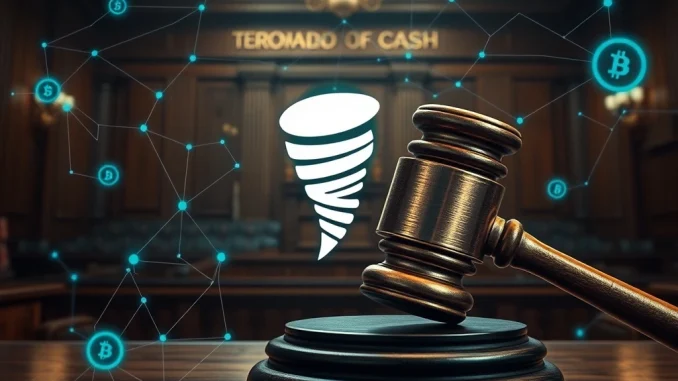
The cryptocurrency world is buzzing with anticipation as the high-stakes **Tornado Cash trial** takes a pivotal turn. In a legal battle that could redefine accountability in the decentralized space, IRS Criminal Investigation Special Agent Stephan George delivered compelling testimony against Roman Storm, co-founder of the popular crypto mixer. This landmark case isn’t just about one individual; it’s a profound test for the entire decentralized finance (DeFi) ecosystem, questioning how far developer responsibility extends when their tools are allegedly used for illicit activities. Are we witnessing a crucial moment that balances innovation with regulatory oversight?
The **Tornado Cash Trial** Heats Up: Allegations of Control
On July 23, 2025, a Manhattan federal court became the stage for a dramatic revelation. Special Agent Stephan George testified that Roman Storm, despite Tornado Cash’s design as a privacy-focused, decentralized tool, allegedly retained a degree of control over funds transacted through the platform. This claim strikes at the very heart of Tornado Cash’s foundational principles. The prosecution’s case relies heavily on forensic analysis of blockchain activity, specifically involving major exchanges like Crypto.com and Binance. Prosecutors contend that Storm’s technical access to smart contracts allowed him to influence illicit fund flows, challenging the notion of a purely trustless system.
The core of the prosecution’s argument suggests that Storm’s interactions with Tornado Cash’s smart contracts were not standard user behavior. Instead, these interactions reportedly deviated in ways that could indicate intentional oversight or intervention. Court documents hint at the possibility of a “backdoor” that might have enabled monitoring or redirection of funds, effectively granting Storm operational control. The IRS emphasizes that while Tornado Cash is technically trustless for its users, Storm’s alleged role in deploying and managing its architecture could link him to criminal facilitation.
Unpacking the IRS’s Case Against **Roman Storm**
The allegations against **Roman Storm** are severe, painting a picture of a developer who may have actively facilitated illegal transactions. The prosecution’s strategy focuses on the technical nuances of how Tornado Cash operates and Storm’s alleged deep involvement in its architecture. Here’s a breakdown of the key claims:
- **Technical Access:** Prosecutors assert that Storm possessed unique technical access to the underlying smart contracts, enabling him to potentially manipulate or oversee transactions.
- **Deviating Behavior:** Evidence presented suggests that Storm’s blockchain activity differed from typical user interactions, hinting at a more involved, administrative role.
- **Criminal Facilitation:** The IRS believes that these alleged actions connect Storm directly to the facilitation of illicit fund flows, including money laundering and sanctions violations.
This approach highlights a growing trend among regulators to hold individuals accountable for the misuse of open-source protocols, even if those protocols are designed to be decentralized.
The Pivotal Role of **Blockchain Forensics**
At the heart of the prosecution’s case is the application of **Blockchain Forensics**. Special Agent George’s testimony centered on his analysis of complex on-chain data to trace funds and identify patterns. This involves scrutinizing transaction histories, wallet addresses, and smart contract interactions to build a narrative of financial activity. However, the defense has swiftly challenged the credibility of this evidence.
Storm’s defense attorneys have questioned George’s qualifications, arguing that his accounting expertise does not necessarily extend to the intricate world of blockchain forensics. They contend that interpreting complex cryptocurrency transactions requires specialized knowledge that George may lack, thereby undermining the reliability of his testimony. Furthermore, the defense has pointed to inconsistencies in the prosecution’s claims, citing the case of Hanfeng Lin, a victim of a crypto romance scam, to argue that disputed funds were never routed through Tornado Cash as alleged. This directly challenges the prosecution’s narrative of direct involvement in illicit activity.
The defense is preparing to counter with its own expert witnesses, potentially including a Chainalysis analyst, to meticulously scrutinize the prosecution’s forensic methods. Their aim is to demonstrate that Tornado Cash’s technical architecture does not inherently enable developer control, reinforcing the platform’s decentralized nature. This battle of technical interpretation will be critical in determining the trial’s outcome.
**Decentralized Finance (DeFi)** Under Scrutiny: A Defining Moment
This trial isn’t just about **Roman Storm** or **Tornado Cash**; it’s a defining moment for the entire **Decentralized Finance (DeFi)** sector. The prosecution’s arguments directly challenge the long-held belief that developers of decentralized protocols are shielded from liability for how end-users utilize their creations. The case forces a critical examination of:
Decentralization vs. Control: How truly decentralized is a protocol if its original developers can still exert influence or if their initial design choices are deemed culpable?
Open-Source Liability: Does creating open-source code, even if designed for privacy, make developers liable for its subsequent misuse by bad actors?
Governance Rights vs. Criminal Intent: The defense plans to distinguish between the legitimate governance rights a developer might have in a protocol and actual criminal intent to facilitate illicit activities. This distinction is paramount for DeFi, where governance tokens and developer input are common.
The outcome will undoubtedly set precedents for how courts define responsibility in decentralized systems, potentially shaping future enforcement standards and the very structure of DeFi protocols.
Prosecution vs. Defense: Key Arguments
| Aspect | Prosecution’s Argument (IRS) | Defense’s Argument (Roman Storm) |
|---|---|---|
| Core Claim | Storm retained control over Tornado Cash funds. | Storm did not control funds; platform is decentralized. |
| Evidence Basis | Forensic analysis of blockchain activity, ‘deviations’ from user behavior, technical access to smart contracts. | Questioning IRS witness expertise, inconsistencies, victim testimony (Hanfeng Lin). |
| Implication | Facilitation of illicit fund flows, potential ‘backdoor’ access. | Platform is trustless; developer role is distinct from criminal intent. |
| Key Witness/Strategy | Special Agent Stephan George (IRS Criminal Investigation) | Potential Chainalysis analyst, focus on technical architecture. |
Broader Implications for **Crypto Regulation**
The **Tornado Cash trial** has profound implications for the future of **Crypto Regulation**. Prosecutors’ aggressive approach aligns with increasing regulatory efforts globally to hold individuals accountable for tools that are later exploited for money laundering or sanctions violations. This reflects a broader shift towards greater oversight in the digital asset space.
However, critics warn that such a precedent could stifle innovation. Imposing liability on developers for the actions of end-users might discourage the creation of privacy-enhancing technologies or open-source software, essential components of a thriving and secure digital economy. The tension between fostering technological advancement and ensuring financial transparency is at the forefront of this legal battle.
As the trial progresses, stakeholders across the crypto industry are closely monitoring its outcome. A conviction could fundamentally redefine legal boundaries for DeFi developers, emphasizing the urgent need for robust compliance frameworks that balance privacy features with regulatory obligations. Conversely, a defense victory might reinforce the technical irreversibility and trustless nature of decentralized systems, potentially complicating future enforcement strategies for authorities. This case vividly underscores the evolving dynamic between rapid technological innovation and the persistent demand for financial transparency in the digital age.
This landmark trial is more than just a legal proceeding; it’s a crucible for the future of decentralized finance, setting a critical precedent for how innovation and regulation will coexist in the digital asset landscape. Its outcome will resonate far beyond the courtroom, shaping the very foundation of crypto development and adoption for years to come.
Frequently Asked Questions (FAQs)
What is Tornado Cash?
Tornado Cash is a decentralized cryptocurrency mixer designed to enhance transaction privacy on the Ethereum blockchain. It allows users to deposit crypto and withdraw it from a different address, making it harder to trace the origin of funds.
Why is Roman Storm on trial?
Roman Storm, a co-founder of Tornado Cash, is on trial for allegedly operating an unlicensed money transmitting business and conspiring to commit money laundering and sanctions violations. The IRS claims he retained control over funds transacted through Tornado Cash, facilitating illicit activities.
What is the core argument of the prosecution?
The prosecution, led by the IRS, argues that Roman Storm had technical access and exerted influence over Tornado Cash’s smart contracts, allowing him to oversee or facilitate the movement of illicit funds, despite the platform’s decentralized design.
How does the defense counter these allegations?
The defense challenges the IRS’s interpretation of blockchain forensics and the qualifications of their witnesses. They argue that Tornado Cash is a truly decentralized and trustless protocol, and that any developer involvement was distinct from criminal intent, emphasizing the platform’s open-source nature.
What are the broader implications of this trial for DeFi?
The trial’s outcome could set a significant legal precedent for decentralized finance (DeFi) developers, influencing how accountability is assigned for the misuse of open-source protocols. It highlights the ongoing tension between privacy-enhancing technologies and regulatory demands for financial transparency.
What is blockchain forensics?
Blockchain forensics is the process of analyzing public blockchain data to trace cryptocurrency transactions, identify wallet addresses, and uncover patterns of financial activity, often used in criminal investigations to track illicit funds.