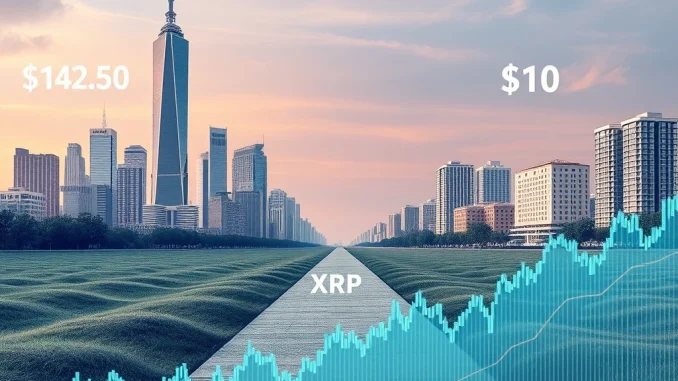
The world of cryptocurrency is often a rollercoaster of exhilarating highs and nerve-wracking lows, and few digital assets embody this more than XRP. Investors and enthusiasts are constantly on the lookout for the next big move, with recent discussions revolving around two wildly different XRP price prediction scenarios: an astonishing $142.50 driven by e-commerce dominance versus a more grounded $10 fueled by institutional adoption. How could one digital asset have such divergent outlooks? Let’s dive deep into the factors shaping XRP’s potential future.
Decoding the Ambitious $142.50 XRP Price Prediction
Imagine XRP becoming the backbone of global online shopping. This is the premise behind a theoretical model that projects XRP reaching an incredible $142.50 per unit. This bold XRP price prediction isn’t pulled from thin air; it’s based on a specific set of assumptions:
E-commerce Market Capture: The model posits XRP capturing a significant 20% of the projected $11.4 trillion global e-commerce payments market by 2029. This means a substantial shift away from traditional payment methods.
Utility-Based Valuation: XRP’s role is viewed as a transaction layer, akin to liquidity assets in traditional finance. Its value is derived from its utility in facilitating these massive payment volumes.
Key Multipliers: The calculation factors in a circulating supply of 60 billion XRP and applies a hypothetical 15x speculative multiplier on a utility-derived market cap of $570 billion. This multiplier accounts for market sentiment and speculative interest beyond pure utility.
While this $142.50 figure certainly captures the imagination, it’s crucial to understand its foundation. It explicitly acknowledges its reliance on optimistic assumptions about transaction volume, token velocity, and market sentiment. For XRP to achieve such a feat, it would require an unprecedented level of adoption, where merchants and consumers worldwide abandon entrenched systems like PayPal, credit cards, and major digital wallets in favor of XRP. This transition would likely need robust regulatory support and a dramatic revaluation of XRP’s market capitalization, factors that are far from guaranteed.
XRP News Today: The Case for $10 and Institutional XRP Adoption
In stark contrast to the high-flying e-commerce projection, other forecasts offer a more conservative, yet perhaps more realistic, outlook. Recent XRP news today highlights an analysis suggesting XRP could reach $10 within six years, primarily driven by increasing institutional XRP adoption and greater regulatory clarity. This projection stems from a more gradual, organic growth model rather than a sudden, disruptive market takeover.
What fuels this more conservative, yet still significant, $10 target?
Regulatory Clarity: The ongoing legal landscape surrounding Ripple and XRP is a major factor. A definitive positive outcome could unlock significant institutional investment and broader utility.
Enterprise Solutions: Ripple, the company behind XRP, has consistently focused on enterprise-level solutions for cross-border payments and liquidity. This aligns perfectly with a strategy centered on institutional adoption rather than direct consumer e-commerce.
Real-World Utility Beyond Retail: Beyond speculative trading, XRP is demonstrating tangible utility in non-retail financial infrastructure. A prime example is the $130 million project in Brazil’s private credit markets, leveraging the XRP Ledger to tokenize traditional assets. With an additional $500 million in queued deals, this initiative underscores XRP’s role as a settlement layer for complex financial instruments. While distinct from e-commerce, these developments build a foundation of real-world value.
The $10 forecast emphasizes a steady, strategic integration of XRP into existing financial systems, a path that might be slower but potentially more sustainable than the rapid displacement envisioned by the e-commerce model.
XRP E-commerce Dominance: A Challenging Path Ahead
While the prospect of XRP dominating the e-commerce landscape is exciting, the journey there is fraught with significant challenges. Capturing 20% of such a massive market isn’t just about technological superiority; it’s about overcoming deeply entrenched habits, existing infrastructure, and powerful competitors.
Consider these hurdles for widespread XRP e-commerce adoption:
Incumbent Giants: PayPal, Visa, Mastercard, and other major digital wallets have decades of market presence, established trust, and vast user bases. Displacing them requires a compelling value proposition that goes beyond just lower transaction costs.
Regulatory Landscape: The global regulatory environment for cryptocurrencies remains fragmented and uncertain. A unified, favorable regulatory framework is essential for any digital asset to achieve widespread adoption in mainstream commerce.
User Experience: For mass adoption, using XRP for payments needs to be as seamless, if not more so, than current methods. This includes ease of acquisition, storage, and spending for the average consumer.
Cost Erosion: A 2025 study noted fragmented fee structures across trading platforms, with costs ranging from 0.5% to 1%. While XRP aims for low transaction fees, the overall cost of acquiring, holding, and transacting with it across various platforms could erode its cost advantage compared to traditional systems.
Traditional Finance Countering: Traditional players are not sitting idle. PayPal’s recent integration of stablecoins and digital assets into its ecosystem signals a proactive move to counter decentralized alternatives, blurring the lines and offering similar functionalities within their existing, trusted frameworks.
The path to e-commerce dominance for XRP is not just about its technical merits but also about navigating a complex ecosystem of competition, regulation, and consumer behavior.
Navigating the Cryptocurrency Forecast Landscape
The broader cryptocurrency forecast landscape adds another layer of complexity to XRP’s trajectory. The crypto market is inherently volatile, and XRP is no exception. Recent market dynamics saw XRP fall over 10% in a 24-hour period as traders unwound bullish positions. Such rapid shifts complicate both short-term trading strategies and long-term price narratives.
For investors, it’s vital to differentiate between speculative modeling and tangible progress. While the $142.50 figure is captivating, its feasibility hinges on factors beyond XRP’s technical capabilities. Real-world projects, like Brazil’s tokenized credit pipeline, offer actionable evidence of XRP’s utility and adoption in specific niches. However, these do not directly translate to e-commerce dominance.
Similarly, the $10 forecast, while more conservative, assumes a gradual institutional shift that could take years to fully materialize. This requires sustained interest from financial institutions, continued regulatory clarity, and the successful integration of Ripple’s solutions into global financial infrastructure.
As the crypto market navigates regulatory uncertainty, technological innovation, and evolving macroeconomic forces, XRP’s price trajectory will remain a barometer of broader sentiment and its ability to deliver on its promises. Both the theoretical and analyst-driven projections serve as benchmarks, not certainties, with actual outcomes contingent on adoption, regulation, and market dynamics.
Conclusion: XRP’s Dual Trajectories and Future Potential
XRP stands at a fascinating crossroads, with its future price potential painted by two vastly different brushstrokes. On one hand, the audacious vision of $142.50 by capturing a significant slice of the e-commerce pie presents an exhilarating, albeit highly speculative, future. This outcome would necessitate a paradigm shift in global payment habits and a favorable regulatory environment unprecedented in crypto history.
On the other hand, the more grounded $10 forecast, driven by steady institutional XRP adoption and growing regulatory clarity, offers a pragmatic pathway for growth. This trajectory emphasizes XRP’s strength as a settlement layer for enterprise solutions and its utility in complex financial instruments, as evidenced by projects like the one in Brazil.
Ultimately, XRP’s journey will likely be a blend of these narratives, with its success dependent on its ability to carve out niches in both retail and institutional finance, while navigating the inherent volatility and regulatory complexities of the crypto market. Investors should remain informed, separating aspirational models from concrete developments, and focus on the real-world utility and adoption that will truly define XRP’s long-term value.
Frequently Asked Questions (FAQs)
Q1: What are the main factors driving the $142.50 XRP price prediction?
The $142.50 XRP price prediction is primarily driven by a theoretical model that assumes XRP captures 20% of the global e-commerce payments market by 2029. It also factors in a utility-based valuation, a 60 billion circulating supply, and a 15x speculative multiplier on a $570 billion utility-derived market cap.
Q2: How does the $10 XRP forecast differ from the $142.50 projection?
The $10 XRP forecast is a more conservative outlook, primarily driven by anticipated institutional XRP adoption and increased regulatory clarity within the next six years. Unlike the e-commerce model, it emphasizes a gradual integration into existing financial systems rather than a rapid market disruption.
Q3: What challenges does XRP face in achieving widespread e-commerce adoption?
XRP faces several challenges, including competition from entrenched payment systems like PayPal and credit cards, the need for robust regulatory support, ensuring a seamless user experience for mass consumers, potential erosion of cost advantage due to fragmented fee structures, and active countering strategies from traditional financial players.
Q4: Are there any real-world examples of XRP’s utility beyond e-commerce?
Yes, XRP is being leveraged in real-world applications beyond e-commerce. A notable example is a $130 million project in Brazil’s private credit markets, which uses the XRP Ledger to tokenize traditional assets. This demonstrates XRP’s utility as a settlement layer for complex financial instruments and its role in broader financial infrastructure.
Q5: What should investors consider when evaluating XRP price predictions?
Investors should distinguish between speculative models and tangible progress. While high price targets can be exciting, their feasibility depends on numerous assumptions. It’s important to focus on real-world utility, institutional adoption, regulatory developments, and broader market dynamics, rather than solely on theoretical projections, when making investment decisions.