In the dynamic world of finance, where every word from key economic figures can send ripples across markets, understanding the undercurrents of political tension is paramount. For cryptocurrency enthusiasts and investors, these macroeconomic shifts, often influenced by central bank policies and government rhetoric, directly impact market sentiment and asset valuations. A recent public exchange involving Jerome Powell, Chair of the Federal Reserve, and former U.S. President Donald Trump serves as a potent reminder of how deeply intertwined politics and monetary policy remain, and why such confrontations can subtly shape the economic landscape that underpins digital assets.
Jerome Powell’s Bold Rebuttal: Setting the Record Straight
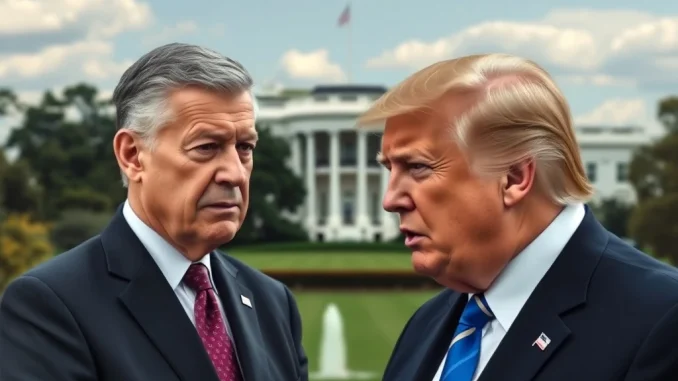
The scene unfolded during a joint tour of the Federal Reserve’s Washington, D.C. headquarters, an unusual setting for such a direct confrontation. President Trump, known for his assertive public style, reiterated a claim that a White House renovation project was costing an astronomical $3.1 billion. However, Federal Reserve Chair Jerome Powell swiftly and publicly refuted this assertion, stating unequivocally, “That’s not true. I haven’t heard that from anybody.”
Powell clarified that the figure cited by Trump likely included a separate federal building that had been constructed five years prior, a detail that significantly alters the context of the cost. This immediate and firm denial by the head of the central bank was remarkable, marking a rare instance of a Fed Chair directly contradicting a sitting or former president’s public statement on such a specific financial matter.
Unpacking the $3.1 Billion White House Renovation Claim: Fact vs. Fiction
The heart of the dispute lay in a stark discrepancy between Trump’s figure and the actual budgetary allocations. While President Trump claimed a staggering $3.1 billion for a White House renovation, official records tell a different story. The 2025 budget, for instance, allocated a far more modest $360 million for the White House restoration.
The alleged $3.1 billion figure, as Powell suggested, appears to be a conflation or misrepresentation, possibly incorporating costs related to other federal infrastructure projects or general government spending rather than solely the White House. This kind of fiscal transparency, or lack thereof, becomes a point of contention, sparking debates about accountability and the accuracy of public statements from high-ranking officials.
For markets, including the volatile crypto space, clarity and accuracy in financial reporting from government sources are crucial. Misinformation, whether intentional or accidental, can lead to uncertainty and erode confidence, which are detrimental to investment environments.
The Enduring Battle for Fed Independence: A Critical Pillar of Stability
Beyond the specific renovation claim, the exchange between Powell and Trump underscored a much larger, ongoing tension: the battle for Fed Independence. The Federal Reserve, as the central bank of the United States, is designed to operate independently of political pressure, making monetary policy decisions based on economic data rather than political expediency. This independence is widely regarded as vital for maintaining economic stability, controlling inflation, and fostering long-term growth.
Trump’s repeated criticisms of Powell, particularly concerning interest rates, have been a consistent feature of his public discourse. Despite the Fed’s decision to keep borrowing costs steady, Trump has consistently pushed for lower rates. This pressure reached a peak with calls for Powell’s resignation from figures like Billy Pulte, head of the Federal Housing Finance Agency.
However, legal experts point to the Supreme Court’s recent ruling reinforcing the Fed’s independence, which significantly complicates any executive efforts to remove the Fed Chair. This legal precedent acts as a bulwark against political interference, safeguarding the institution’s ability to make difficult but necessary economic decisions without fear of reprisal.
Trump Criticism and Its Ripple Effects: Navigating Political Pressure
The public nature of Trump Criticism against Jerome Powell and the Federal Reserve carries significant weight. Treasury Secretary Scott Bessent joined the chorus, expressing confusion over the renovation costs and calling for an “internal review” of the Fed’s operations. Bessent’s comments on Fox Business, labeling the central bank an “unaccountable agency” and a “new kind of central planning,” echo broader critiques of federal spending and perceived overreach.
While Trump described the renovation as “luxurious,” he stopped short of calling it a “fireable offense,” despite his prior calls for Powell’s resignation. This nuanced stance highlights the delicate political dance at play. The ongoing pressure, however, risks undermining market confidence in the Fed’s autonomy. Independent agencies often face executive overreach, and the Fed is no exception. Such public spats can lead to:
- Increased market volatility due to uncertainty about future monetary policy.
- Erosion of trust in nonpartisan institutions tasked with economic stewardship.
- Heightened partisan narratives on fiscal responsibility, especially with the 2025 midterms approaching.
For cryptocurrency markets, which thrive on stability and predictability in traditional finance, any perceived weakening of the Fed’s independence could introduce new layers of systemic risk and unpredictability.
Beyond the Headlines: Why This Federal Reserve Standoff Matters
The confrontation between Jerome Powell and Donald Trump is more than just a political spat over renovation costs; it’s a significant episode highlighting the delicate balance between political influence and institutional independence. Powell’s firm stance aligns with his reputation for cautious, evidence-based communication, starkly contrasting with Trump’s assertive public style. This incident has reignited debates about federal transparency and the crucial role of nonpartisan institutions in verifying executive claims.
The implications extend beyond immediate headlines:
- Market Confidence: Any perceived political meddling in Fed decisions can spook investors, leading to capital flight or decreased investment in various asset classes, including cryptocurrencies.
- Institutional Integrity: The ability of institutions like the Federal Reserve to operate without undue political pressure is fundamental to their credibility and effectiveness.
- Economic Policy Clarity: Mixed messages or public disputes from high-ranking officials can obscure the true state of economic policy and outlook, making it harder for businesses and consumers to plan.
The White House has yet to formally respond to the Fed’s rebuttal, leaving the dispute to simmer in the public sphere. As the economic landscape continues to evolve, the strength and perceived independence of institutions like the Federal Reserve will remain critical anchors for stability, influencing everything from interest rates to the broader investor sentiment that impacts even the most nascent of digital assets.
Frequently Asked Questions (FAQs)
Q1: What was the main point of contention between Jerome Powell and Donald Trump?
The primary point of contention was Donald Trump’s claim that a White House renovation project cost $3.1 billion, which Federal Reserve Chair Jerome Powell publicly denied, clarifying that the figure was inaccurate and likely included a separate federal building constructed years earlier.
Q2: Why is the Federal Reserve’s independence important?
The Federal Reserve’s independence is crucial because it allows the central bank to make monetary policy decisions based on economic data and long-term stability goals, rather than short-term political pressures. This helps maintain price stability, maximize employment, and ensure the health of the financial system, free from partisan influence.
Q3: How does political pressure on the Fed affect financial markets, including crypto?
Political pressure on the Fed can create uncertainty about future monetary policy, potentially leading to increased market volatility. If investors perceive that the Fed’s independence is being compromised, it can erode confidence in economic stability, which can negatively impact traditional markets and, by extension, influence investor sentiment and capital flows within the cryptocurrency space.
Q4: What was the actual budget allocated for the White House renovation mentioned?
The 2025 budget allocated a significantly lower figure of $360 million for the White House restoration, which contrasts sharply with the $3.1 billion figure cited by Donald Trump.
Q5: Has President Trump previously criticized Jerome Powell or the Federal Reserve?
Yes, President Trump has repeatedly criticized Jerome Powell and the Federal Reserve, particularly over their decisions regarding interest rates, often advocating for lower rates to stimulate the economy during his presidency.