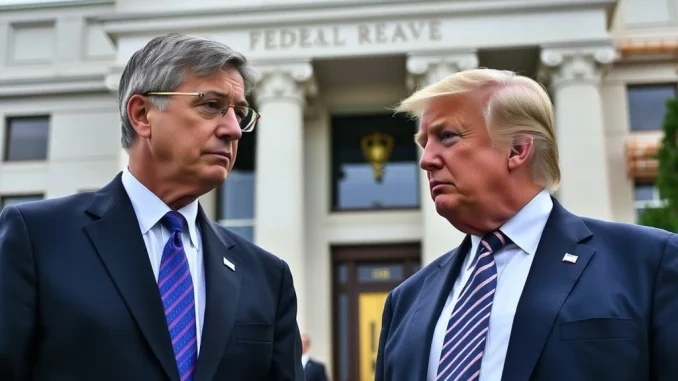
In an unexpected turn of events that sent ripples through Washington and financial markets, Federal Reserve Chair Jerome Powell publicly challenged President Donald Trump’s assertions regarding the cost of renovations at the central bank. This rare public confrontation underscores the deep-seated tensions between political leadership and the institutional autonomy of the nation’s central bank, a dynamic often closely watched by those navigating the volatile world of cryptocurrencies and traditional finance alike.
Jerome Powell’s Unwavering Stand: Upholding Fed Independence
During a guided tour of the Fed’s Washington headquarters, an extraordinary scene unfolded. Standing beside President Trump, who wore a hard hat, Powell directly refuted the President’s claim that renovations had exceeded $3.1 billion. “That’s not true. I haven’t heard that from anybody,” Powell stated firmly, clarifying that the figure cited by Trump included a separate federal building completed five years prior. This direct rebuttal from a sitting Fed chair to the president who appointed him in 2017 was a moment of profound significance, highlighting the critical importance of Fed independence.
Powell’s measured yet firm denial served as a powerful reaffirmation of the Federal Reserve’s role as a guardian of economic data accuracy and institutional integrity. Central bankers typically steer clear of public disputes with elected officials to preserve their policy credibility. However, this incident saw Jerome Powell step into the political arena to correct what he viewed as a factual misrepresentation, signaling that the Fed would not yield to external pressures, even from the highest office.
Donald Trump’s Persistent Pressure: The Battle Over Interest Rates
The renovation claim emerged amidst Donald Trump’s intensified campaign to pressure Powell to lower interest rates. Trump has consistently argued that reducing borrowing costs could save the U.S. “hundreds of billions” in interest payments, especially as national debt interest reached a staggering $1.1 trillion in 2024. This persistent push for rate cuts has been a recurring theme in the President’s public statements, reflecting a desire to stimulate economic growth and reduce the burden of national debt.
Despite Trump’s advocacy, Powell has maintained that current economic conditions do not justify rate reductions, opting instead to keep the benchmark rate unchanged. The renovation claim, therefore, appeared to be another strategic lever in Trump’s broader effort to influence the Fed’s monetary policy decisions. However, the absence of corroborating evidence for the $3.1 billion figure left it vulnerable to Powell’s public rebuttal, underscoring the challenges of using unsubstantiated claims as a basis for policy pressure.
Scrutinizing the Renovation Claim: A Deeper Look at Economic Policy Debates
The dispute over the renovation costs quickly became a focal point in the ongoing debate surrounding U.S. economic policy. Trump’s response to Powell’s clarification — “So we’re going to take a look. We’re going to see what’s happening, and it’s got a long way” — signaled his intent to further scrutinize the matter. This exchange highlighted the tension between political figures seeking immediate economic outcomes and the central bank’s commitment to data-driven decision-making, often with a longer-term perspective.
The incident also brought to light internal divisions within Trump’s administration. Billy Pulte, head of the Federal Housing Finance Agency, had earlier called for Powell’s resignation on social media, amplifying calls for the Fed chair’s removal. Yet, legal experts caution that replacing Powell would be challenging due to recent Supreme Court rulings reinforcing the Fed’s autonomy. When pressed on whether the renovation issues constituted a “fireable offense,” Trump demurred, stating, “I would love to see it completed,” while insisting the broader issue was not a matter of accountability but efficiency.
Treasury Secretary Bessent’s Stance and the Broader Implications
Adding to the scrutiny, Treasury Secretary Scott Bessent expressed confusion over the renovation costs and advocated for an “internal review” of the Fed’s operations. Bessent’s comments aligned with Trump’s narrative, framing the central bank as an “unaccountable agency” engaging in “central planning.” This narrative attempts to undermine the Fed’s credibility and independence, portraying it as an entity operating outside the purview of democratic accountability.
However, Powell’s steadfast refusal to lower rates this year has positioned the Fed as a counterweight to political pressures, emphasizing data-driven decision-making over political expediency. This incident underscores the delicate balance between political influence and institutional independence in economic governance. While the Fed has no official mandate to verify non-financial claims like Trump’s renovation figure, Powell’s public correction served as a strategic reaffirmation of the central bank’s authority.
The Enduring Struggle for Central Bank Autonomy
By dismissing the claim with a blend of firmness and composure, Jerome Powell not only defended the Fed’s credibility but also signaled to market participants and policymakers that the institution would not yield to external pressures. This episode is likely to influence perceptions of economic discourse in a polarized political climate. As Donald Trump continues to amplify his critiques of the Fed, Powell’s approach—balancing collegiality with unwavering commitment to data—positions the central bank as a neutral arbiter amid partisan tensions.
The $3.1 billion claim, now publicly discredited, may fade from prominence, but the broader struggle over monetary policy independence remains a defining issue for U.S. economic governance. Understanding these dynamics is crucial for anyone monitoring financial markets, as the stability and predictability of central bank actions directly impact everything from bond yields to cryptocurrency valuations.
Frequently Asked Questions (FAQs)
What was the core disagreement between Powell and Trump?
The core disagreement centered on President Trump’s claim that Federal Reserve renovations cost over $3.1 billion. Jerome Powell publicly refuted this, clarifying that the figure incorrectly included a separate federal building completed years prior.
Why is the Federal Reserve’s independence important?
The Federal Reserve’s independence is crucial for maintaining monetary policy credibility and stability. It allows the central bank to make decisions based on economic data and long-term objectives, free from short-term political pressures, which helps prevent inflation and maintain confidence in the economy.
What are Donald Trump’s main arguments for lower interest rates?
Donald Trump has consistently argued that lower interest rates would stimulate economic growth and significantly reduce the U.S. national debt interest payments, which he claims could save hundreds of billions of dollars annually. He believes current rates are too high and hinder economic potential.
How did other officials react to this confrontation?
Reactions varied. Billy Pulte, head of the Federal Housing Finance Agency, publicly called for Powell’s resignation. Treasury Secretary Scott Bessent expressed confusion over the renovation costs and advocated for an “internal review” of the Fed’s operations, aligning with the narrative of the Fed as an “unaccountable agency.”
What are the broader implications for U.S. economic policy?
This incident underscores the ongoing tension between political influence and central bank autonomy in U.S. economic policy. It highlights the Fed’s commitment to data-driven decision-making and its role as a counterweight to political pressures, reinforcing the importance of its independence for financial stability and market confidence.