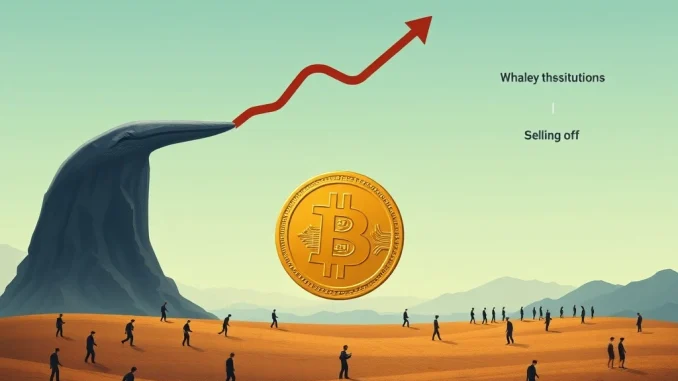
Are you wondering why Bitcoin price seems stuck in a tight range despite all the buzz? For the past couple of weeks, the world’s leading cryptocurrency has been navigating a tricky channel between $115,000 and $120,000, leaving many investors scratching their heads. While the immediate momentum might feel flat, a deeper dive into on-chain data reveals a fascinating story: a stark divergence between the big players and everyday traders. It’s a classic tale of accumulation by the strong and capitulation by the weak, hinting at a significant shift in market dynamics.
Understanding the Current Bitcoin Price Range
The current Bitcoin price action has been a topic of intense discussion, with its sideways movement causing both frustration and anticipation among market participants. The $118,000 mark has emerged as a psychological barrier, a level that the asset struggles to break decisively. This consolidation phase, while seemingly dull, is crucial for market health, allowing for price discovery and the absorption of supply. What’s driving this equilibrium?
- Reduced Spot ETF Inflows: After a period of aggressive buying, the flow into Bitcoin spot ETFs has flattened, removing a major immediate tailwind that previously propelled prices upward.
- Macroeconomic Uncertainty: Broader economic concerns, including inflation fears and interest rate speculation, continue to cast a shadow over risk assets like cryptocurrencies.
- Regulatory Scrutiny: Ongoing discussions and evolving frameworks around cryptocurrency regulation add a layer of caution for institutional investors, influencing their pace of investment.
This tight range suggests a battle between buyers and sellers, where neither side has managed to gain a definitive upper hand. However, the underlying activity tells a different story about who’s preparing for the next big move.
The Whale Accumulation Phenomenon: Who’s Buying Big?
While many short-term traders might feel the pinch of stagnation, on-chain data points to a significant trend: whale accumulation. These large market participants, often referred to as ‘whales’ due to their substantial holdings, are not just holding; they’re actively adding to their Bitcoin stashes. This behavior is a strong indicator of institutional confidence in Bitcoin’s long-term potential.
- Consistent Buying: Reports from CryptoQuant Insights highlight that large wallets have been consistently accumulating Bitcoin since May. One notable instance includes a $2.7 billion inflow into Binance, reportedly from a Satoshi-era miner, underscoring the scale of this activity.
- High Accumulation Trend Scores: AMBCrypto’s Accumulation Trend Score, which uses a color-coded metric to indicate buying activity, has consistently shown ‘cooler hues’ (scores of 0.95 or higher) since mid-July. This signifies aggressive buying by large entities, suggesting conviction in future price appreciation.
- Strategic Positioning: Whales typically operate with a longer investment horizon and often possess deeper insights into market trends. Their accumulation signals a belief that Bitcoin’s fundamental value and future trajectory remain strong, driven by factors like increasing corporate acquisitions and broader adoption trends.
What’s Happening with Bitcoin ETF Inflows?
The introduction of Bitcoin ETF products has been a game-changer, opening the floodgates for institutional capital and significantly legitimizing Bitcoin as an asset class. Initially, these inflows were a primary catalyst for Bitcoin’s upward momentum, driving significant price rallies.
- Initial Euphoria: The early months following spot Bitcoin ETF approval saw unprecedented demand, pushing Bitcoin to new all-time highs as traditional investors gained easier access.
- Normalization Phase: We are now observing a normalization in the pace of these inflows. The initial rush has subsided, and while institutions continue to invest, the daily net inflows are more measured. This doesn’t mean institutions have stopped buying, but rather that the market has adjusted to this new demand channel.
- Long-Term Impact: Despite the temporary slowdown in the *rate* of inflows, the mere existence of spot ETFs continues to provide a robust infrastructure for future institutional adoption. This sustained interest from traditional finance remains crucial for long-term demand, even if the immediate impact on price is less dramatic than during the initial launch phase.
Retail Investors: Why Are They Selling Off?
In stark contrast to the institutional buying, retail selling has been a noticeable trend among short-term holders (STHs) since early 2023. These individual investors are showing signs of capitulation, offloading their holdings. Why this divergence from the smart money?
- Profit-Taking: Some retail investors might be taking profits after Bitcoin’s significant run-up earlier in the year, especially if they bought in at much lower prices during previous cycles.
- Fear and Impatience: The current sideways price action, coupled with ongoing macroeconomic uncertainties and regulatory ambiguity, can lead to impatience and fear among less experienced traders. They might be selling to avoid potential dips or to reallocate funds to perceived safer assets.
- Liquidation Pressures: Smaller traders, particularly those engaged in leveraged trading, might face forced liquidations during periods of prolonged consolidation or unexpected volatility, contributing to sell pressure in the market.
This dynamic highlights a classic market pattern: institutional investors with a long-term view often ‘buy the dip’ or accumulate during consolidation, while retail investors, driven by short-term sentiment, may sell prematurely.
Navigating the Crypto Market’s Equilibrium
The current equilibrium in the crypto market is a fascinating study in divergent investor behavior. While institutional players are quietly building their positions, retail sentiment appears muted. Google Trends data, for instance, shows a lack of mass public interest, indicating that Bitcoin hasn’t yet entered the ‘euphoria’ phase typically seen at the peak of a bull market.
- Key Support Levels: The $115,000 threshold has proven to be a robust support level, repeatedly holding firm and preventing a broader market sell-off. This resilience indicates strong underlying demand at this price point.
- Key Resistance Levels: The $120,000 mark acts as a significant resistance. A sustained break above this level could signal renewed bullish momentum, especially if Bitcoin ETF inflows resume their aggressive pace.
- Trader Sentiment & Caution: While some analysts project aggressive price targets, such as $150,000, these forecasts remain highly conditional on macroeconomic clarity and regulatory developments. Crypto trader Trader Mayne has also highlighted the growing institutional frenzy around Bitcoin treasuries, drawing parallels to speculative manias in traditional markets. He cautions that while this fervor is bullish, it could also precede a correction if overextended investors face profit-taking or forced liquidations. This underscores the need for careful monitoring of market dynamics.
The current state of Bitcoin price is a compelling narrative of two distinct market forces at play. While the price action might appear stagnant, beneath the surface, a significant whale accumulation is underway, contrasting sharply with retail selling. This divergence, fueled by the evolving landscape of Bitcoin ETFs and broader crypto market dynamics, suggests that the smart money is positioning for future growth. As institutional buying continues and retail selling potentially exhausts itself, the stage could be set for a powerful breakout. Investors are advised to keep a close eye on institutional movements and key support/resistance levels, as these will likely dictate Bitcoin’s next major move. The long-term outlook remains robust, but the short-term path requires careful navigation and understanding of these underlying trends.
Frequently Asked Questions (FAQs)
What does it mean for Bitcoin to be ‘trapped in a range’?
When Bitcoin is ‘trapped in a range,’ it means its price is consolidating within defined upper and lower boundaries (e.g., $115,000-$120,000) for an extended period. This indicates a balance between buying and selling pressure, where neither bulls nor bears can decisively push the price outside these levels.
Why are whales accumulating Bitcoin while retail investors sell?
Whales (large institutional investors or high-net-worth individuals) typically have a longer-term investment horizon and more sophisticated market analysis. They often see consolidation phases or dips as opportunities to accumulate assets at favorable prices, believing in Bitcoin’s long-term growth. Retail investors, on the other hand, are often more sensitive to short-term price fluctuations, fear of missing out (FOMO), or fear, uncertainty, and doubt (FUD), leading them to sell during periods of stagnation or minor corrections.
How do Bitcoin ETF inflows affect its price?
Bitcoin ETF inflows represent institutional capital entering the market. When these inflows are high, they create significant buying pressure, often leading to price increases. Conversely, a flattening or decrease in these inflows can reduce immediate buying pressure, contributing to price consolidation or even declines, as a major tailwind is removed.
What are the key price levels to watch for Bitcoin in this scenario?
Based on the current market dynamics, the key support level to watch is $115,000. A sustained break below this could signal further bearish pressure. The key resistance level is $120,000; a decisive break above this, especially accompanied by renewed ETF inflows, could reignite bullish momentum.
Is now a good time to buy Bitcoin given the current market?
Whether now is a ‘good time’ to buy Bitcoin depends on an individual’s investment strategy, risk tolerance, and time horizon. The current phase of whale accumulation suggests that large players see value at these levels for long-term positioning. However, short-term volatility and macroeconomic uncertainties persist. It’s crucial to conduct your own research and consider consulting a financial advisor.