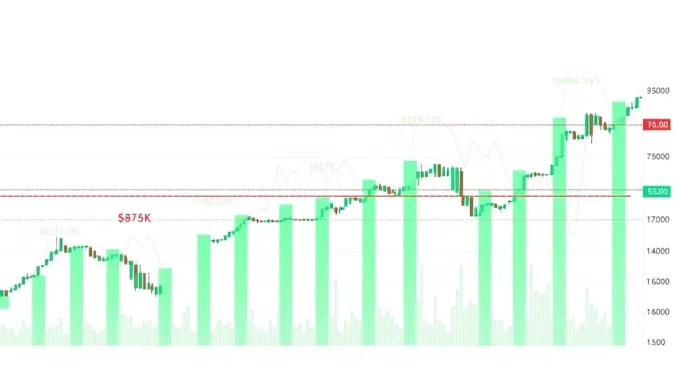
The cryptocurrency world is buzzing, and for good reason. Recent Bitcoin price movements have captivated investors, showing remarkable resilience around the $117,000 mark. What’s driving this stability, and what does it mean for the future of the leading digital asset? Let’s dive into the latest insights shaping Bitcoin’s trajectory.
Why is Bitcoin Price Holding Strong at $117K?
Bitcoin’s recent market behavior highlights the emergence of a critical support zone around $117,000. On-chain data and technical analysis reveal structural shifts in market dynamics, suggesting a transition toward buyer dominance at elevated price levels. The $117K–$118K range is solidifying as a focal point for stabilization.
- Significant Transactions: Over 1.48 million BTC changed hands in mid-July, reflecting concentrated accumulation near $117,000.
- Increased Buying Pressure: There’s been notable buying pressure between $105,000 and $120,000.
- Subdued Selling: Selling activity remained low below $100,000, reinforcing the strength of higher price levels.
This strong Bitcoin price consolidation near $117,000 indicates a significant shift, where buyers are stepping in decisively, preventing deeper corrections and reinforcing the current levels as a base.
Unpacking On-Chain Accumulation: A Deeper Dive
A key factor reinforcing Bitcoin’s current strength is the pronounced on-chain accumulation within the $100,000–$115,000 corridor. The supply change chart, marked by green bars above the zero line, clearly shows this trend. As prices approached $115,000, the percentage of Bitcoin accumulated neared 100%, signaling that holders in this zone are retaining assets rather than offloading them.
This holding behavior has reinforced buying pressure, contributing to price consolidation at higher levels. Conversely, distribution—marked by red bars below the zero line—remained concentrated between $85,000 and $95,000, where selling pressure historically peaked. However, recent data shows this distribution has diminished, suggesting the market has absorbed much of the available supply.
On-chain metrics also provide a nuanced view. The NVT (Network Value to Transaction) Golden Cross has surged to 1.98, nearing its historical “overheated” threshold of 2.2, which typically signals overvaluation. Yet, Bitcoin’s price has risen alongside a divergence in NVT, suggesting real on-chain activity rather than just speculative frenzy. Shifts in holder behavior, with long-term holders net distributing and short-term holders net accumulating, mirror late-stage bull market patterns, raising questions about sustainability.
What Does BTC Consolidation Tell Us About Future Moves?
Technical patterns further validate the significance of the $117K support. Bitcoin has traded within a symmetrical triangle pattern, with consolidation between $115,724 and $122,077 reinforcing the zone as a potential catalyst for a breakout. Institutional analysts note that $117,000 has transitioned from a psychological benchmark to a structurally critical level, supported by a multi-year bullish megaphone breakout.
This period of BTC consolidation is creating distinct technical patterns that could dictate the next major move:
- Breakout Potential: A sustained move above $122,077 could drive prices toward $140,000.
- Correction Risk: A breakdown below $117K risks a deeper correction to $100,000 or the Q1 2025 accumulation zone at $93,000.
On the 4-hour chart, volume has shifted toward the triangle’s boundaries, with traders anticipating a directional move. The daily chart also reveals an inverse head and shoulders pattern, where a successful retest of $117K—confirmed by a close above $118K—projects a target of $125,500.
Analyzing Broader Crypto Market Trends: Institutional and Macro Factors
Beyond the charts, broader crypto market trends are influencing Bitcoin’s trajectory. Cumulative net inflows into major Bitcoin ETFs reached $54.47 billion in July, driven by strong institutional demand. This influx of capital from traditional finance players signals growing mainstream acceptance and confidence in Bitcoin as an asset class.
However, macroeconomic uncertainties, such as potential delays in Federal Reserve policy decisions regarding interest rates, remain a risk to risk assets like Bitcoin. These broader economic factors can introduce volatility and influence investor sentiment.
Coinglass liquidation heatmaps highlight the volatility of leveraged positions, with $28.6 million in long liquidations and $25.2 million in short liquidations recorded within a single 24-hour period in early July. This underscores rapid sentiment shifts and the need for vigilance.
Actionable Insights for Traders
As Bitcoin navigates this pivotal juncture, traders must remain vigilant. Understanding these market dynamics is key to making informed decisions:
- Monitor Key Levels: Keep a close eye on the $117,000 support and the $122,077 resistance levels.
- Risk Management: Implement tight stop-loss orders to mitigate exposure to sudden volatility.
- Hedging Strategies: Consider hedging with options to protect positions against unexpected price swings.
- Stay Informed: Follow macroeconomic developments and institutional flow data, as these significantly impact the market.
The Road Ahead for Bitcoin
The evolving interplay between technical patterns, institutional activity, and macroeconomic factors will shape Bitcoin’s trajectory in the coming weeks and months. The $117K–$118K support zone remains a key determinant of whether the asset sustains its current momentum or faces a deeper correction. As the market digests these dynamics, Bitcoin stands at a critical crossroads, poised for its next significant move.
Frequently Asked Questions (FAQs)
1. What does Bitcoin’s $117K support level signify?
The $117K support level indicates a strong price floor where buying interest is significant enough to prevent further declines. It has transitioned from a psychological level to a structurally critical one, reinforced by on-chain accumulation and technical patterns.
2. How does on-chain accumulation impact Bitcoin’s price?
On-chain accumulation, especially when reaching high percentages (like 100% near $115K), suggests that holders are retaining their assets rather than selling. This reduces the available supply on exchanges, contributing to increased buying pressure and price consolidation at higher levels.
3. What technical patterns are influencing Bitcoin’s current price?
Bitcoin is currently trading within a symmetrical triangle pattern, indicating consolidation. An inverse head and shoulders pattern on the daily chart also suggests a potential bullish target if $117K is successfully retested and closed above $118K.
4. How do institutional inflows affect Bitcoin’s market?
Significant cumulative net inflows into Bitcoin ETFs, totaling billions, indicate strong institutional demand. This brings substantial capital into the market, often providing a stable buying base and signaling growing mainstream adoption, which can positively influence the Bitcoin price.
5. What are the main risks for Bitcoin at this juncture?
Key risks include a breakdown below the $117K support, which could lead to a deeper correction towards $100K or even $93K. Macroeconomic uncertainties, such as Federal Reserve policy delays, also pose a risk to risk assets like Bitcoin, potentially increasing volatility.