Get ready for a monumental shift in the Ethereum ecosystem! As the digital world increasingly relies on decentralized applications, the underlying blockchain infrastructure must evolve to meet soaring demand. The upcoming Ethereum Fusaka Fork, slated for early November 2025, isn’t just another update; it’s a strategic leap designed to dramatically enhance the network’s core capabilities, focusing on vital aspects like transaction throughput and resilience against malicious activity. While it might not introduce flashy new user features, its backend optimizations are set to pave the way for a more robust and efficient future for the world’s leading smart contract platform.
What is the Ethereum Fusaka Fork and Why Does it Matter?
The Ethereum Fusaka Fork is a significant hard fork, a fundamental change to the Ethereum protocol that requires all participants (nodes) to upgrade their software. Unlike recent user-centric updates such as the Pectra fork in May 2025, which brought features like account abstraction, Fusaka is all about strengthening the network’s foundational layers. It bundles 11 Ethereum Improvement Proposals (EIPs) aimed at refining core parameters and bolstering overall network resilience. Think of it as upgrading the engine and chassis of a high-performance vehicle, ensuring it can handle more power and remain stable under pressure.
This strategic move is critical for several reasons:
- Enhanced Throughput: By increasing the block gas limit, more transactions can be processed within each block, directly impacting network capacity.
- Improved Security: Specific EIPs are dedicated to fortifying nodes against spam and other denial-of-service attacks, making the network more robust.
- Reduced Fees (Potentially): Greater capacity can lead to lower transaction fees during periods of high demand, making the network more accessible and cost-effective for users and developers.
- Long-term Stability: These backend adjustments are crucial for maintaining Ethereum’s competitive edge and supporting its continued growth as a global decentralized computing platform.
Boosting Ethereum Scalability: The 150 Million Gas Limit
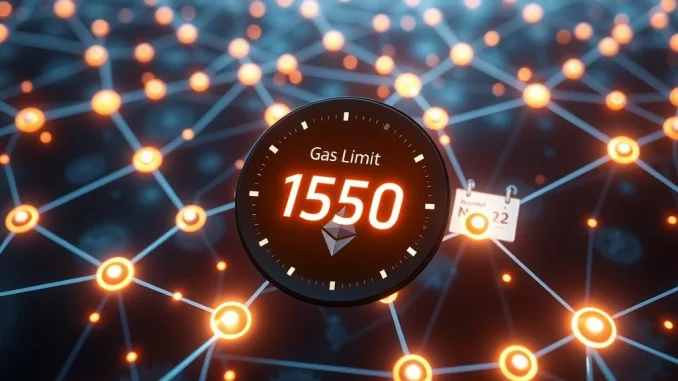
One of the most impactful changes arriving with Fusaka is the increase in the block gas limit to 150 million units. To understand the significance of this, let’s break down what ‘gas’ means on Ethereum. Gas is the unit that measures the computational effort required to execute operations on the Ethereum network. Every transaction, every smart contract execution, consumes gas. The block gas limit dictates the maximum total gas that can be consumed by all transactions within a single block. Previously, this limit hovered around 30 million units.
Raising this limit to 150 million is a monumental step for Ethereum scalability. In practical terms, it means:
- More Transactions Per Block: A higher limit allows for significantly more operations to be included in each block, increasing the network’s overall transaction processing capacity.
- Reduced Congestion: During peak demand, a higher capacity can alleviate network congestion, leading to faster transaction confirmations.
- Potential for Lower Fees: When the network is less congested, the competition for block space decreases, which can translate into lower gas prices (transaction fees) for users.
However, this boost to capacity isn’t without its considerations. A higher gas limit can lead to larger blocks, which might result in slightly slower block propagation times across the network and increased storage demands for nodes. Ethereum developers have carefully weighed these trade-offs, concluding that the benefits to scalability and user experience outweigh these manageable challenges within the current infrastructure.
Fortifying Blockchain Security: Defending Against Spam Attacks
Beyond increasing transaction capacity, the Fusaka fork also brings critical enhancements to blockchain security. A key component of this is the implementation of EIP-7825, designed to fortify Ethereum nodes against various forms of spam attacks. In a decentralized network, nodes are the backbone, validating transactions and maintaining the blockchain’s integrity. Malicious actors sometimes attempt to overwhelm nodes with junk data or resource-intensive requests, aiming to disrupt network stability or increase operational costs for node operators.
EIP-7825 introduces mechanisms to make it harder and more expensive for attackers to flood the network with spam. This includes better resource management for nodes, improved data handling, and potentially more robust filtering capabilities. By making nodes more resilient, the Fusaka fork directly contributes to:
- Network Stability: Ensuring that nodes can efficiently process legitimate transactions without being bogged down by malicious activity.
- Operational Efficiency: Reducing the overhead for node operators, which in turn helps maintain the decentralization of the network as running a node remains accessible.
- User Confidence: A more secure and stable network builds greater trust among users and developers, encouraging further adoption of Ethereum-based applications.
These security enhancements are vital for Ethereum’s long-term health, protecting its foundational infrastructure from potential vulnerabilities and ensuring it remains a reliable platform for decentralized finance (DeFi), gaming, NFTs, and countless other applications.
The Strategic Timing of the ETH Upgrade
The timeline for this pivotal ETH upgrade has been meticulously planned to ensure a smooth deployment. Testing for Fusaka commenced with a devnet launch in July 2025, followed by public testnets in September and October 2025. The final bundle of EIPs was confirmed on August 1, 2025, providing client teams ample time (two months) to integrate the updates before the mainnet activation. This structured approach, culminating in a pre-announced block height activation, ensures synchronized node upgrades across the globe.
A notable decision during the planning phase was the exclusion of EIP-7907, which proposed to double the contract code size limit. Developers opted to defer this change to a future fork, a calculated move to avoid potential delays in the testing timeline and ensure the timely deployment of Fusaka. Community stakeholders, including Ethereum protocol lead Nixo, emphasized the importance of adhering to the schedule, particularly to align the upgrade with the Devconnect developer conference in Buenos Aires (November 17–22, 2025). This alignment helps maintain momentum in the development cycle and provides a timely platform for developers to discuss and build upon the newly enhanced network.
This accelerated six-month upgrade cadence, a pattern established after the Pectra fork, demonstrates Ethereum’s commitment to iterative and consistent improvement. It allows the network to adapt quickly to emerging needs and challenges while minimizing disruption.
Navigating the Competitive Landscape: Ethereum’s Future
While the Fusaka fork may not introduce flashy new features for end-users, its impact on Ethereum’s competitive standing is profound. By significantly expanding transaction capacity and reinforcing core security measures, this upgrade directly supports Ethereum’s ability to attract and retain cutting-edge decentralized applications. In a rapidly evolving blockchain landscape, maintaining low fees, high speed, and robust security is paramount for Ethereum to hold its position against faster Layer 2 (L2) scaling solutions and alternative Layer 1 (L1) blockchains like Solana or Avalanche.
The focus on technical stability over disruptive features underscores Ethereum’s mature and iterative development strategy. This approach prioritizes long-term health and reliability, ensuring that the network can continue to be the backbone for the vast majority of decentralized finance (DeFi) applications, burgeoning gaming platforms, and the ever-expanding NFT ecosystem. The ability to handle increased demand efficiently and securely is not just a technical improvement; it’s a strategic imperative that ensures Ethereum remains the platform of choice for innovation in the decentralized world.
A Milestone in Ethereum’s Evolution
As the November 2025 activation date for the Fusaka fork draws nearer, the Ethereum community remains steadfast in its focus on minimizing risks and ensuring a seamless transition. The emphasis on timely deployment, rigorous testing, and a cautious balance between progress and protocol stability highlights the project’s unwavering commitment to refining its core infrastructure. The Fusaka fork is more than just a technical update; it marks another crucial milestone in Ethereum’s ongoing evolution, ensuring the network remains adaptable, secure, and scalable enough to meet the escalating demands of a decentralized future. It solidifies Ethereum’s foundation, paving the way for further innovation and broader adoption.
Frequently Asked Questions (FAQs)
Q1: What is the primary goal of the Ethereum Fusaka Fork?
The primary goal of the Ethereum Fusaka Fork is to enhance the network’s core scalability and security. It focuses on backend optimizations like increasing the block gas limit and implementing stronger spam defense mechanisms, rather than introducing new user-facing features.
Q2: How does the 150 million gas limit impact Ethereum users?
The 150 million Ethereum gas limit allows for significantly more transactions to be processed per block. This can lead to reduced network congestion, faster transaction confirmation times, and potentially lower transaction fees, especially during periods of high network demand.
Q3: Why was EIP-7907 (doubling contract code size) deferred to a future fork?
EIP-7907 was deferred to avoid potential delays in the Fusaka fork’s testing timeline. Developers prioritized the timely deployment of the current bundle of EIPs to align with the Devconnect conference and maintain development momentum, choosing to address the contract code size limit in a subsequent upgrade.
Q4: How does Fusaka improve blockchain security?
Fusaka improves blockchain security primarily through EIP-7825, which strengthens Ethereum nodes against spam attacks. This makes the network more resilient to malicious attempts to disrupt stability or overwhelm node resources, ensuring more reliable operation for all participants.
Q5: When is the Ethereum Fusaka Fork expected to be activated?
The Ethereum Fusaka Fork is scheduled for activation in early November 2025. Testing began in July 2025 with devnets, followed by public testnets in September and October 2025, leading up to the mainnet activation at a pre-announced block height.