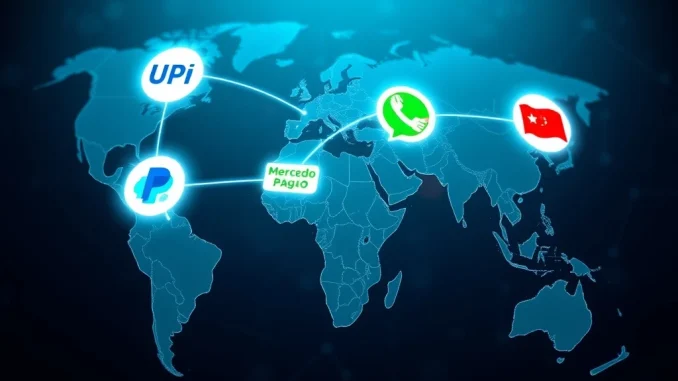
Get ready for a seismic shift in how money moves across borders! PayPal, a name synonymous with online payments, is set to launch ‘PayPal World,’ a groundbreaking platform designed to seamlessly integrate major domestic digital wallets like India’s UPI, Brazil’s Mercado Pago, and China’s WeChat Pay into its vast global merchant network. This bold move isn’t just about convenience; it’s a strategic play that could redefine global commerce for an estimated two billion users, fundamentally altering the landscape of cross-border payments.
PayPal World: A Game Changer for Cross-Border Payments?
Imagine being able to shop from an international vendor using your preferred local payment app, without the hassle of currency conversions or new accounts. That’s the promise of PayPal World. Slated for a fall rollout, this innovative service aims to bridge the gap between local digital ecosystems and PayPal’s extensive global reach. Users will be able to transact with any PayPal or Venmo merchant using their existing UPI, Mercado Pago, or WeChat Pay accounts, bypassing traditional credit cards and banking hurdles.
While operating on traditional fiat infrastructure, PayPal World mirrors key functionalities often associated with stablecoins, such as rapid settlement and efficient currency conversion. This dual approach highlights PayPal’s strategy: leveraging the familiarity and regulatory clarity of fiat while adopting the speed and efficiency seen in the digital asset space. This isn’t just an upgrade; it’s a strategic pivot to capture a larger share of the burgeoning global digital economy.
Unpacking the Integration: UPI, Mercado Pago, and WeChat Pay
The choice of these specific digital wallets for integration is no accident. They represent some of the largest and most dynamic payment ecosystems globally:
- India’s UPI (Unified Payments Interface): A real-time payment system that has revolutionized digital transactions in India, boasting billions of monthly transactions. Its inclusion opens up the vast Indian consumer market to PayPal merchants.
- Brazil’s Mercado Pago: The fintech arm of MercadoLibre, Latin America’s e-commerce giant, Mercado Pago is a dominant force in digital payments across the region, offering a robust ecosystem of services.
- China’s WeChat Pay: An integral part of Tencent’s WeChat super-app, WeChat Pay is ubiquitous in China, facilitating everything from online purchases to in-store payments. Its integration offers unprecedented access to Chinese consumers for PayPal merchants.
By bringing these powerhouses into its fold, PayPal World is not just simplifying transactions; it’s creating a more inclusive global commerce environment, making it easier for businesses to reach new customers and for consumers to access international goods and services.
PayPal’s Dual Strategy: Fiat vs. Stablecoins (PYUSD)
Interestingly, this new fiat platform arrives amidst PayPal’s continued push into the stablecoin arena. The company’s own stablecoin, PYUSD, is an integral part of its broader product vision. The recent expansion of PYUSD to the Solana blockchain and the SEC’s decision in April to drop its 15-month investigation into PYUSD have cleared significant regulatory hurdles, allowing PayPal to scale its stablecoin across multiple blockchains. This demonstrates PayPal’s commitment to both traditional and innovative digital payment systems.
This dual strategy is critical. While PayPal World addresses immediate cross-border payment complexities using existing fiat rails, PYUSD positions PayPal for the future of digital assets. The company’s collaboration with Fiserv Inc. and Circle Internet Financial Ltd. to develop a regulated stablecoin, as highlighted by Bloomberg, further underscores its ambitions in this space. This initiative aims to create a U.S. dollar-backed digital currency, leveraging PayPal’s infrastructure and Circle’s expertise with USD Coin (USDC). This strategic move also follows PayPal’s involvement in the Trump-backed USD1 stablecoin, which has faced scrutiny over transparency.
Industry Reactions: Is PayPal World a ‘Stablecoin Killer’?
The announcement of PayPal World has sparked considerable debate among industry analysts regarding its potential impact on the nascent stablecoin market. Is this new fiat platform a direct competitor, or does it serve a different purpose?
- A Bridge, Not a Disruptor: Gitay Shafran, founder of FUSD issuer The Fedz, views PayPal World as primarily a ‘bridge between legacy fiat systems.’ He argues that it lacks the open, permissionless infrastructure inherent to crypto innovation, suggesting it won’t directly disrupt the core value proposition of decentralized stablecoins.
- Traditional Reliance: Andrei Grachev of Falcon Finance points out that while the platform elevates fiat payments, it remains reliant on traditional banking channels and foreign-exchange mechanisms. This reliance could limit its ability to truly compete with stablecoins, especially in micro-payments or regions with underdeveloped banking infrastructure.
Despite these perspectives, CEO Alex Chriss remains optimistic, emphasizing the platform’s role in addressing the complexities of cross-border payments and positioning it as a foundational bridge for ‘the future of commerce,’ including AI-driven shopping and agent-based wallet transactions. Analysts like Dr. Jamal Oudeen stress that PayPal World’s focus on compliance and security could attract institutional users wary of regulatory ambiguities, a distinct advantage over some decentralized alternatives.
The Road Ahead: Challenges and Opportunities for Global Digital Wallets
PayPal’s venture into integrating these massive global digital wallets signifies a broader trend where traditional financial firms are increasingly entering the digital asset space, directly challenging decentralized projects like Tether and USDC. For PayPal, navigating these complex dynamics while maintaining its reputation for security and compliance will be paramount. The success of PayPal World will depend on its ability to truly streamline user experience, manage regulatory complexities across multiple jurisdictions, and demonstrate clear advantages over existing payment methods.
This bold move by PayPal could indeed reshape the digital payments landscape, making international transactions more accessible and efficient for billions. Whether it’s a ‘stablecoin killer’ or a complementary solution, it undeniably marks a significant evolution in how we envision global commerce.
Frequently Asked Questions (FAQs)
What is PayPal World?
PayPal World is a new platform launched by PayPal that integrates major domestic digital wallets like India’s UPI, Brazil’s Mercado Pago, and China’s WeChat Pay into its global merchant network, allowing users to make cross-border payments without opening new accounts or using traditional cards.
How does PayPal World benefit users?
Users benefit from streamlined international commerce, the ability to use their preferred local digital wallets for global transactions, and avoiding the need for new accounts or traditional credit cards, simplifying cross-border payments for an estimated two billion users.
Does PayPal World use stablecoins or fiat currency?
PayPal World primarily relies on traditional fiat infrastructure, though it mirrors some stablecoin functions like rapid settlement and currency conversion. PayPal also has its own stablecoin, PYUSD, which it continues to integrate into its broader offerings, indicating a dual strategy.
How does PayPal World compare to existing stablecoins?
While PayPal World offers similar benefits like rapid settlement, it operates on traditional banking channels and foreign-exchange mechanisms. Industry analysts debate its impact, with some seeing it as a bridge for legacy fiat systems rather than a direct competitor to decentralized, permissionless stablecoins like Tether or USDC.
What are the key partnerships involved in PayPal’s stablecoin efforts?
PayPal is actively involved in stablecoin development, including its own PYUSD. It has also partnered with Fiserv Inc. and Circle Internet Financial Ltd. to develop a regulated stablecoin, leveraging PayPal’s infrastructure and Circle’s expertise with USD Coin (USDC).
When is PayPal World expected to roll out?
The service is slated for a fall rollout, according to the announcement.