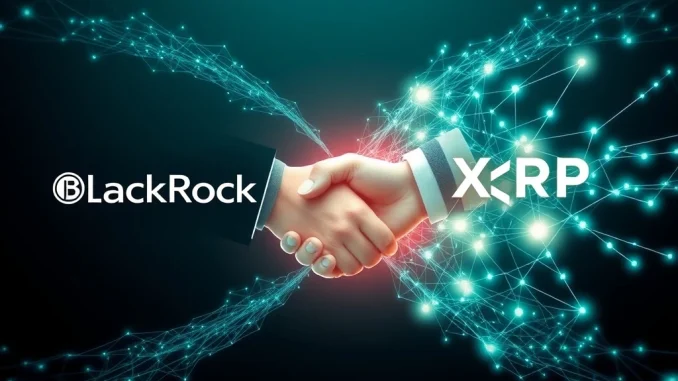
The cryptocurrency world is constantly abuzz with speculation, and few topics have generated as much chatter recently as the alleged convergence of two titans: BlackRock, the world’s largest asset manager, and Ripple, a leading force in blockchain and enterprise solutions. For anyone following XRP news today, the viral posts suggesting a secret alignment between these firms have been hard to ignore. But let’s set the record straight: while a formal merger is not on the table, a fascinating and strategic collaboration around tokenization is indeed reshaping the landscape of global finance. This article dives deep into the verifiable facts, separates rumor from reality, and explores how this powerful synergy is paving the way for the next era of digital assets.
Unpacking the XRP and BlackRock Buzz: Fact vs. Fiction
Recent online discussions, particularly fueled by crypto researcher Chain Mind, ignited a wildfire of speculation about BlackRock and Ripple operating as a single entity. The core of this theory posits that Ripple, with its robust blockchain infrastructure, is strategically positioned to serve BlackRock’s burgeoning interest in digital assets. While the idea of such a monumental union is captivating, it’s crucial to understand that no definitive evidence supports a full merger or a hidden operational alignment. Instead, what we’re witnessing is a series of strategic collaborations and overlapping objectives, primarily centered on the revolutionary potential of tokenization.
The narrative isn’t about a secret takeover; it’s about two distinct entities leveraging their unique strengths to innovate within the rapidly evolving digital finance space. Ripple focuses on providing the underlying blockchain framework, enabling efficient and scalable digital transactions. BlackRock, on the other hand, brings unparalleled liquidity, capital, and a deep understanding of traditional financial markets. Their combined efforts, particularly in the realm of tokenized assets, are far more significant than any unproven merger claims.
The Power of Tokenization: A Core Collaboration
One of the most compelling examples of this strategic alliance is the OUSG initiative. In June 2025, Ondo Finance launched tokenized U.S. Treasuries (OUSG) on Ripple’s XRP Ledger. This wasn’t a random choice; these tokens are partially backed by BlackRock’s money market funds and rely on Ripple’s RLUSD stablecoin for minting and redemption. This partnership beautifully illustrates a clear division of labor:
- Ripple’s Role: Provides the high-performance blockchain framework (XRP Ledger) and the stablecoin (RLUSD) for on-chain transactions and settlement.
- BlackRock’s Role: Offers the underlying liquidity and capital through its widely recognized money market funds, bringing traditional financial stability to the digital realm.
- Ondo Finance’s Role: Acts as the bridge, tokenizing real-world assets (U.S. Treasuries) and making them accessible on-chain.
Both BlackRock and Ripple have confirmed this collaboration, underscoring its significance as a pivotal step toward integrating traditional finance with on-chain systems. This isn’t just about moving money; it’s about creating new financial instruments that are more efficient, transparent, and accessible through the power of tokenization.
Ripple’s Regulatory Clarity and Institutional Adoption
Another element fueling the speculation around Ripple and BlackRock is Ripple’s partial victory in its 2023 SEC lawsuit. The court’s ruling that XRP is not a security in secondary market transactions was a landmark decision for the crypto industry. Chain Mind, among others, interprets this as a strategic milestone that positions Ripple as a regulated, compliant infrastructure provider, ideal for handling institutional capital.
While this interpretation highlights Ripple’s strengthened position, critics argue that it stretches the available evidence. They point out that the SEC’s case was filed under a different chair and its implications might not be as broad as some suggest, especially concerning a direct Ripple-BlackRock alliance. Nevertheless, the increased regulatory clarity for XRP undoubtedly makes the XRP Ledger a more attractive platform for institutional players looking to engage with digital assets in a compliant manner. This clarity reduces legal uncertainty, a major barrier for traditional finance firms venturing into blockchain.
Beyond the Headlines: Shared Connections and Distinct Strategies
The interconnectedness of Wall Street often leads to interesting overlaps. Personnel ties, such as Nathan Allman, co-founder of Ondo Finance, and SEC Chair Gary Gensler both having backgrounds at Goldman Sachs, have drawn attention. This has led to theories of a potential ‘closed ecosystem’ involving Ripple’s partners, regulators, and financiers. While these connections are verifiable, direct coordination or proof of a unified agenda remains unproven. It’s more likely a reflection of the interconnected nature of top-tier finance and regulatory bodies.
It’s crucial to distinguish between shared backgrounds and shared operational strategies. Both firms operate with distinct objectives:
| Company | Primary Focus | Key Initiatives |
|---|---|---|
| Ripple | Blockchain infrastructure, cross-border payments, enterprise solutions, digital identity. | XRP Ledger, RippleNet, RLUSD stablecoin, CBDC partnerships. |
| BlackRock | Asset management, ETFs, traditional finance investments, institutional capital. | BUIDL fund (tokenized assets), exploring blockchain for efficiency. |
BlackRock’s BUIDL fund, which now manages over $2.6 billion, emphasizes digital asset tokenization but operates independently from Ripple’s core blockchain infrastructure development. Their strategies are complementary, not merged. BlackRock seeks to leverage blockchain for its existing asset management business, while Ripple aims to be the foundational layer for a new digital economy.
The XDNA Enigma: Coincidence or Coordinated Innovation?
Perhaps the most enigmatic element fueling the conspiracy theories is the July 4, 2025, launch of XDNA, a token on the XRP Ledger. This date notably coincides with BlackRock’s XDNA ETF, which is focused on the genomics sector. The on-chain XDNA token aims to support sovereign DNA identity and encrypted medical records, aligning with Ripple’s broader digital identity ambitions.
The precise timing of these seemingly unrelated launches has sparked suspicion, leading some to believe in a deeper, coordinated effort. However, a direct causal link remains unverified. While Ripple’s decentralized identity framework on the XRP Ledger and BlackRock’s ambitious push to tokenize $100 trillion in assets suggest complementary roadmaps, whether this is a meticulously planned convergence or merely a striking coincidence is still unclear. It highlights the growing trend of blockchain technology extending beyond finance into various sectors, including personal data and identity management.
Navigating the Future of Digital Finance with XRP
Analysts consistently emphasize that while the synergy between Ripple and BlackRock is undeniably notable, there is no concrete evidence of a formal merger or a secret, unified operation. The viral post by Chain Mind, despite its widespread influence, lacks verifiable proof of a single, unified entity. Both companies continue to pursue their distinct objectives within the blockchain space: Ripple is advancing its tokenization infrastructure and enterprise solutions, while BlackRock is leveraging its immense capital and market presence to back on-chain assets and explore the efficiencies blockchain offers.
The broader implications of these developments highlight the rapidly evolving landscape of tokenized assets and digital assets. As traditional financial institutions increasingly adopt blockchain for streamlined settlement, enhanced liquidity, and new financial products, firms like Ripple and BlackRock are at the forefront, leveraging their unique expertise to shape the industry. For instance, major players like J.P. Morgan and Siemens have already issued tokenized bonds on public blockchains, signaling a clear shift towards decentralized infrastructure. These initiatives, while separate from the alleged Ripple-BlackRock collaboration, underscore the widespread institutional embrace of blockchain technology.
The distinction between speculation and actionable progress is critical. While the viral post generated significant attention, it does not substantiate a merger or a secret partnership. Instead, both companies are advancing their own visions for blockchain’s transformative role in finance. BlackRock’s BUIDL fund and Ripple’s extensive tokenization efforts reflect a shared recognition of blockchain’s immense potential, but they pursue divergent implementation strategies. As the industry moves forward, the focus should remain on the tangible contributions of each firm rather than unproven conjectures. The speculation surrounding Ripple and BlackRock ultimately underscores the dynamic yet fragmented nature of blockchain innovation, with key players like these driving both competition and collaboration in shaping the future of digital finance.
Frequently Asked Questions (FAQs)
Q1: Is BlackRock merging with Ripple or acquiring XRP?
A: No, there is no verifiable evidence to support claims of a merger or acquisition between BlackRock and Ripple. Speculation largely stems from a viral post by a crypto researcher, but both companies operate as distinct entities with separate strategies.
Q2: What is the nature of the collaboration between BlackRock and Ripple?
A: Their collaboration is strategic, primarily focused on tokenization and integrating traditional finance with blockchain. A key example is the OUSG initiative, where Ondo Finance launched tokenized U.S. Treasuries on the XRP Ledger, backed in part by BlackRock’s money market funds.
Q3: How does Ripple’s SEC lawsuit outcome affect its relationship with BlackRock?
A: Ripple’s partial victory, which clarified that XRP is not a security in secondary market transactions, enhances its position as a compliant blockchain infrastructure provider. This increased regulatory clarity makes the XRP Ledger more attractive for institutional adoption, aligning with BlackRock’s growing interest in digital assets, but it doesn’t signify a merger.
Q4: What is the significance of the XDNA token launch on the XRP Ledger and BlackRock’s XDNA ETF?
A: The coincidental launch dates of XDNA on the XRP Ledger (for digital identity) and BlackRock’s XDNA ETF (for genomics) have sparked speculation. While intriguing, there is no verified causal link or proof of direct coordination. It highlights the broader trend of blockchain’s application across diverse sectors, including digital identity and data management.
Q5: Are there any direct personnel links between Ripple, BlackRock, and regulators?
A: Yes, some individuals, like Ondo Finance co-founder Nathan Allman and SEC Chair Gary Gensler, have ties to Goldman Sachs. While these connections are verifiable, they do not prove a ‘closed ecosystem’ or direct coordination between Ripple, BlackRock, and regulators. They reflect common career paths in the financial industry.