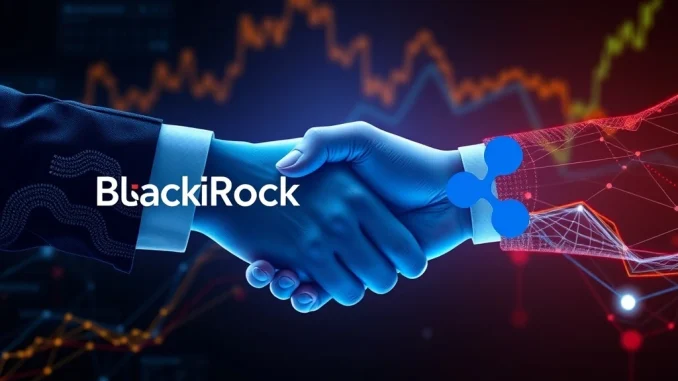
The cryptocurrency world is buzzing with renewed speculation about a profound strategic alignment between two financial giants: BlackRock and Ripple. For anyone tracking the pulse of digital finance, the idea of these titans, one a traditional asset management behemoth and the other a leading blockchain innovator, working in tandem is nothing short of revolutionary. While claims of them being a “single entity” remain unverified, the emerging partnerships and synchronized initiatives paint a compelling picture of a shared vision for the future of finance, deeply rooted in XRP and its underlying technology.
Decoding the BlackRock Ripple Connection: More Than Just Coincidence?
Recent viral discussions, sparked by crypto researcher Chain Mind, have reignited the debate: are BlackRock and Ripple merely converging, or is there a deeper, more calculated strategic alignment at play? The evidence, while circumstantial for a full merger, points strongly towards a powerful synergy. The most concrete example of this growing collaboration is seen through Ondo Finance’s tokenized U.S. Treasuries (OUSG), launched on the XRP Ledger in June 2025. These innovative tokens are notably backed by BlackRock’s robust money market funds, and their minting and redemption processes leverage Ripple’s RLUSD stablecoin. This intricate setup positions Ripple as the essential infrastructure provider, while BlackRock acts as the crucial liquidity backbone, bridging the gap between traditional finance and cutting-edge blockchain technology.
This isn’t just a one-off project. It represents a significant stride towards integrating vast pools of traditional capital with the efficiency and transparency offered by decentralized ledgers. For many, this partnership through OUSG is a clear indicator of a shared roadmap, hinting at a future where conventional assets are seamlessly tokenized and managed on blockchain platforms.
The Rise of Tokenized Assets: A New Era for Investment
The concept of tokenized assets is rapidly transforming how we perceive ownership and investment. Imagine real-world assets—like real estate, art, or even U.S. Treasuries—being represented as digital tokens on a blockchain. This offers unparalleled liquidity, fractional ownership, and transparent, immutable records. BlackRock CEO Larry Fink has been a vocal proponent of this paradigm shift, publicly advocating for the tokenization of a staggering $100 trillion in assets. This bold vision aligns perfectly with Ripple’s ongoing efforts to build robust infrastructure capable of handling such a massive influx of tokenized value.
The OUSG initiative is a prime example of this vision taking shape. By leveraging the XRP Ledger, known for its speed and cost-efficiency, BlackRock is tapping into a blockchain ecosystem that can facilitate institutional-grade transactions. This move isn’t isolated; major financial players like J.P. Morgan and Siemens are also actively exploring tokenized securities on public blockchains, signaling a systemic shift towards decentralized financial systems. BlackRock’s own BUIDL fund, which settles on Ethereum, further underscores their multi-faceted approach to embracing blockchain technology for asset management.
What are the benefits of tokenized assets?
- Increased Liquidity: Assets that were once illiquid, like real estate, can be easily traded.
- Fractional Ownership: Allows smaller investors to own a portion of high-value assets.
- Enhanced Transparency: All transactions are recorded on a public, immutable ledger.
- Reduced Costs: Streamlined processes can cut down on intermediaries and fees.
- Faster Settlements: Blockchain technology enables near-instantaneous transaction finality.
Unpacking Digital Identity Initiatives: Securing Our Digital Future
Beyond asset tokenization, another fascinating area of convergence between Ripple and BlackRock lies in their respective pursuits of digital identity solutions. The simultaneous launch of XDNA—a token on the XRP Ledger focused on sovereign DNA identity—and BlackRock’s XDNA ETF on July 4, 2025, has certainly raised eyebrows. The token’s focus on encrypted medical records and secure personal data aligns seamlessly with Ripple’s broader ambitions in decentralized identity frameworks. While it’s unclear if this was a meticulously planned convergence or a fortunate coincidence, the thematic overlap is striking.
Ripple has been actively developing decentralized identity solutions on the XRP Ledger, aiming to empower individuals with greater control over their personal data and digital footprint. This is a critical component for a future where digital interactions require verifiable, secure identities. BlackRock’s interest, as evidenced by their ETF, suggests an understanding of the immense market potential and societal importance of robust digital identity systems. This shared focus highlights a complementary roadmap, where Ripple provides the foundational technology and BlackRock potentially facilitates investment into the burgeoning digital identity sector.
XRP’s Pivotal Role in the Evolving Financial Landscape
The journey of XRP and Ripple has been significantly shaped by its legal battles, particularly the partial victory against the SEC in 2023. This landmark ruling established that XRP is not a security in secondary market transactions, providing much-needed clarity for institutional adoption. Some analysts, including Chain Mind, suggest this outcome was a calculated step, positioning Ripple as a regulated and appealing platform for institutional capital. While critics rightly point out the limited scope of the ruling, its impact on Ripple’s ability to engage with traditional finance cannot be overstated.
The XRP Ledger’s inherent capabilities—speed, low transaction costs, and scalability—make it an attractive contender for cross-border payments and asset tokenization. Ripple’s long-standing focus on solving real-world payment inefficiencies, coupled with the newfound regulatory clarity for XRP, positions it uniquely to facilitate the integration of traditional finance with blockchain technology. It’s no longer just about payments; XRP is increasingly seen as a versatile digital asset capable of powering a wide array of financial innovations.
Navigating Speculation and Reality: The Challenges of Misinformation
While the synergy between BlackRock and Ripple is undeniable, it’s crucial to distinguish between strategic alignment and unfounded speculation. The viral post by Chain Mind, despite its widespread reach, lacks verified sources for the claim of a “single entity.” This underscores a significant challenge within the crypto space: the rapid spread of misinformation. Experts consistently urge caution, emphasizing the need to verify claims independently before drawing conclusions.
The narrative is further complicated by shared Wall Street ties. Figures like Nathan Allman, co-founder of Ondo Finance, and SEC Chair Gary Gensler both have backgrounds at Goldman Sachs. Such personnel overlaps naturally fuel theories of a coordinated ecosystem. However, direct, concrete evidence of collusion or a secret merger between Ripple and BlackRock remains absent. While connections exist and collaborations are forming, it’s vital to rely on verifiable facts rather than elaborate conspiracy theories.
As the sector matures, the ability to discern genuine innovation from speculative narratives will become even more critical. The partnership through OUSG and the thematic overlaps in digital identity are compelling, highlighting a growing intersection between blockchain and traditional finance. However, it’s important to remember that a formal corporate merger or complete unification has not been confirmed.
The Road Ahead: Distinct Paths, Shared Vision
BlackRock and Ripple, while operating from distinct financial sectors, are undoubtedly advancing along increasingly complementary roadmaps. Ripple continues to strengthen its position as a leading provider of blockchain infrastructure for cross-border payments and digital asset solutions. BlackRock, on the other hand, is leveraging its immense capital and market influence to explore and invest in the tokenization of traditional assets and the broader digital finance ecosystem.
Their individual efforts—Ripple’s technological innovation and infrastructure development, and BlackRock’s strategic capital deployment and embrace of new financial paradigms—converge on a shared vision: the reimagining of global financial systems. Whether this powerful synergy will eventually culminate in a unified corporate entity or continue as independent but highly synchronized progress remains an open and intriguing question for the future of finance. One thing is clear: the collaboration we are witnessing is a testament to the irreversible march towards a more tokenized and digitally integrated financial world.
Frequently Asked Questions (FAQs)
Q1: What is the primary evidence suggesting a BlackRock and Ripple strategic alignment?
A1: The most direct evidence is the collaboration through Ondo Finance’s tokenized U.S. Treasuries (OUSG). These tokens, launched on the XRP Ledger, are backed by BlackRock’s money market funds and utilize Ripple’s RLUSD stablecoin for operations. This arrangement shows a functional partnership in tokenized assets.
Q2: Is BlackRock merging with Ripple?
A2: No, there is no concrete evidence or official confirmation of a merger between BlackRock and Ripple. While there is strong speculation and evidence of strategic alignment and collaboration on projects like OUSG, claims of them being a “single entity” remain unverified and are largely considered misinformation.
Q3: How does the XRP Ledger play a role in this alleged alignment?
A3: The XRP Ledger is central to the OUSG tokenization initiative, serving as the blockchain infrastructure for these tokenized U.S. Treasuries. Its speed, low costs, and scalability make it an attractive platform for institutional-grade tokenized assets, aligning with BlackRock’s vision for asset tokenization.
Q4: What are “tokenized assets” and why are they important to BlackRock and Ripple?
A4: Tokenized assets are real-world assets (like stocks, bonds, or real estate) represented as digital tokens on a blockchain. They are important because they offer benefits like increased liquidity, fractional ownership, enhanced transparency, and faster settlements. Both BlackRock and Ripple see tokenization as a key component of the future financial system, with BlackRock CEO Larry Fink advocating for the tokenization of trillions of dollars in assets.
Q5: What is the significance of the XDNA token and ETF?
A5: The simultaneous launch of the XDNA token on the XRP Ledger (focused on sovereign DNA identity) and BlackRock’s XDNA ETF has sparked intrigue. While potentially coincidental, it highlights a shared thematic interest in digital identity solutions, with Ripple developing decentralized identity frameworks and BlackRock potentially facilitating investment into this emerging sector.
Q6: How has Ripple’s SEC lawsuit outcome affected its relationship with traditional finance?
A6: Ripple’s partial victory in its SEC lawsuit, which clarified that XRP is not a security in secondary market transactions, provided crucial regulatory clarity. This outcome has helped position Ripple as a more appealing and regulated platform for institutional capital, fostering greater confidence for traditional finance entities to engage with its technology and the XRP ecosystem.