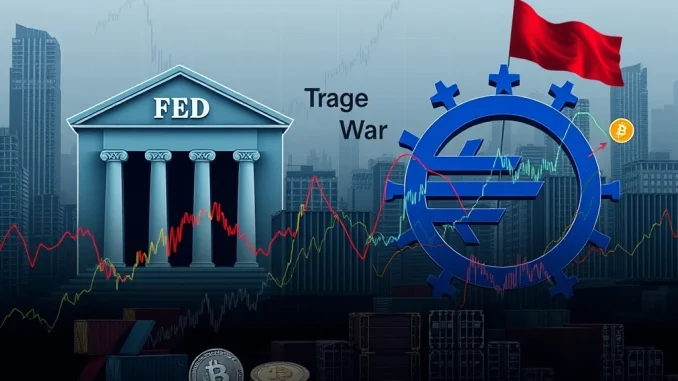
In the dynamic world of finance, central bank decisions often send ripples across every market, and none more so than the often-unpredictable realm of cryptocurrencies. As investors eagerly watch for shifts in the global economic tide, understanding the stance of key players like the Federal Reserve is paramount. This year, despite many global central banks moving towards rate cuts, the U.S. Federal Reserve has maintained its cautious approach, keeping Federal Reserve Rates steady. This decision has sparked intense debate, particularly concerning its ripple effect on risk-on assets like Bitcoin and other digital currencies, which often thrive on lower borrowing costs and increased liquidity.
Federal Reserve Rates: Why the Cautious Hold?
The U.S. Federal Reserve finds itself at a critical juncture, balancing its dual mandate: controlling inflation and fostering maximum employment. After battling double-digit inflation in late 2022, the inflation rate has now moderated to 2%. However, the Federal Open Market Committee (FOMC) remains hesitant to declare victory, questioning whether this decline represents a durable trend or merely a temporary lull. This caution is a primary reason why the Federal Reserve Rates have remained unchanged throughout the year, a stark contrast to some global counterparts.
Several factors contribute to the Fed’s cautious posture:
- Persistent Inflationary Pressures: While headline inflation has cooled, underlying price pressures in certain sectors, particularly services, remain a concern. The Fed aims for a sustained return to its 2% target.
- Robust Employment Data: Strong job growth and low unemployment figures give the Fed less urgency to cut rates to stimulate the economy.
- Geopolitical Uncertainties: Global conflicts and supply chain disruptions continue to pose risks to price stability.
- Political Scrutiny: The Fed operates under significant political pressure, with President Trump and his allies openly criticizing Chairman Jerome Powell. Powell has consistently defended the Fed’s independence, emphasizing data-driven decisions.
The interplay between these elements creates a complex puzzle for policymakers, making any decision on Federal Reserve Rates a high-stakes move.
How Do Trump Tariffs Shape Global Economic Uncertainty?
Adding another layer of complexity to the Fed’s decision-making process are President Donald Trump’s aggressive tariff policies. Threats to escalate duties on European goods from 20% to a staggering 50% have sent shockwaves through global markets. These Trump Tariffs introduce significant volatility and uncertainty, making it incredibly difficult for central banks to accurately predict future inflationary pressures and their broader economic impacts.
Here’s how these tariffs muddy the waters:
- Supply Chain Disruptions: Increased tariffs can disrupt established global supply chains, leading to higher costs for businesses and, subsequently, consumers.
- Reduced Trade Volume: Fear of escalating trade wars can lead to a reduction in international trade, impacting economic growth in multiple countries.
- Currency Fluctuations: Trade tensions often lead to currency volatility, which can impact import/export prices and inflation.
- Investment Hesitation: Businesses may delay investment decisions due to uncertainty about future trade policies, slowing economic activity.
The specter of escalating Trump Tariffs looms large over economic forecasts, forcing central banks like the Fed and the ECB to adopt a ‘wait and see’ approach rather than commit to aggressive rate adjustments.
ECB Rate Pause: A Divergent Path, Yet Intertwined?
While the Fed has held its ground, the European Central Bank (ECB) has charted a somewhat different course. Since June 2024, the ECB implemented eight rate cuts, a significant easing compared to the Fed’s steady stance. However, the ECB recently announced an ECB Rate Pause, keeping its benchmark rate at 2% after peaking at 4%. This decision reflects similar uncertainties plaguing the global economy, particularly the potential impact of Trump Tariffs.
ECB President Christine Lagarde articulated the central bank’s “wait and watch” stance, underscoring that trade negotiations could significantly influence future monetary policy decisions. Analysts suggest that the ECB might resume rate cuts in September if U.S.-EU trade negotiations progress positively. This highlights the interconnectedness of global economies; even with different approaches, both central banks are keenly observing the same geopolitical and trade developments. The ECB Rate Pause, therefore, isn’t just about European economic conditions but also about the broader global financial environment.
Crypto Market Volatility: What’s the Impact on Digital Assets?
The decisions made by the Federal Reserve and the ECB, alongside the unpredictable nature of Trump Tariffs, have a direct and often amplified impact on the Crypto Market Volatility. Cryptocurrencies, often seen as risk assets, tend to perform better in environments of lower interest rates and ample liquidity, as investors are more willing to take on risk.
Here’s how these macro factors influence the crypto landscape:
- Higher Borrowing Costs: When the Fed holds rates steady, borrowing costs remain elevated. This can reduce the capital available for speculative investments, including cryptocurrencies.
- Reduced Risk Appetite: Economic uncertainty stemming from trade wars or inflation concerns can lead investors to de-risk, moving capital out of volatile assets like crypto and into safer havens.
- Market Anticipation vs. Reality: The crypto market often front-runs anticipated rate cuts. When these cuts don’t materialize, or central banks pause, it can lead to immediate price corrections and increased Crypto Market Volatility.
- Dollar Strength: A stronger U.S. dollar, often a consequence of higher rates or safe-haven demand, can put downward pressure on dollar-denominated assets like Bitcoin.
The current environment of uncertainty means that crypto investors need to remain vigilant, as digital asset prices will likely continue to react sharply to every whisper of central bank policy shifts and trade negotiation outcomes.
Navigating the Complex Monetary Policy Landscape Ahead
The current Monetary Policy Landscape is undeniably complex, characterized by a delicate balance of inflation control, economic growth, and geopolitical stability. The Fed’s reluctance to cut rates has kept borrowing costs elevated across the U.S. economy, affecting credit-dependent sectors such as housing and consumer goods. Similarly, while the ECB has managed to align inflation with its target, partly due to a stronger euro and lower oil prices, growth in the Eurozone remains fragile.
Key elements shaping the path forward:
| Factor | Impact on Policy | Outlook |
|---|---|---|
| U.S.-EU Trade Negotiations | Resolution could reduce economic uncertainty. | Potential catalyst for Fed reassessment. |
| Inflation Trends | Sustained decline needed for rate cuts. | Watched closely by both Fed and ECB. |
| Employment Data | Strong employment reduces urgency for cuts. | Key metric for Fed’s dual mandate. |
| Geopolitical Events | Can introduce new inflationary pressures or instability. | Unpredictable, requires central bank agility. |
Until trade tensions are definitively resolved, analysts caution that central banks will likely maintain a measured approach. The potential for an ECB rate cut in September, contingent on U.S.-EU negotiations, underscores the profound interconnectedness of global monetary policy. The ripple effects of one central bank’s decisions are keenly felt across borders, impacting everything from national economies to the highly sensitive Crypto Market Volatility.
What Should Investors Watch For?
For those navigating this complex environment, especially in the crypto space, here are some actionable insights:
- Monitor Trade Talks: Keep a close eye on the progress of U.S.-EU trade negotiations, particularly the August 1st deadline. A positive resolution could signal a shift in central bank stances.
- Inflation Data: Continue to track inflation reports from major economies. A clear, sustained downward trend could pave the way for future rate cuts.
- Central Bank Commentary: Pay attention to speeches and press conferences from Fed Chair Powell and ECB President Lagarde for clues on their forward guidance.
- Economic Indicators: Watch employment figures, GDP growth, and consumer spending data, as these provide insights into the underlying health of economies.
In conclusion, the current global economic climate is a testament to the intricate dance between monetary policy, geopolitical events, and market reactions. The Federal Reserve’s steadfast hold on rates, the ECB’s recent pause, and the overarching shadow of Trump’s tariffs all contribute to a period of heightened uncertainty. While the resolution of trade negotiations offers a glimmer of hope for clarity, the path forward for central banks and, by extension, the sensitive cryptocurrency markets, remains fraught with variables. Staying informed and agile will be key for investors navigating this turbulent Monetary Policy Landscape.
Frequently Asked Questions (FAQs)
Q1: Why is the Federal Reserve holding rates steady despite global central banks cutting them?
The Federal Reserve is maintaining its current rates primarily due to its dual mandate of controlling inflation and fostering full employment. While inflation has come down, the Fed wants to ensure a durable trend towards its 2% target and sees continued strength in the employment market, reducing the immediate need for rate cuts to stimulate growth. Geopolitical uncertainties and the potential impact of Trump tariffs also contribute to their cautious stance.
Q2: How do Trump Tariffs specifically affect central bank decisions?
Trump Tariffs introduce significant uncertainty and volatility into global markets. They can disrupt supply chains, increase costs for businesses, and potentially lead to higher inflation or reduced economic growth. This makes it challenging for central banks like the Fed and ECB to accurately forecast economic conditions and determine appropriate monetary policy, often leading them to adopt a more cautious, ‘wait and watch’ approach.
Q3: What is the significance of the ECB Rate Pause?
The ECB Rate Pause signifies a moment of reflection for the European Central Bank after a series of eight rate cuts. While European inflation has aligned with its target, the pause indicates that the ECB, much like the Fed, is grappling with global uncertainties, particularly the impact of U.S. trade policies. It suggests a cautious outlook and a readiness to reassess based on evolving economic and geopolitical developments, especially regarding U.S.-EU trade negotiations.
Q4: How does Crypto Market Volatility relate to these central bank decisions?
Cryptocurrency markets are highly sensitive to central bank decisions and the broader economic outlook. When central banks hold rates steady or signal higher borrowing costs, it can reduce investor appetite for risk, leading to increased Crypto Market Volatility. Conversely, expectations of rate cuts often fuel risk-taking. The current uncertainty surrounding Federal Reserve rates, ECB actions, and Trump Tariffs contributes significantly to the unpredictable nature of digital asset prices.
Q5: What is the overall Monetary Policy Landscape looking like for the rest of the year?
The overall Monetary Policy Landscape remains complex and interconnected. Central banks are navigating inflation, growth, and geopolitical risks. The resolution of U.S.-EU trade negotiations by August 1st could be a key turning point, potentially allowing central banks to reassess their stances. However, until trade tensions are resolved and inflation trends are definitively clear, a measured and cautious approach is likely to persist across major economies, with global decisions closely watching each other’s moves.