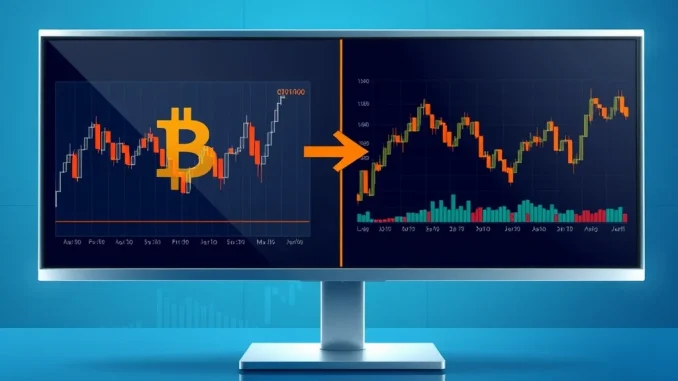
Bitcoin Breakout Hinges on Nasdaq Surge, Expert Warns Amid Market Stalemate
Global Markets, May 2025: The cryptocurrency market faces a period of pronounced consolidation, with Bitcoin’s price movement appearing tethered to traditional equity indices. According to prominent analyst Michaël van de Poppe, Bitcoin’s next significant breakout is contingent upon a decisive upward move from the Nasdaq Composite Index. This analysis arrives as both asset classes navigate a choppy, range-bound environment, with investors globally awaiting clearer macroeconomic signals to determine market direction.
Bitcoin Breakout Stalled by Traditional Market Indecision
For the past several weeks, Bitcoin has traded within a relatively narrow band, failing to establish a sustained trend in either direction. This period of consolidation follows a volatile first quarter and reflects broader uncertainty across financial markets. Van de Poppe’s observation highlights a recurring theme in post-2020 market dynamics: the increasing, though imperfect, correlation between flagship cryptocurrencies and major technology stock indices. The current stalemate suggests that without a catalyst from traditional finance, digital asset markets may lack the momentum for an independent rally. Market participants report decreased trading volumes and a cautious stance, with many opting to wait on the sidelines until a clearer trend emerges from equity markets or key economic data releases.
The Nasdaq Correlation and Modern Market Mechanics
The relationship between Bitcoin and the Nasdaq is not merely coincidental but rooted in shared investor demographics, macroeconomic sensitivities, and liquidity flows. Both assets are often categorized as “risk-on” investments, meaning their prices tend to rise when investor appetite for risk is high and fall when sentiment sours. The Nasdaq, heavily weighted toward technology and growth stocks, is particularly sensitive to interest rate expectations and long-term growth forecasts—factors that also profoundly impact valuation models for digital assets like Bitcoin.
- Liquidity Linkage: Macroeconomic policies that inject or withdraw liquidity from the financial system affect both equities and cryptocurrencies simultaneously.
- Institutional Overlap: The same large asset managers, hedge funds, and corporate treasuries that trade tech stocks are now significant participants in the crypto market.
- Sentiment Synchronization: News regarding inflation, Federal Reserve policy, or geopolitical stability triggers nearly simultaneous reactions across both asset classes.
This interconnectedness means that a decisive breakout for the Nasdaq, particularly one driven by positive earnings or dovish central bank signals, could unlock a wave of correlated buying pressure in Bitcoin.
Historical Precedents and the Current Range-Bound Environment
Examining recent history provides context for van de Poppe’s warning. Throughout 2023 and 2024, several of Bitcoin’s most significant rallies were preceded or accompanied by strong bullish momentum in the Nasdaq. Conversely, sharp corrections in tech stocks often precipitated sell-offs in digital assets. The current market phase mirrors patterns seen in late 2022 and mid-2024, where both markets entered prolonged consolidation periods characterized by low volatility and directionless price action. These phases typically resolve with a strong directional move, but the trigger often originates in traditional markets due to their larger size and influence on global capital allocation. The present choppiness indicates that neither bulls nor bears have sufficient conviction to force a move, leaving the market susceptible to an external catalyst.
Awaiting Macro Cues: The Data Investors Are Watching
The “macro cues” referenced by analysts are specific, scheduled data releases and events that shape monetary policy expectations. Investors and algorithms alike are scrutinizing several key indicators. Upcoming Consumer Price Index (CPI) and Personal Consumption Expenditures (PCE) reports will provide the latest snapshot of inflation. Federal Reserve meeting minutes and speeches by central bank officials offer clues about future interest rate decisions. Additionally, quarterly earnings reports from major Nasdaq-listed companies, particularly in the semiconductor and software sectors, serve as a barometer for corporate health and future growth prospects. A positive surprise across these fronts could provide the fundamental justification for a Nasdaq breakout, which, according to the observed correlation, would be the most likely precursor to a sustained Bitcoin rally.
Expert Insight: The Mechanics of a Correlated Move
Michaël van de Poppe’s analysis extends beyond simple observation. He explains the potential mechanics: a strong Nasdaq rally would improve overall risk sentiment across trading desks and investment committees. This renewed confidence often leads to portfolio rebalancing, where funds allocated to “risk” assets are increased. As Bitcoin is now a staple in many multi-asset portfolios and hedge fund strategies, it stands to receive a direct inflow. Furthermore, positive momentum in equities generates media headlines and retail investor enthusiasm, which can spill over into cryptocurrency exchanges. The process is not instantaneous but can develop over days or weeks as conviction builds. The critical threshold, analysts note, is a Nasdaq move that convincingly breaks above key resistance levels on high volume, signaling institutional participation rather than short-term speculation.
Implications for Traders and Long-Term Holders
The current market dynamic presents distinct scenarios for different types of market participants. Short-term traders may view the Nasdaq as a leading indicator, using its price action to inform positions in Bitcoin and other cryptocurrencies. Range-bound strategies, such as selling at resistance and buying at support, have been effective but carry the risk of a sudden breakout. Long-term investors, often referred to as “holders,” might see the consolidation as an accumulation opportunity, betting on the long-term appreciation of Bitcoin irrespective of short-term correlation. However, even this group monitors traditional markets, as a severe downturn in equities could trigger a broad liquidity crunch affecting all asset classes. The prevailing advice from multiple analysts is to maintain a balanced portfolio, manage risk through position sizing, and avoid over-leverage during periods of low volatility and unclear direction.
Conclusion
The path forward for Bitcoin appears intertwined with the fortunes of the technology-heavy Nasdaq index. As expert Michaël van de Poppe warns, a definitive Bitcoin breakout likely requires a prior or concurrent upside resolution in traditional equities. This period of market choppiness reflects a global financial system in wait-and-see mode, parsing through inflation data, central bank commentary, and corporate earnings. For investors, understanding this correlation is crucial for navigating the current environment. While Bitcoin’s long-term value proposition remains distinct, its short-to-medium-term price action continues to be significantly influenced by the same macroeconomic forces and investor sentiment that drive the Nasdaq, making the latter a key chart to watch for anyone anticipating the next major Bitcoin breakout.
FAQs
Q1: Why does Bitcoin’s price seem linked to the Nasdaq?
The correlation stems from shared characteristics as “risk-on” assets. They are influenced by similar factors: interest rate expectations, inflation data, and overall investor sentiment toward growth and technology. The same institutional investors are often active in both markets.
Q2: What does “range-bound” or “choppy” market mean?
It describes a period where the price of an asset trades between a consistent high price (resistance) and low price (support) without breaking out in either direction. It indicates a balance between buying and selling pressure and a lack of decisive momentum.
Q3: What macro cues are markets currently awaiting?
Key cues include monthly inflation reports (CPI, PCE), employment data, decisions and statements from the U.S. Federal Reserve and other central banks, and quarterly earnings reports from major publicly traded companies.
Q4: Has this correlation between Bitcoin and the Nasdaq always existed?
No. The correlation has strengthened notably since 2020, coinciding with increased institutional adoption of Bitcoin and a market environment heavily driven by macroeconomic liquidity and central bank policy.
Q5: Does this mean Bitcoin cannot rise if the Nasdaq is falling?
While a negative correlation is possible, it has become less common. A strong, independent Bitcoin rally during a sustained Nasdaq decline would require a uniquely powerful catalyst specific to the cryptocurrency ecosystem, such as a major regulatory breakthrough or a technical network upgrade driving isolated demand.
Related News
- Sonic SVM Unveils Powerful Tokenomics Shift for SONIC Token
- Mastercard and Standard Chartered complete first live test of Multi-Token Network
- XRP DeFi Upgrade: Flare's Modular Lending Unlocks New Utility for FXRP Holders
Related: Trump Meme Tokens Crash: Devastating $4.3B Wipeout Leaves Retail Investors Reeling
Related: Global Stablecoin Access: Alchemy Pay Integrates USA₮ for Compliant Payments in 173 Countries