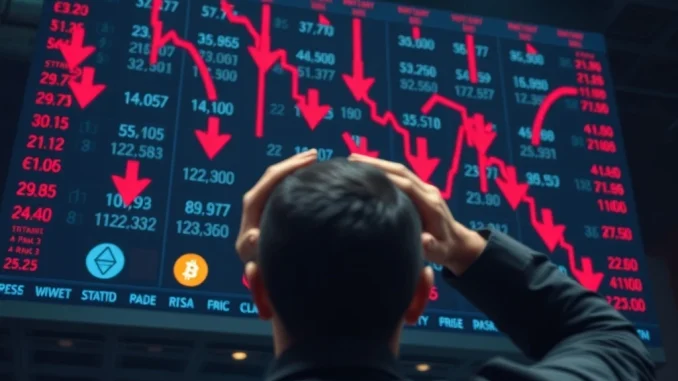
Crypto Bear Market: How Forced Deleveraging Triggered a Trillion-Dollar Collapse
Global, May 2025: The cryptocurrency market has entered a confirmed bear phase, with Bitcoin falling nearly 50% from its recent all-time high. This downturn, erasing trillions in total market value, was not driven by shifting narratives but by a powerful and mechanical force: forced deleveraging. A confluence of cascading liquidations, sustained ETF outflows, and broader macroeconomic stress created a perfect storm, systematically unwinding the leveraged positions that had buoyed prices during the bull run.
Crypto Bear Market Defined by Deleveraging Pressure
Market analysts now identify forced deleveraging as the primary engine of the recent crash. Unlike sentiment-driven corrections, this process is involuntary and algorithmic. When asset prices fall below specific thresholds, leveraged positions—funded with borrowed capital—are automatically sold by exchanges and lending platforms to repay loans. This selling creates further downward pressure, triggering more liquidations in a self-reinforcing cycle known as a “liquidation cascade.” Data from analytics firms shows that over a critical 72-hour period, more than $15 billion in long positions were liquidated across major crypto derivatives exchanges. This fire sale of assets directly accelerated the pace of the decline, transforming a correction into a full-scale bear market.
The Mechanics of the Market Meltdown
The deleveraging event unfolded through three interconnected channels, each amplifying the others. First, the derivatives market acted as the initial trigger. As Bitcoin broke below key technical support levels, a wave of stop-loss orders and margin calls was executed.
- Liquidation Domino Effect: Large leveraged long positions on futures platforms were the first to be closed, flooding the market with sell orders.
- Spot Market Contagion: The rapid price drop in futures bled into the spot market, where panic selling from retail and institutional holders began.
- Collateral Unwind: Loans collateralized by crypto assets on decentralized and centralized finance platforms became under-collateralized, forcing automatic repayments or seizures, adding more sell-side pressure.
This mechanical unwinding created a liquidity vacuum, where buyers retreated, and automated systems dominated trading.
The Critical Role of ETF Outflows
Simultaneously, the spot Bitcoin Exchange-Traded Funds (ETFs), once hailed as a pillar of institutional adoption, became a significant source of sell pressure. For eleven consecutive trading days, these ETFs experienced net outflows, totaling over $4 billion. This represented a stark reversal from the consistent inflows seen during the prior bullish trend. The outflows indicated that traditional finance institutions and ETF shareholders were reducing exposure, directly removing capital from the crypto ecosystem. Each redemption request by an ETF authorized participant required the fund to sell Bitcoin from its treasury to raise cash, creating a consistent and visible overhang on the market.
Historical Context and Macroeconomic Stress
This event echoes previous crypto downturns, such as the deleveraging that followed the collapse of Terra/LUNA in 2022 and the FTX bankruptcy. However, the 2025 episode is distinct due to the mature presence of spot ETFs and a more integrated, albeit fragile, global financial landscape. Broader macroeconomic conditions provided the tinder. Rising interest rates, persistent inflation concerns, and geopolitical tensions led investors to flee risk assets globally. Cryptocurrencies, still perceived by mainstream portfolios as high-risk, were among the first assets sold to raise cash or reduce portfolio volatility. This macro stress test revealed that crypto’s correlation with traditional risk-off moments remains significant, disproving earlier theories of it being a perfect hedge.
Consequences and Market Implications
The immediate consequence has been a dramatic repricing of the entire digital asset sector. Total cryptocurrency market capitalization has retreated to levels not seen in over two years. Beyond valuation, the structure of the market is changing.
- Reduced Leverage: Average leverage ratios across exchanges have plummeted as traders and institutions de-risk.
- Protocol Stress: Decentralized Finance (DeFi) protocols reliant on crypto collateral have seen total value locked (TVL) drop sharply, testing their economic security.
- Regulatory Scrutiny: The volatility and investor losses have renewed calls from policymakers for stricter oversight on crypto leverage and derivatives.
- Industry Consolidation: Weaker projects and over-leveraged firms face insolvency, likely leading to a wave of consolidation and bankruptcies, similar to past cycles.
The market is now in a phase of price discovery, searching for a stable floor without the artificial support of excessive leverage.
Conclusion: A Market Reset, Not an End
The confirmed crypto bear market, catalyzed by forced deleveraging, represents a painful but necessary market reset. It has systematically removed the speculative excess and high-risk leverage that built up during the preceding bull run. While trillions in paper value have been wiped out, the core blockchain infrastructure and leading assets like Bitcoin and Ethereum continue to operate. The path forward will likely be characterized by lower volatility, a focus on fundamental utility over speculation, and a more cautious approach to leverage from all market participants. This deleveraging cycle, though severe, is a recurring feature of financial markets and serves to establish a more sustainable foundation for future growth.
FAQs
Q1: What is forced deleveraging in crypto?
Forced deleveraging is the automatic, involuntary liquidation of borrowed trading positions when the value of the collateral falls below a required level. It triggers a cascade of selling that can rapidly depress prices.
Q2: How do ETF outflows affect Bitcoin’s price?
When investors redeem shares of a spot Bitcoin ETF, the fund must sell actual Bitcoin from its holdings to return cash to the investor. This creates direct sell pressure on the Bitcoin market, contributing to price declines.
Q3: Is this bear market different from previous ones?
Yes. While deleveraging is a common theme, the 2025 downturn is uniquely influenced by the mechanics of large-scale spot Bitcoin ETFs, which provide a new channel for institutional sell pressure not present in earlier cycles.
Q4: How long do crypto bear markets typically last?
Historical crypto bear markets have varied, often lasting between 12 to 18 months. Their duration depends on broader economic conditions, regulatory developments, and the time needed for over-leverage to fully unwind and for new, organic demand to emerge.
Q5: What happens after a major deleveraging event?
Markets typically enter a period of consolidation and low volatility. Weak projects fail, leverage is reduced, and investor focus shifts from speculation to fundamentals. This sets the stage for the next cycle, often beginning with accumulation by long-term investors.
Related News
- SG-Forge And SWIFT Bridge Crypto And Traditional Finance in Groundbreaking Settlement
- US Stock Market Reveals Stark Divergence as Major Indices Open Mixed
- Shiba Inu’s Path To $0.00005 Hits Roadblock: Why Crypto Experts Say This Lesser-Known $0.04 Token Might Be A Better Investment
Related: Algorithmic Stablecoins Are 'True DeFi': Vitalik Buterin's Revealing 2025 Vision
Related: Prediction Markets Shatter Records with $12 Billion Weekly Volume as Mainstream Adoption Surges
Related: DOGEBALL Presale Analysis: Understanding the DB75 Code and the 2026 Crypto Presale Landscape