RWA Yacht Charter: INVESTING YACHTS Launches Revolutionary Tokenized Model in Ibiza
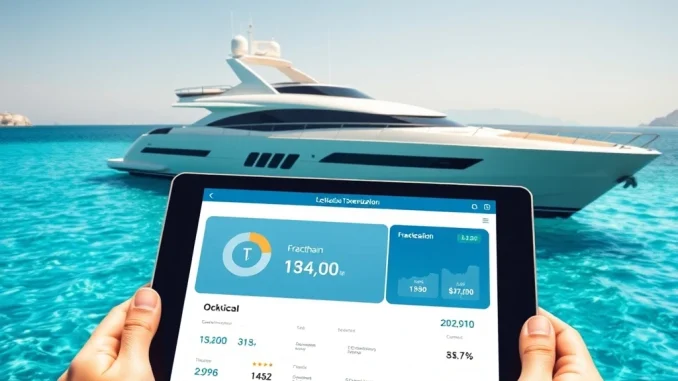
Ibiza, Spain, 8th February 2026: INVESTING YACHTS, a pioneer in maritime asset digitization, has officially launched a novel Real World Asset (RWA) yacht charter model. This initiative represents a significant evolution in how high-value physical assets are financed, owned, and utilized, merging the traditional luxury yacht industry with blockchain-based tokenization. The model aims to democratize access to yacht ownership and chartering through fractionalized digital tokens, providing a tangible use case for RWA protocols beyond conventional finance.
Understanding the RWA Yacht Charter Model
The core innovation lies in the application of Real World Asset tokenization to a specific, high-value industry. INVESTING YACHTS acquires or partners with existing luxury yacht owners to tokenize the vessel’s value. Each yacht is represented as a digital asset on a blockchain, typically divided into a finite number of tokens. These tokens confer proportional ownership rights and revenue shares from the yacht’s charter operations. Token holders can benefit from potential asset appreciation and a share of the income generated when the yacht is rented, all managed through smart contracts that automate distribution and record-keeping. This structure transforms a single, illiquid asset into a divisible, tradable, and accessible investment vehicle.
The Mechanics of Maritime Asset Tokenization
The process involves several critical steps to ensure legal compliance, asset security, and operational integrity. First, a thorough legal framework is established, aligning with maritime law and the financial regulations of the vessel’s flag state and the jurisdictions of potential investors. A specialized marine surveyor then conducts an independent appraisal to determine the yacht’s fair market value. Following this, a legal entity, often a Special Purpose Vehicle (SPV), is created to hold the physical asset. The ownership of this SPV is then digitized into tokens on a chosen blockchain network. Smart contracts govern key functions:
- Revenue Distribution: Automatically allocates charter income to token holders based on their stake.
- Governance: Allows token holders to vote on certain operational decisions, such as charter pricing or scheduled maintenance.
- Transparency: Provides an immutable, public ledger for all financial transactions related to the asset.
This model reduces administrative overhead and builds trust through algorithmic execution of agreed-upon terms.
Historical Context: The Evolution of Asset Tokenization
The concept of securitizing and fractionalizing assets is not new. Real estate investment trusts (REITs) and timeshare models have existed for decades. However, blockchain technology solves historical inefficiencies. Traditional fractional ownership often involves cumbersome paperwork, opaque management, and limited liquidity. Blockchain introduces near-instant settlement, global accessibility, and 24/7 markets. The RWA narrative in crypto gained substantial traction in 2023-2024, primarily focusing on tokenized treasury bills and private credit. INVESTING YACHTS’ model expands this frontier into alternative tangible assets, testing the technology’s utility in a complex, service-oriented industry like luxury charters.
Implications for the Luxury Charter and Investment Markets
This launch has multifaceted implications. For the luxury charter market, it introduces a new capital pool for yacht owners and builders. Owners can unlock liquidity without selling their asset outright, while builders can pre-finance new constructions through tokenized offerings. For investors, it opens a previously inaccessible asset class. Instead of requiring millions for full ownership, individuals can gain exposure with significantly lower capital. It also provides portfolio diversification into a non-correlated tangible asset. The model could potentially stabilize charter pricing by creating a more efficient, transparent marketplace directly connecting asset owners with a global base of micro-investors and users.
Operational and Regulatory Challenges
Despite its promise, the RWA yacht model faces hurdles. Maritime law is internationally complex, varying by flag, port state, and coastal jurisdiction. Ensuring the digital token’s legal recognition as a true ownership right across borders is a paramount challenge. Insurance models must adapt to cover fractional interests held by potentially hundreds of anonymous token holders. Furthermore, the physical management of the asset—maintenance, crew, docking, and client service—requires a trusted, traditional management company to interface with the digital ownership layer. INVESTING YACHTS must navigate these complexities to prove the model’s long-term viability beyond a conceptual pilot.
Conclusion
The launch of INVESTING YACHTS’ RWA yacht charter model in Ibiza marks a compelling step in the convergence of physical luxury assets and decentralized finance. By applying blockchain tokenization to yacht ownership, the project seeks to enhance liquidity, accessibility, and transparency in a niche market. Its success will depend not only on technological execution but also on robust legal frameworks and seamless integration with the physical world of yacht management. This model serves as a live case study for how RWA protocols can move beyond simple financial instruments to digitize and democratize ownership of complex, high-value experiential assets.
FAQs
Q1: What is an RWA in the context of yachting?
An RWA, or Real World Asset, is a tangible, physical asset whose value is represented digitally on a blockchain. In yachting, it refers to tokenizing a physical yacht so its ownership and revenue rights can be divided and traded as digital tokens.
Q2: How do investors make money from a tokenized yacht?
Investors primarily earn through two avenues: revenue sharing from the yacht’s charter fees distributed proportionally via smart contracts, and potential capital appreciation if the token’s market value increases relative to the underlying yacht’s value.
Q3: What are the risks involved in this model?
Key risks include regulatory uncertainty across different countries, the illiquidity of secondary markets for the tokens, operational risks of the physical yacht (damage, maintenance costs), and the volatility of the cryptocurrency used to purchase the tokens.
Q4: Can token holders use the yacht for personal trips?
This depends on the specific structure. Some models offer usage rights proportional to ownership stake (e.g., a number of days per year), often managed through a booking system integrated with the token platform. Others may be purely investment vehicles with no direct usage rights.
Q5: How is the value of a yacht token determined?
The initial value is typically based on a professional appraisal of the physical yacht, divided by the number of tokens issued. Subsequently, the market price on secondary trading platforms is determined by supply and demand, influenced by the yacht’s charter performance, maintenance status, and overall market sentiment.
Related News
- Bhutan's Govt-Linked Wallet Transfers 929 BTC to Binance Amid Bitcoin Price Surge
- Pendle Team's Strategic $3.83M Deposit to Bybit Signals Confident Treasury Management
- Solana Could Stunningly Outperform Bitcoin in 2025: Institutional Shift and Real-World Utility Drive Momentum
Related: Bitcoin Valuation Models Reveal Surprising Targets Despite $70K Chop
Related: IPO Genie: The Revolutionary Platform Beating Crowdfunding for Early-Stage Crypto Exposure