Pivotal Crypto Market Structure Bill Clears House, SEC Chair Confirms Senate Review Now Underway
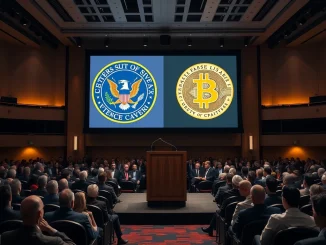
Washington, D.C., May 15, 2025: In a development that marks a significant milestone for the digital asset industry, the Chair of the U.S. Securities and Exchange Commission (SEC) confirmed that a major crypto market structure bill has successfully passed the House of Representatives. The announcement, delivered during a live CNBC interview, signals that comprehensive federal legislation for cryptocurrency is now advancing to the U.S. Senate for review, potentially reshaping the regulatory landscape for years to come.
Crypto Market Structure Bill Passes House with Bipartisan Support
The legislative journey for this landmark bill has been years in the making. Lawmakers have grappled with how to apply existing securities and commodities laws to a rapidly evolving technological sector. The bill that passed the House represents a concerted effort to create a clear regulatory framework, aiming to protect investors while fostering innovation. Its passage, achieved with notable bipartisan support, underscores a growing consensus in Congress that federal action is necessary to provide certainty for businesses, consumers, and regulators alike. The legislation seeks to delineate clear jurisdictional lines between the SEC and the Commodity Futures Trading Commission (CFTC), a long-standing point of contention in crypto regulation.
SEC Chair Outlines the Path Forward in the Senate
During the televised interview, the SEC Chair provided a measured but clear confirmation of the bill’s progress. The Chair emphasized that the agency’s primary focus remains on investor protection and market integrity, principles that are central to the proposed legislation. With the bill now moving to the Senate, the review process is expected to involve rigorous committee hearings, expert testimony, and likely amendments. Key Senate committees, including Banking and Agriculture, will scrutinize the bill’s provisions. The Chair’s public acknowledgment places official weight on the process, indicating that the SEC is actively engaged in shaping the final outcome. Historical context is important here; previous attempts at similar legislation have stalled in committee, making this advancement particularly noteworthy.
Implications for Exchanges, Tokens, and Stablecoins
The core of the bill addresses fundamental questions of market structure. A major component is the classification of digital assets. The proposed framework could establish a pathway for certain cryptocurrencies to be deemed digital commodities under CFTC oversight, while others meeting specific criteria would remain securities regulated by the SEC. This classification is crucial for trading platforms, which may need to register as alternative trading systems (ATS) or national securities exchanges. Furthermore, the bill contains stringent provisions for stablecoin issuers, likely requiring them to maintain high-quality liquid asset reserves and obtain federal charters. The table below outlines the potential regulatory split based on current bill drafts.
| Asset Type / Activity | Potential Primary Regulator | Key Regulatory Requirements |
|---|---|---|
| Digital Asset Securities (e.g., certain tokens from ICOs) | Securities and Exchange Commission (SEC) | Registration, disclosure, broker-dealer compliance |
| Digital Commodities (e.g., Bitcoin, Ethereum) | Commodity Futures Trading Commission (CFTC) | Anti-fraud, anti-manipulation, exchange registration |
| Stablecoin Issuance | Federal Reserve / OCC / SEC (based on structure) | Bank-like reserves, transparency, redemption guarantees |
| Trading Platforms | SEC and/or CFTC | Exchange or ATS registration, custody rules, market surveillance |
Industry and Regulatory Reaction to the Legislative Milestone
Initial reactions from across the financial and technology sectors have been cautiously optimistic. Major cryptocurrency exchanges have issued statements welcoming the progress toward regulatory clarity, which they argue is essential for scaling operations and ensuring consumer safety in the United States. Conversely, some consumer advocacy groups have urged senators to strengthen investor protection clauses, particularly around disclosure and conflict-of-interest rules for trading platforms. From a regulatory perspective, the bill’s passage through the House provides a concrete legislative text for agencies like the SEC and CFTC to work with, moving beyond the current enforcement-heavy approach to a more structured rulebook. This shift could reduce regulatory uncertainty that has driven some blockchain innovation offshore.
The Long Road from Proposal to Potential Law
It is critical to understand that passage in the House is only one step in a lengthy process. The Senate must draft, debate, and pass its own version of the bill. Any differences between the House and Senate bills would then need to be reconciled in a conference committee before a final version is sent to the President for signature. This timeline could span months or extend into the next congressional session. Historical precedents, such as the Dodd-Frank Act, show that major financial market structure reforms involve complex negotiations and can evolve significantly from their initial drafts. Stakeholders are preparing for this next phase of detailed policy work.
Conclusion: A Defining Moment for U.S. Crypto Policy
The confirmation that the crypto market structure bill has passed the House represents a defining moment in the maturation of the digital asset ecosystem. It moves the national conversation from theoretical debates to practical legislative action. While significant hurdles remain in the Senate, the establishment of a clear congressional framework is now a tangible possibility. The outcome of this process will determine the United States’ competitive position in financial technology, the security of markets for millions of investors, and the long-term trajectory of blockchain innovation. All eyes will now turn to the Senate as it begins its thorough review of this pivotal legislation.
FAQs
Q1: What is the main goal of the crypto market structure bill that passed the House?
The primary goal is to establish a comprehensive federal regulatory framework for digital assets. It aims to clarify whether cryptocurrencies are securities or commodities, assign clear regulatory authority between the SEC and CFTC, and create rules for trading platforms and stablecoin issuers to protect investors and ensure market integrity.
Q2: What does it mean now that the bill is moving to the U.S. Senate?
The bill will be assigned to relevant Senate committees (like Banking or Agriculture) for review. Senators will hold hearings, propose amendments, and eventually vote on their own version. The Senate version must pass before differences with the House bill are reconciled, a process that can take considerable time.
Q3: How might this bill affect everyday cryptocurrency investors?
If enacted, investors could see greater protections on centralized exchanges, including clearer disclosures about assets, stronger custody rules for their holdings, and defined processes for resolving disputes. The goal is to reduce fraud and manipulation, making the market safer for participation.
Q4: Does this bill make Bitcoin and Ethereum officially not securities?
The bill, in its current form, creates a test to classify digital assets. It is widely anticipated that it would formally classify Bitcoin and potentially Ethereum as digital commodities under CFTC jurisdiction, but the final determination would depend on the specific language passed into law.
Q5: What are the next immediate steps following the SEC Chair’s confirmation?
The Senate parliamentarian will formally receive the bill from the House. Senate leadership will then refer it to committees to begin the markup process. Simultaneously, lobbying efforts from industry groups, advocates, and regulatory agencies will intensify as they seek to influence the Senate’s version of the legislation.
Related News
- Nomura's Strategic Pivot: Japanese Banking Giant Cuts Crypto Exposure After Q3 Losses
- Binance Alpha Unveils Aspecta (ASP): A Game-Changer for Early-Stage Crypto Projects
- Bitcoin Correlation With S&P 500 Hits 2-Year High - What This Means For Investors
Related: Solana's Pivotal Moment: Technical Analysis Points to Potential Bottom at $74 Support
Related: Bitcoin Rebound: A Cautious Recovery as Analysts Warn of Underlying Weakness
Related: Crypto Funding Rounds Surge in January 2026: A Detailed Analysis of the Capital Influx