Ethereum’s Stunning 99% Gas Drop Forces ENS to Scrap Crucial L2 Rollup Plans
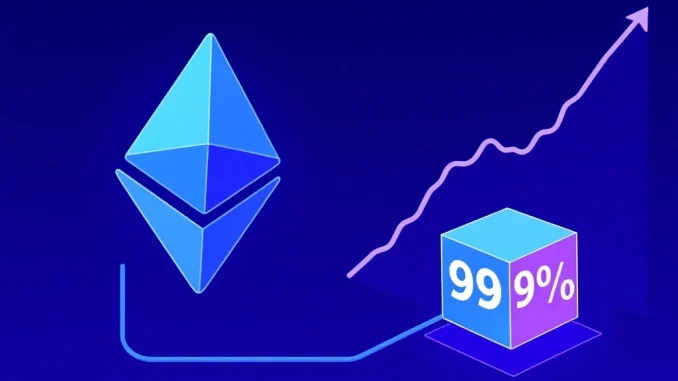
Global, May 2025: In a decisive move that underscores Ethereum’s rapid evolution, the Ethereum Name Service (ENS) has officially abandoned its planned Namechain Layer 2 rollup. This surprising pivot comes directly in response to Ethereum’s own core network achieving a staggering 99% reduction in gas costs, rendering the separate scaling layer unnecessary for ENS’s upcoming ENSv2 upgrade. The cancellation signals a major shift in developer strategy, highlighting how successful protocol-level improvements can fundamentally alter the blockchain application landscape.
ENS Cancels Namechain as Ethereum Gas Fees Plummet
The Ethereum Name Service, the decentralized protocol that maps human-readable names like ‘alice.eth’ to machine-readable identifiers such as Ethereum addresses, had been developing a dedicated Layer 2 solution known as Namechain. The primary goal was to drastically reduce transaction costs and increase speed for registering and managing .eth domains, creating a better user experience. However, with the implementation of Ethereum’s latest series of upgrades, most notably further optimizations post-Dencun and continued scaling of data availability layers, gas fees on the Ethereum mainnet (Layer 1) have fallen to levels once thought impossible.
This fee reduction is not a temporary market fluctuation but a structural change driven by technological advancements. The integration of proto-danksharding concepts and enhanced blob transaction processing has massively increased the data capacity of the network, reducing competition for block space. Consequently, the economic rationale for ENS to build and maintain a complex Layer 2 rollup—with its own security assumptions, bridging complexities, and operational overhead—has evaporated. The development team confirmed that ENSv2, the next major iteration of the protocol, will now reside entirely on Ethereum Layer 1.
The Technical Drivers Behind Ethereum’s Scaling Success
To understand why ENS’s decision is so significant, one must examine the technical milestones Ethereum has recently achieved. The reduction in gas costs is the culmination of a multi-year roadmap known as ‘The Surge,’ focused on scaling through rollups and data sharding.
- EIP-4844 (Proto-Danksharding): This upgrade introduced ‘blob-carrying transactions,’ which provide rollups with a new, inexpensive data storage space. This directly lowered the cost for Layer 2s to post data to Ethereum, a saving that is now being passed on to end-users even on Layer 1 as network congestion eases.
- Optimistic and ZK-Rollup Maturation: The widespread adoption of general-purpose rollups like Arbitrum, Optimism, and zkSync has successfully diverted a large portion of transaction volume away from the main chain, freeing up capacity.
- Client and Execution Optimization: Continuous improvements to Ethereum’s execution and consensus clients have increased the network’s efficiency in processing transactions, allowing for higher throughput within the same gas limits.
The collective impact of these upgrades has been a dramatic shift in the economic model of the network. Transactions that cost over $50 during peak demand in previous years can now be executed for a few cents, fundamentally changing the calculus for application developers.
A Strategic Reversal with Industry-Wide Implications
ENS’s choice to scrap Namechain is more than a project-specific update; it is a case study in adaptive blockchain development. For years, the prevailing narrative insisted that complex decentralized applications (dApps) needed to migrate to Layer 2 or sidechain solutions to be viable. ENS’s reversal challenges that notion, suggesting that for some applications, a highly scalable and cost-effective Layer 1 may be the simplest and most secure path forward.
This has implications for trust and security models. By staying on Layer 1, ENSv2 will inherit the full security guarantees of the Ethereum mainnet, avoiding the additional trust assumptions or fraud proof windows associated with many Layer 2s. It also simplifies the user experience by eliminating the need for bridging assets or understanding multiple network layers to manage a domain. The decision reflects a pragmatic assessment: why build a complex highway system when the existing roads have been upgraded to handle all the traffic smoothly and cheaply?
Comparing the Pathways: L1 vs. L2 Development
The following table outlines the key considerations that likely influenced ENS’s final decision:
| Consideration | Layer 1 (Ethereum Mainnet) Pathway | Layer 2 (Namechain Rollup) Pathway |
|---|---|---|
| Security Model | Full Ethereum consensus security. | Derived security with additional trust assumptions in sequencers and provers. |
| User Experience | Direct interaction; no bridging required. | Requires bridging funds and understanding a second network. |
| Development & Maintenance | Leverages existing Ethereum tooling and infrastructure. | Requires building/maintaining rollup stack, sequencers, and bridge contracts. |
| Cost Structure (Post-2025 Upgrades) | Extremely low, predictable gas fees. | Low fees, but with added complexity and potential bridge costs. |
| Composability | Native composability with all other L1 dApps and assets. | Limited to the rollup’s ecosystem; cross-L2 composability is complex. |
As the table demonstrates, with gas costs equalized, the advantages of staying on the more secure, simpler, and natively composable Layer 1 become compelling for a service like ENS, which benefits from deep integration with the wider Ethereum ecosystem.
Conclusion: A New Phase for Ethereum Development
The cancellation of the Namechain Layer 2 rollup by ENS is a powerful testament to Ethereum’s scaling success. It marks a potential inflection point where the core network becomes economically viable for a broader range of applications than previously imagined. This event will likely prompt other development teams to re-evaluate their scaling roadmaps, weighing the benefits of complex multi-layer architectures against the simplicity of an increasingly capable base layer. For the Ethereum community, the 99% drop in gas costs is not just a metric; it is a catalyst that is reshaping fundamental development strategies, proving that sustained protocol innovation can deliver tangible, game-changing results for builders and users alike.
FAQs
Q1: What is ENS and what was Namechain?
The Ethereum Name Service (ENS) is a protocol that provides human-readable names for cryptocurrency addresses. Namechain was its planned proprietary Layer 2 rollup, designed to reduce costs and improve performance, which has now been canceled.
Q2: Why did ENS cancel its Layer 2 plans?
ENS canceled the Namechain rollup because gas fees on the Ethereum mainnet have fallen by approximately 99% due to recent scaling upgrades, making a separate scaling layer economically unnecessary for their needs.
Q3: What caused Ethereum’s gas fees to drop 99%?
The drop is primarily attributed to successful implementations of Ethereum’s scaling roadmap, including EIP-4844 (proto-danksharding), which reduced data costs for rollups, and the overall maturation and adoption of Layer 2 networks that reduce mainnet congestion.
Q4: Will ENSv2 still launch?
Yes. ENSv2, the next-generation upgrade to the protocol, is still in development. The key change is that it will now be deployed directly on the Ethereum Layer 1 mainnet instead of on a separate Layer 2 rollup.
Q5: Does this mean Layer 2 solutions are no longer needed?
Not at all. Layer 2 rollups remain critical for high-throughput applications like gaming and decentralized exchanges that require ultra-low latency and millions of transactions. ENS’s decision is specific to its use-case, where lower transaction volume and high value for mainnet security make L1 optimal after the fee reduction.
Related News
- Qubetics Tokenized Marketplace Reshapes Investments | Polkadot Powers Interoperability | Fantom Targets $2 Amid Bullish Momentum
- Analyst Who Predicted Bitcoin Crash To $54,500 Reveals Where Price Is Headed Next
- Bitcoin Options: Nasdaq PHLX Files Exciting SEC Proposal for Trading
Related: Strategic Shift: Binance Empowers SAFU Fund by Transitioning Reserves to Bitcoin