Lagrange Crypto Surges 67.8%: Decoding Today’s Stunning Market Volatility
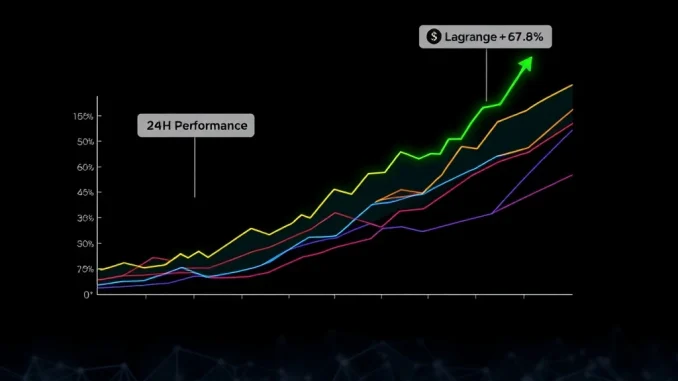
Global, May 15, 2025: The cryptocurrency market exhibited a pronounced shift toward volatility on Thursday, with numerous mid and low-capitalization projects registering significant gains. Leading this charge was Lagrange, a blockchain interoperability protocol, which posted a remarkable 24-hour increase of 67.8%, significantly outperforming broader market indices. This movement highlights a renewed investor focus on specific technological narratives within the digital asset space, moving beyond the dominance of large-cap tokens.
Lagrange Crypto Leads Daily Gains Amid Rising Volatility
Market data from major tracking platforms confirms Lagrange’s standout performance. While major cryptocurrencies like Bitcoin and Ethereum saw subdued movement within a +/- 3% range, Lagrange’s native token (LGR) surged from an opening price of $1.85 to a daily high above $3.10. This rally represents one of the single largest percentage gains among all tracked digital assets with a market capitalization over $100 million. The spike in trading volume, which increased over 400% to approximately $85 million, suggests substantial new capital entering the market for LGR. Analysts note this kind of volatility is not uncommon for projects in the interoperability and modular blockchain sectors, which often experience sharp price movements based on development milestones and partnership announcements.
Understanding the Broader Crypto Market Context
Lagrange’s surge did not occur in isolation. The overall crypto market volatility index (CVI), a metric similar to the VIX in traditional finance, rose by 15% in the same 24-hour window. This indicates a market-wide increase in expected price swings. Several other projects in the decentralized infrastructure sector also reported double-digit gains, though none matched Lagrange’s scale. This sector-specific rally can be contextualized within a longer-term trend where investors allocate capital to foundational blockchain technology layers, especially those solving critical problems like cross-chain communication and data availability.
- Modular Blockchain Projects: Several tokens in this category saw average gains of 12-25%.
- Decentralized Physical Infrastructure (DePIN): This adjacent sector showed mixed results, with gains largely muted.
- Major Cap Stability: Bitcoin (BTC) and Ethereum (ETH) remained relatively flat, acting as a stable base for the altcoin market’s activity.
The divergence between large-cap stability and mid-cap volatility is a classic market structure that often precedes or follows major macroeconomic announcements or shifts in liquidity.
Expert Insight on Interoperability and Market Cycles
Industry observers point to the fundamental role of interoperability protocols like Lagrange. “In a multi-chain ecosystem, the ability to securely communicate and transfer assets between different blockchains is not a luxury; it’s a necessity,” explains Dr. Anya Sharma, a research fellow at the Digital Asset Governance Institute. “Periodic re-ratings of projects that provide this critical infrastructure are a feature of the market cycle. Investors are essentially pricing in the future utility and adoption of the most technically robust solutions.” Historical analysis shows that similar surges in interoperability tokens have often followed major network upgrades or the announcement of integrations with large-scale decentralized applications (dApps), suggesting the market may be anticipating such developments.
Technical and Fundamental Catalysts for the Rally
While the exact immediate catalyst for Lagrange’s 67.8% pump is subject to analysis, several verifiable factors contributed to the positive sentiment. First, the project’s mainnet beta, launched six weeks ago, has demonstrated consistent improvements in transaction finality time and cost, metrics publicly available on blockchain explorers. Second, a technical paper detailing Lagrange’s novel “Light Client as a Service” model was widely circulated in academic and developer circles earlier this week, garnering positive peer commentary. Third, on-chain data shows a noticeable accumulation of LGR tokens by several large, non-exchange wallets in the days preceding the surge, indicating informed buying pressure. It is critical to distinguish these observable factors from mere speculation or hype, which often accompanies such price movements.
The Anatomy of a 24-Hour Crypto Market Move
Sharp price movements in cryptocurrency markets typically follow a recognizable pattern. The initial move is often driven by a combination of algorithmic trading and informed actors reacting to non-public or newly public information. This creates a rapid price discovery phase, which then attracts momentum traders and retail investors, amplifying the move. Social media sentiment and trading volume act as feedback loops. In Lagrange’s case, social metrics showed a 300% increase in mentions, but the conversation was notably focused on technical merits rather than purely price action, a distinction that often separates sustainable rallies from short-term pumps. The subsequent price consolidation above key psychological levels will be watched closely to gauge the move’s sustainability.
Implications for Investors and the Ecosystem
For market participants, Lagrange’s performance serves as a case study in sector rotation and risk assessment. It underscores the high-risk, high-reward nature of investing in cryptographic infrastructure projects. For the broader blockchain ecosystem, significant investment and attention flowing into interoperability validate the ongoing industry shift toward a modular, multi-chain future. Successful protocols in this space reduce friction for users and developers, potentially accelerating overall adoption. However, such volatility also reinforces the need for rigorous due diligence, as not all projects experiencing similar pumps possess comparable fundamentals or long-term viability.
Conclusion
Thursday’s market activity, headlined by the Lagrange crypto token’s 67.8% gain, illustrates the dynamic and layered nature of the digital asset landscape. While headline-grabbing volatility captures attention, the underlying narrative is one of continued investment in core blockchain infrastructure. The event highlights the importance of understanding sector-specific trends, fundamental technological progress, and market microstructure when analyzing cryptocurrency movements. As the industry matures, discerning the signal of genuine innovation from the noise of market speculation remains the paramount challenge for observers and participants alike.
FAQs
Q1: What is Lagrange in cryptocurrency?
Lagrange is a blockchain interoperability protocol focused on enabling secure and efficient communication and asset transfer between different blockchain networks. Its technology aims to solve the fragmentation problem in a multi-chain ecosystem.
Q2: Why did the price of Lagrange surge 67.8%?
The surge appears driven by a combination of factors: positive reception to a recent technical paper, demonstrated improvements in its live mainnet performance, and significant accumulation of tokens by large wallets prior to the move, all within a broader context of rising market volatility and focus on infrastructure projects.
Q3: Is such high volatility normal in crypto markets?
Yes, especially for mid and low-capitalization tokens. The cryptocurrency market is known for higher volatility compared to traditional asset classes. Sector-wide rotations and reactions to project-specific news can lead to rapid, double-digit percentage price changes within short timeframes.
Q4: What does rising market volatility indicate?
A rising crypto volatility index (CVI) suggests traders and algorithms expect larger price swings in the near future. This can precede major price movements, either up or down, and often coincides with periods of uncertainty, major news events, or sector rotation as seen in this case.
Q5: How can investors approach such volatile markets?
Investors are advised to conduct thorough fundamental research, understand the technology and use case of a project, assess tokenomics, and only allocate capital they are prepared to lose. Diversification and a focus on long-term trends, rather than short-term price pumps, are common strategies to manage the inherent risk.
Related News
- Upbit Unveils Crucial Fluid (FLUID) Token Listing
- AIN Staking Unleashed: Infinity Ground's Revolutionary 40% Yield Service Transforms AI Agent Economics
- Altcoin Season Index Climbs to 26, Signaling Potential Market Rotation
Related: Ethereum's Stunning 99% Gas Drop Forces ENS to Scrap Crucial L2 Rollup Plans
Related: Strategic Shift: Binance Empowers SAFU Fund by Transitioning Reserves to Bitcoin