Bitcoin ETF Outflows Reveal Alarming Institutional Retreat Signaling Prolonged Dip
Global Financial Markets, May 2025: A persistent and record-breaking trend of outflows from U.S.-listed spot Bitcoin Exchange-Traded Funds (ETFs) is providing a critical, data-driven signal that the current downturn in the cryptocurrency’s price may be more than a short-term correction. This sustained capital flight, marking the longest consecutive withdrawal streak since the funds launched in January 2024, points to a deliberate recalibration by institutional investors rather than panic selling. The dynamic underscores Bitcoin’s evolving, and perhaps problematic, correlation with traditional risk assets like technology stocks, differentiating it from safe-haven plays like gold during broader market stress.
Bitcoin ETF Outflows Hit Record Streak, Defining a New Trend
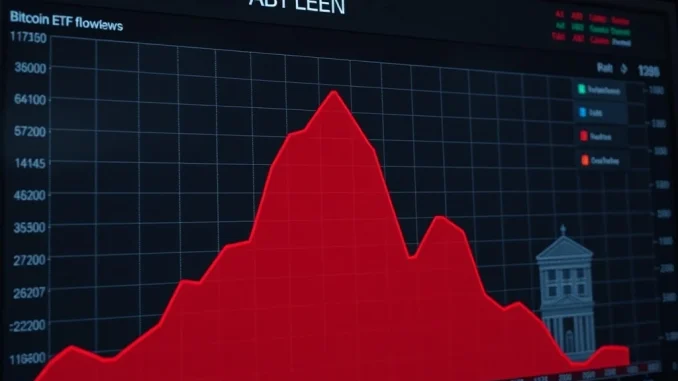
Since their landmark approval, spot Bitcoin ETFs have served as a transparent window into institutional sentiment. Recent data from major fund issuers reveals a clear and concerning pattern: net outflows have persisted for over three consecutive weeks, eclipsing any previous period of withdrawal since inception. This isn’t a single-day sell-off event. Analysts interpret this prolonged exit as a strategic “retreat”—a methodical reduction of exposure—rather than a wholesale liquidation. The distinction is crucial. Liquidation implies a rush for the exits, often driven by fear. A retreat suggests a calculated decision based on reassessed portfolio risk, macroeconomic outlook, or asset performance, indicating a potentially longer-term shift in positioning.
This trend emerges against a backdrop where Bitcoin has declined approximately 50% from its all-time high set in late 2024. While such drawdowns are not unprecedented in Bitcoin’s volatile history, the context provided by ETF flow data adds a new layer of understanding. The outflows are extending an existing period of weakness for the digital asset, contrasting sharply with the behavior of other major asset classes. This data provides tangible evidence moving beyond price charts alone, offering insight into the behavior of the sophisticated investors these products were designed to attract.
The Risk-On Reality: Bitcoin’s Correlation with Tech Stocks
The current market environment highlights a significant evolution in Bitcoin’s perceived role within global finance. The initial narrative of Bitcoin as “digital gold”—a uncorrelated hedge against inflation and systemic risk—has been challenged. Instead, trading patterns throughout 2024 and into 2025 have consistently shown Bitcoin behaving as a classic risk-on asset. Its price movements have demonstrated a heightened correlation with technology-heavy indices like the Nasdaq-100, particularly during periods of macroeconomic uncertainty, rising interest rates, or geopolitical tension.
When institutional portfolios need to reduce overall risk exposure, the process of “de-risking” often follows a hierarchy. Highly liquid assets with strong recent performance but high volatility are frequently trimmed first to raise cash and lower portfolio beta. The sustained ETF outflows suggest Bitcoin is now firmly in this category. It is being treated not as a unique, uncorrelated store of value, but as a high-growth, high-risk tech-adjacent investment. Consequently, it gets “cut first” when risk appetite wanes. This reclassification by large-scale money managers has profound implications for its price stability and recovery trajectory during broad market corrections.
Diverging Dynamics: Bitcoin Versus Traditional Havens
The differing behavior between asset classes further illuminates Bitcoin’s current position. During the same period of ETF outflows and price decline for Bitcoin, traditional safe havens have exhibited different dynamics. Gold, for instance, has experienced corrections but often from a position of recent strength and within a longer-term bullish trend fueled by central bank buying and currency devaluation concerns. Its pullbacks are frequently viewed as buying opportunities within a secular trend.
In contrast, Bitcoin’s correction is occurring from a position of perceived weakness, exacerbated by the visible exit of institutional capital via ETFs. Major equity indices have also corrected, but similarly, their fundamentals—corporate earnings, economic data—provide a different set of valuation metrics and support levels. Bitcoin lacks these traditional fundamentals, making investor sentiment and capital flows, as seen in the ETF data, even more critical as primary price drivers. This divergence underscores that Bitcoin and gold are reacting to different investor impulses in the current climate.
Historical Context and the Path Forward
To fully grasp the significance of the current ETF outflow trend, one must consider the historical context of Bitcoin’s market cycles. Previous bear markets and major drawdowns, such as those in 2018 and 2022, were primarily driven by retail sentiment, leveraged positions in unregulated markets, and specific industry crises (e.g., the collapse of FTX). The 2025 landscape is fundamentally different due to the existence of regulated, transparent ETFs. These vehicles provide the first clear, real-time gauge of institutional appetite.
The prolonged outflow streak suggests that the current downturn is being led by institutions, a novel dynamic in Bitcoin’s history. This could imply a longer consolidation phase, as institutional capital typically moves more slowly and deliberately than retail speculation. Recovery may require not just a technical price bottom, but a shift in the macroeconomic conditions that govern institutional risk models—such as a pivot in central bank policy or a resurgence in global liquidity.
Conclusion: A Signal of Structural Shift, Not Just a Price Dip
The record streak of Bitcoin ETF outflows offers a compelling and sobering narrative for the market. It signals a sustained institutional retreat rooted in a recalibration of risk, firmly placing Bitcoin in the “risk-on” category of institutional portfolios. This trend suggests the current Bitcoin price dip is intertwined with broader de-risking in financial markets and may not be temporary unless that macro environment changes. The data moves the discussion beyond short-term price predictions, highlighting a potential structural shift in how the world’s largest investors perceive and utilize the premier cryptocurrency. For the market to find a durable bottom, this flow of institutional capital must stabilize and reverse, a process that will depend heavily on factors extending far beyond the crypto ecosystem itself.
FAQs
Q1: What are Bitcoin ETF outflows, and why are they significant?
Bitcoin ETF outflows occur when the total value of shares redeemed from a spot Bitcoin Exchange-Traded Fund exceeds the value of shares created. They are significant because they provide a transparent, real-time measure of net institutional and large-scale investor demand or retreat from Bitcoin through regulated channels.
Q2: How does an institutional “retreat” differ from a “liquidation”?
A retreat implies a measured, strategic reduction in exposure, often as part of portfolio rebalancing or risk management. Liquidation suggests a rapid, urgent sell-off, typically driven by panic or margin calls. The current prolonged outflow pattern is more characteristic of a retreat.
Q3: Why is Bitcoin considered a “risk-on” asset now?
Bitcoin’s price has shown increasing correlation with technology stocks and other growth-oriented assets, especially during periods of market stress. When investors seek to reduce risk, they often sell these volatile, liquid assets first, which is the behavior now being observed via ETF flows.
Q4: How does this situation differ from Bitcoin’s past bear markets?
Previous major downturns were largely driven by retail sentiment and crypto-specific events. The current trend is notable because it is visibly led by institutional capital flowing out of regulated products (ETFs), a new dynamic since their 2024 launch.
Q5: What would need to happen for this outflow trend to reverse?
A reversal would likely require a change in the macroeconomic conditions that affect institutional risk appetite, such as lower interest rates, increased market liquidity, or a sustained period of stability in traditional markets that renews confidence in growth assets.
Related News
- Ethereum Exchange Reserves Plummet to 8-Year Low: Bullish Signal for Long-Term Gains
- Binance SENT Perpetual Futures: Strategic Expansion into High-Leverage Derivatives Trading
- Unveiling the Truth: Why Bitcoin’s Astonishing Cycle Top Might Still Be Ahead
Related: Meme Coins 2026: ChatGPT's Analysis Projects APEMARS, Dogecoin Among Top Contenders
Related: Best Presale Crypto of 2026: Essential Analysis of ZKP, Digitap, BlockchainFX, and BMIC
Related: Crypto Finance: The Essential Foundation for a Broader Digital Future, Says a16z's Chris Dixon