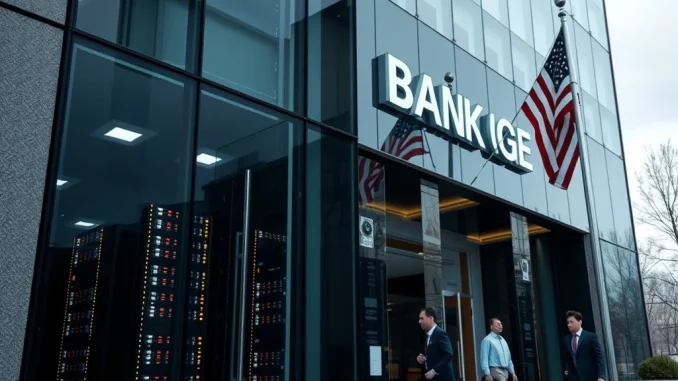
Crypto-Friendly Bank Approved: Trump Administration Greenlights Erebor National Charter
Washington, D.C., October 2025: In a landmark decision for the digital asset industry, federal regulators under the Trump administration have granted a national bank charter to Erebor Bank, formally recognizing it as the United States’ first banking institution primarily designed for cryptocurrency and blockchain-based finance. This approval signals a decisive shift toward deeper integration of digital assets into the core of the nation’s regulated financial system, providing a long-sought bridge between innovative crypto firms and traditional banking services.
Crypto-Friendly Bank Receives Historic National Charter
The Office of the Comptroller of the Currency (OCC), the federal agency responsible for chartering national banks, finalized the approval for Erebor Bank this week. This move represents the most significant regulatory endorsement of a crypto-native financial institution to date. Unlike state-level trust charters or limited-purpose licenses, a full national bank charter grants Erebor Bank the authority to operate across all fifty states under a unified federal framework. It can offer a full suite of services, including taking deposits, facilitating payments, and providing custody for digital assets, all under the direct supervision of the OCC. This development follows years of regulatory uncertainty and piecemeal guidance for crypto companies seeking banking relationships, often referred to as “de-risking” by traditional banks wary of compliance complexities.
Regulatory Context and the Path to Approval
The approval of Erebor Bank did not occur in a vacuum. It is the culmination of a multi-year evolution in the U.S. regulatory approach to digital assets, which accelerated during President Trump’s second term.
- 2020-2023: The OCC under previous leadership issued interpretive letters allowing national banks to hold cryptocurrency for customers and use stablecoins for payment activities. However, no institution built from the ground up for crypto received a full charter.
- 2024: The Trump administration’s executive order on digital asset innovation directed federal agencies to develop a coherent framework, emphasizing consumer protection while fostering American competitiveness.
- 2025: Following stringent capital, liquidity, and compliance reviews, Erebor Bank demonstrated it could meet the “safety and soundness” standards required of all national banks, paving the way for final charter approval.
This structured timeline underscores a deliberate, criteria-based process rather than a sudden policy shift. Regulators emphasized that Erebor’s approval sets a high bar, requiring robust anti-money laundering (AML) protocols, cybersecurity defenses exceeding traditional bank standards, and clear risk management frameworks for asset volatility.
Implications for the Broader Financial Ecosystem
The creation of a federally chartered, crypto-friendly bank has immediate and long-term consequences for multiple stakeholders. For cryptocurrency exchanges and fintech startups, it promises reliable access to banking services like corporate accounts, wire transfers, and armored car services for cash, which have been intermittently unavailable. For institutional investors, such as hedge funds and family offices, it provides a regulated, insured custodian for digital asset holdings, potentially unlocking further institutional capital. Perhaps most significantly, for everyday users, it legitimizes the pathway between fiat currency and digital assets, with the potential for FDIC-insured dollar deposits alongside secure crypto wallets within the same institution. However, analysts caution that Erebor’s success will depend on its ability to scale its compliance operations and navigate the ongoing evolution of specific crypto regulations from the SEC and CFTC.
Erebor Bank’s Structure and Proposed Services
Erebor Bank has structured itself as a hybrid institution, aiming to serve both traditional and digital asset customers. Its business model is built on several core pillars designed to address historical pain points in crypto finance.
| Service Pillar | Description | Traditional Banking Gap Addressed |
|---|---|---|
| Fiat-to-Crypto Onramps | Seamless conversion of USD deposits to major cryptocurrencies and stablecoins within a single, regulated account. | Eliminates reliance on third-party payment processors and external exchanges for initial entry. |
| Institutional-Grade Custody | Cold storage solutions with multi-signature protocols and insurance, offered alongside traditional asset custody. | Provides a federally supervised alternative to private, uninsured crypto custodians. |
| Regulatory Compliance Hub | Integrated transaction monitoring and reporting tools to satisfy Bank Secrecy Act (BSA) and AML requirements for client businesses. | Reduces the compliance burden and risk for partner crypto businesses, making them more bankable. |
| Interbank Settlement | Exploring the use of blockchain technology for real-time, cross-border interbank settlements. | Targets inefficiencies in the legacy SWIFT network for correspondent banking. |
This service matrix indicates Erebor’s intent to function not just as a niche player, but as a potential innovator within the broader banking infrastructure.
Expert Analysis on Safety and Market Impact
Financial policy experts view the charter as a double-edged sword. “By bringing crypto activities inside a nationally chartered bank, regulators can apply the full force of federal banking law,” notes Dr. Anya Sharma, a fellow at the Brookings Institution. “This means higher capital requirements, regular examinations, and clear accountability. It’s a trade-off: the industry gains legitimacy but must accept a level of oversight it has historically resisted.” Market impact has been immediately positive for correlated sectors. Publicly traded companies involved in crypto mining, blockchain infrastructure, and brokerage services saw notable stock price increases following the announcement, reflecting investor optimism for reduced systemic banking risk. Conversely, shares of some traditional money center banks dipped slightly, signaling perceived competitive pressure on future financial technology services.
Conclusion
The Trump administration’s approval of Erebor Bank as a crypto-friendly national bank marks a transformative moment in the maturation of digital asset finance. It moves the conversation from regulatory perimeter skirmishes to the core of the established financial system. While challenges in implementation and ongoing regulatory coordination remain, this decision provides a concrete, federally supervised model for integrating digital assets. It establishes a precedent that other applicants will need to meet, potentially paving the way for a new category of financial institution in the United States. The success of this crypto-friendly bank will be closely watched by global regulators, traditional finance, and the crypto industry as a test case for the future of money.
FAQs
Q1: What does a “national bank charter” mean for Erebor Bank?
A national bank charter is issued by the OCC and allows Erebor to operate as a bank across the entire United States under federal law. It subjects the bank to comprehensive federal oversight, including regular examinations, capital requirements, and consumer protection laws, similar to major banks like JPMorgan Chase or Bank of America.
Q2: Will customer cryptocurrency holdings at Erebor Bank be FDIC-insured?
No. The FDIC insurance that covers up to $250,000 per depositor applies only to traditional fiat currency (U.S. dollar) deposits held at the bank. Cryptocurrency and digital asset holdings are not legal tender and are not covered by FDIC insurance. Erebor Bank will likely offer separate private insurance for its custody services.
Q3: How does this differ from a state-chartered crypto bank?
State charters, like those issued in Wyoming for Special Purpose Depository Institutions (SPDIs), are limited to that specific state’s jurisdiction and regulations. A national charter provides a uniform set of federal rules, preempts conflicting state laws, and grants the ability to operate nationwide without needing separate licenses in each state, offering greater scale and regulatory clarity.
Q4: Can any crypto company now get a national bank charter?
Absolutely not. The OCC has emphasized that Erebor Bank’s approval sets a very high standard. Any future applicant must demonstrate exceptional strength in capital planning, risk management (especially for crypto volatility), cybersecurity, and AML compliance. The process is rigorous and designed only for the most robust and well-prepared institutions.
Q5: What is the immediate practical effect for someone who owns Bitcoin?
In the short term, for an individual, not much will change immediately. However, in the medium term, you may have the option to open an account at a federally regulated bank that allows you to securely buy, hold, and potentially even borrow against your Bitcoin alongside your checking account, all within a single, familiar banking interface.
Related News
- Core PCE Index Unveils Steady US Inflation: August Data Meets Forecasts
- Mistral AI: The European Powerhouse Challenging OpenAI
- ChatGPT’s AI-Powered Research Reveals 5 Must-Have Cryptos for Bear Market Strength
Related: Spartans.com CashRake: Analyzing the 33% Rakeback Model Shifting Online Casino Economics