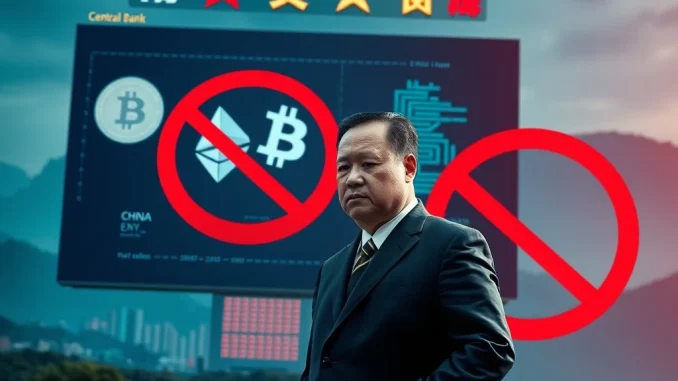
China’s Crypto Crackdown: Central Bank Unleashes Strict Nationwide Ban on Tokens and Stablecoins
Beijing, China – April 2025: In a definitive move that solidifies its position as the world’s most restrictive major economy for digital assets, China’s central bank has launched a sweeping crackdown on all cryptocurrency and stablecoin-related activities. The People’s Bank of China (PBOC), in concert with top financial regulators, has issued a forceful restatement of the nation’s comprehensive ban, explicitly blocking token issuance, trading, mining, and any unapproved stablecoin operations. This announcement signals not just a reminder of existing policy but a clear intent for stricter, more coordinated enforcement that targets both domestic actors and overseas-linked business channels, marking a pivotal moment for the global crypto landscape.
Decoding China’s Central Bank Crypto Crackdown
The latest directive from Chinese authorities leaves no room for ambiguity. Virtual currencies, including Bitcoin and Ethereum, are not legal tender within China’s borders. All related business activities—from operating an exchange to facilitating peer-to-peer trades—remain illegal. The statement specifically highlights the prohibition of “token issuance and financing,” which targets Initial Coin Offerings (ICOs) and security token offerings, and “virtual currency trading,” encompassing both spot and derivative markets. Furthermore, the crackdown extends to “mining,” the energy-intensive process of validating transactions and creating new coins, which China had previously purged in 2021. The most pointed addition in this 2025 enforcement wave is the explicit targeting of “unapproved stablecoin” issuers. Stablecoins, digital assets pegged to stable reserves like the US dollar, are viewed by regulators as a potential threat to monetary sovereignty and financial stability, especially as China advances its own state-backed Digital Currency Electronic Payment (DCEP) system, the digital yuan.
The Historical Context and Escalating Enforcement Timeline
To understand the weight of this 2025 announcement, one must examine the decade-long trajectory of China’s crypto policy. The government’s stance has evolved from cautious observation to outright prohibition.
- 2013: The PBOC and four other ministries issued a notice warning financial institutions against Bitcoin, marking the first major regulatory action.
- 2017: Authorities banned ICOs and shut down domestic cryptocurrency exchanges, forcing major players like OKEx and Huobi to relocate offshore.
- 2021: This year saw the most aggressive pre-2025 actions. A joint statement from multiple regulators, including the PBOC, declared all crypto-related transactions illegal. This was followed by a nationwide crackdown on Bitcoin mining, which at its peak accounted for over 65% of the global hash rate, leading to a mass exodus of mining operations.
- 2023-2024: Enforcement focused on closing loopholes, targeting over-the-counter (OTC) trading desks, social media groups facilitating trades, and offshore exchange services marketing to Chinese citizens.
The 2025 statement is therefore not a new policy but a powerful escalation of enforcement, likely driven by concerns over capital flight, financial risk, and the need to create a controlled environment for the digital yuan’s adoption.
Implications for Global Crypto Markets and Stablecoin Issuers
The ripple effects of China’s hardened stance are immediate and multifaceted. For global cryptocurrency markets, the removal of a once-dominant retail and mining player has already reshaped the industry’s geography. Mining is now decentralized across North America, Central Asia, and Europe. However, the renewed ban creates persistent uncertainty, often triggering short-term volatility as markets assess the impact on trading volumes and liquidity from one of the world’s largest pools of capital.
For stablecoin issuers like Tether (USDT) and USD Coin (USDC), the crackdown presents a significant compliance challenge. While these stablecoins operate on decentralized blockchains, their use by Chinese citizens—often as an on-ramp to other cryptocurrencies or a store of value—is now explicitly in the crosshairs. Regulators are likely increasing scrutiny on payment channels and banking relationships that could facilitate the flow of yuan into these stablecoins. This enforcement push underscores a global regulatory trend of treating stablecoins as potential shadow payment systems that require stringent oversight.
The Digital Yuan Factor: A State-Backed Alternative
Analysts universally connect the intensity of China’s crypto crackdown to the parallel development and rollout of its Central Bank Digital Currency (CBDC), the e-CNY. The digital yuan is a completely centralized, programmable currency issued and controlled by the PBOC. Its goals are multifold: to increase payment efficiency, enhance monetary policy tools, and reduce dependency on the dollar-dominated global financial system. By eliminating competition from decentralized cryptocurrencies and private stablecoins, the Chinese government clears the path for the e-CNY to become the dominant digital currency within its economy. The contrast is stark: where Bitcoin offers decentralization and censorship resistance, the digital yuan offers state-backed stability and integrated surveillance capabilities, aligning perfectly with China’s broader financial and social governance objectives.
| Feature | Decentralized Cryptocurrencies (e.g., Bitcoin) | China’s Digital Yuan (e-CNY) |
|---|---|---|
| Issuer | Decentralized Network | People’s Bank of China (State) |
| Control | Distributed, Permissionless | Centralized, Permissioned |
| Legal Status in China | Illegal (Not Legal Tender) | Legal Tender (Digital Form of RMB) |
| Primary Goal | Decentralized Store of Value/Payment | Monetary Sovereignty, Payment Efficiency, Control |
| Anonymity | Pseudonymous | Controlled Anonymity (Traceable by PBOC) |
Conclusion: A Defined Path in a Fractured Landscape
China’s 2025 crypto crackdown, spearheaded by its central bank, represents a decisive consolidation of its sovereign digital finance strategy. By reaffirming and strengthening the ban on all cryptocurrency and stablecoin activities, Chinese authorities are prioritizing control, financial stability, and the promotion of their native digital currency. This action reinforces the global fracture in digital asset regulation, with jurisdictions like the European Union and the United Kingdom pursuing structured regulatory frameworks, while China opts for prohibition. For the global crypto industry, China’s door is firmly closed, redirecting focus and innovation elsewhere. The enduring message is clear: within China’s financial ecosystem, the state’s authority over money is absolute and non-negotiable, a principle now being enforced with renewed vigor in the digital age.
FAQs
Q1: What specific activities does China’s 2025 crypto ban target?
The ban explicitly targets four core areas: the issuance of new tokens (like ICOs), all forms of cryptocurrency trading, cryptocurrency mining operations, and the issuance or use of any stablecoin not approved by Chinese authorities.
Q2: Is Bitcoin illegal to own personally in China?
While the 2021 and 2025 statements focus on banning business activities, the regulatory environment makes personal ownership extremely risky. Banks are prohibited from facilitating transactions, and authorities actively monitor and block access to trading platforms, effectively criminalizing the process of acquiring and holding cryptocurrencies.
Q3: Why is China targeting stablecoins specifically?
Stablecoins are viewed as a direct challenge to monetary policy and capital controls. They can facilitate the movement of value out of the yuan system and into dollar-pegged assets without using traditional banking channels. This undermines the state’s control over the financial system and competes with the official digital yuan.
Q4: How does this crackdown relate to China’s digital yuan?
The crackdown is intrinsically linked. By removing competition from decentralized cryptocurrencies and private stablecoins, the government creates a controlled environment where the digital yuan (e-CNY) can become the primary, state-sanctioned digital payment and value storage tool without rival alternatives.
Q5: Can Chinese citizens still access crypto markets through VPNs and offshore exchanges?
Technically possible, but increasingly dangerous. The 2025 enforcement emphasizes targeting “overseas-linked” channels. Authorities employ sophisticated internet monitoring to detect and penalize such activities, and penalties for violating foreign exchange and financial regulations can be severe.
Related News
- Kansas Bitcoin Reserve: Pioneering Legislation Aims to Transform State Treasury with Abandoned Digital Assets
- Troller Cat Presale: Unlocking 449% ROI Potential with Explosive Growth
- Bitcoin Soars: BTC Price Surges Above $96,000 Milestone in Major Rally
Related: Bithumb's Shocking 2,000 BTC Error Triggers Instant Market Panic and Sell-Off