ASTER Cryptocurrency: Analyst Highlights Long-Term Accumulation Thesis Amid Market Volatility
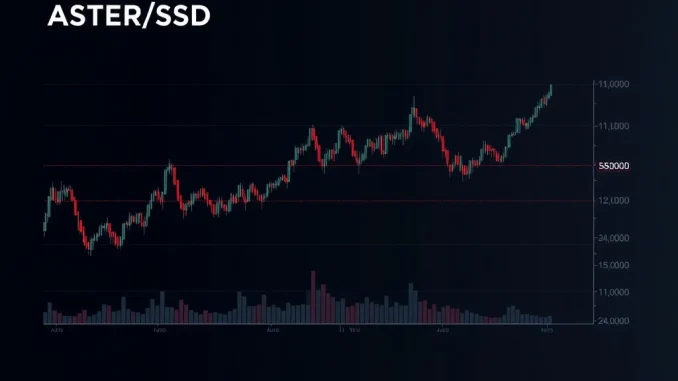
Global, May 2025: The cryptocurrency ASTER has drawn significant analytical attention as it consolidates near the $0.50 level, a price point approximately 80% below its all-time high of $2.43. Market observers are scrutinizing on-chain data and technical patterns following a detailed report from a widely followed analyst that frames the current phase as a potential long-term accumulation opportunity. This analysis emerges as the broader digital asset market navigates a period of heightened volatility and selective capital rotation.
ASTER Cryptocurrency: Contextualizing the Current Market Position
ASTER, a digital asset operating on its own dedicated blockchain, reached its peak valuation in late 2023 during a broader market upswing. Since that zenith, its price trajectory has followed a pattern common to many altcoins, undergoing a significant correction alongside shifting macroeconomic conditions and evolving investor sentiment toward risk assets. The token’s current trading band, hovering around $0.50, represents a critical juncture that technical analysts often describe as a “value discovery” zone. Historical data from major exchanges shows that trading volume for ASTER has seen intermittent spikes, suggesting periods of both accumulation and distribution among large holders, often referred to as “whales.” The project’s underlying fundamentals, including its consensus mechanism, transaction throughput, and developer activity, provide the foundational context against which all price action occurs. It is within this framework that market participants evaluate short-term price pressure against potential long-term utility and adoption curves.
Decoding the Long-Term Accumulation Analysis
The recent analyst report that has spurred discussion does not constitute investment advice but rather a detailed examination of observable market structure. The core thesis hinges on identifying specific price levels where sustained buying interest, or accumulation, appears to manifest over an extended timeframe. Analysts use a suite of tools to gauge this activity.
- On-Chain Metrics: Data from blockchain explorers can reveal movement of tokens between wallet types. An increase in tokens moving from exchange wallets to long-term holding addresses is often interpreted as a bullish signal for reduced selling pressure.
- Technical Support Zones: Chart analysis identifies price ranges where an asset has historically found buying support. Repeated tests of these levels without a breakdown can indicate strong accumulation.
- Volume Profile: This analysis shows at which price levels the most trading activity has occurred over a set period. High-volume nodes can act as strong support or resistance.
- Market Sentiment Indicators: Tools tracking social media mentions, search trends, and funding rates on derivatives exchanges help contextualize whether price action is driven by speculation or strategic positioning.
The referenced analysis reportedly points to a confluence of these factors aligning for ASTER at its current range, suggesting the possibility of a multi-year accumulation phase similar to patterns observed in other digital assets prior to major market cycles. It is crucial to note that such patterns are probabilistic, not deterministic, and depend heavily on broader market conditions and project-specific developments.
Historical Precedents and Market Psychology
The concept of accumulation phases is not new to financial markets. In traditional equities and commodities, extended periods of sideways or downward price action often see informed investors building positions before a trend becomes apparent to the wider public. In cryptocurrency markets, which operate 24/7 and are highly sentiment-driven, these phases can be more volatile but follow similar psychological principles. The dramatic drawdown from all-time highs can deter retail investors, often creating opportunities for entities with longer time horizons. The 2600% potential cited in some reports is a mathematical projection based on a return to, or exceeding, previous highs from a significantly lower base. Such projections are inherently speculative and should be understood as model-based scenarios, not forecasts. They illustrate magnitude, not certainty, and their realization would require a favorable alignment of project development, ecosystem growth, and macro-level tailwinds for digital assets.
Broader Market Implications and Risk Considerations
The attention on ASTER reflects a larger trend within cryptocurrency investing: the search for assets perceived to be in a pre-growth phase. As capital flows rotate, analysts and funds continuously screen for projects with specific technical set-ups and fundamental triggers. However, this search carries inherent risks that every investor must acknowledge.
First, altcoins like ASTER typically exhibit higher volatility and correlation to Bitcoin’s price movements than more established assets. A downturn in the leading cryptocurrency can negate positive project-specific developments. Second, the “accumulation” thesis depends on accurate interpretation of data, which can be ambiguous. What appears as accumulation could be preparatory selling by early investors. Third, regulatory developments for the crypto sector remain a persistent unknown, capable of impacting all projects irrespective of their technical merits.
Professional portfolio managers often stress that any allocation to speculative altcoins should be sized appropriately within a broader, diversified strategy. Due diligence extends beyond chart patterns to include ongoing assessment of the project’s GitHub repository activity, governance decisions, partnership announcements, and competitive positioning within its niche.
Conclusion
The analysis surrounding the ASTER cryptocurrency underscores the sophisticated, data-driven approaches now prevalent in digital asset markets. While the identification of a potential long-term accumulation zone provides a compelling narrative framework, it represents one analytical perspective among many. The ultimate trajectory for ASTER will be determined by the interplay of its network development, adoption metrics, and the overarching crypto market cycle. For observers and participants, the situation highlights the importance of separating verifiable on-chain data and technical patterns from speculative price targets, maintaining a focus on fundamental research and prudent risk management in a rapidly evolving asset class.
FAQs
Q1: What does “accumulation” mean in cryptocurrency trading?
In trading, accumulation refers to a phase where investors are consistently buying and holding an asset, often during periods of low prices or sideways movement, with the expectation of future price appreciation. It is typically identified through analyzing trading volume, wallet activity, and sustained buying pressure at certain price levels.
Q2: How reliable are analyst price projections like the 2600% opportunity mentioned?
Long-term percentage projections are highly speculative models, not guarantees. They are often based on historical patterns or Fibonacci extensions and depend on a perfect alignment of bullish factors. They should be treated as illustrative of potential magnitude within a best-case scenario, not as a financial forecast.
Q3: What key factors should someone research beyond price charts when looking at a project like ASTER?
Essential research includes the project’s whitepaper and use case, the activity and size of its development team (check GitHub), the tokenomics (supply, distribution, inflation), governance structure, partnerships, community strength, and its competitive landscape within the blockchain sector.
Q4: What is the main risk of investing based on a technical “accumulation” thesis?
The primary risk is misinterpreting the data. Market activity can be manipulated or appear misleading. Furthermore, a technically sound pattern can fail if the project’s fundamentals deteriorate or if the broader cryptocurrency market enters a prolonged bear phase, overwhelming any positive project-specific signals.
Q5: How does the current regulatory environment affect altcoins like ASTER?
The regulatory environment is a significant factor. Increased scrutiny on cryptocurrency exchanges, security classifications for tokens, and compliance requirements can impact liquidity, accessibility, and investor sentiment. Regulatory clarity or uncertainty can have a direct effect on price and adoption, regardless of a project’s technical analysis.
Related News
- Bitmine's Massive $745 Million ETH Stake Reveals Stunning Crypto Strategy
- 🃏 Best Online Casinos in India 2025 – Top 9 Real Money Sites Compared
- Momentum (MMT) Listing: Upbit Unveils New KRW Trading Pair
Related: HYPE Listing Confirmed: Coinbase's Crucial Move for Hyperliquid Spot Trading
Related: GameFi Revolution: How PlayZap Games and GENCY AI Are Pioneering Smarter AI Advertising
Related: Trump-Linked Crypto Project's $5M WBTC Sale via DeFi Sends Shockwaves