Crypto Market Plunge: 6.38% Wiped Out as Sector Enters ‘Extreme Fear’ Zone
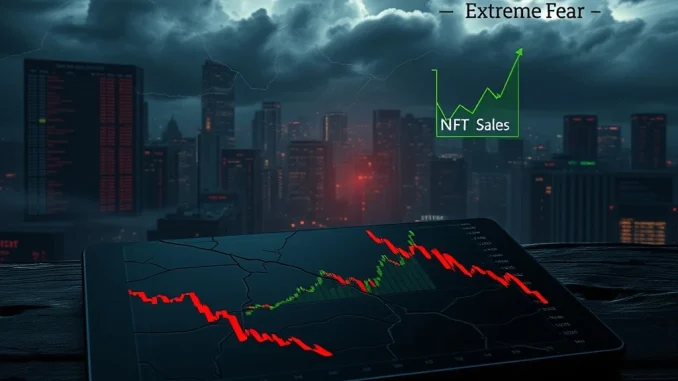
Global, May 2025: The digital asset landscape convulsed this week, with the total cryptocurrency market capitalization shedding a significant 6.38% over a seven-day period. This sharp decline propelled the widely watched Crypto Fear & Greed Index firmly into the “Extreme Fear” territory, a psychological marker that often signals heightened investor anxiety and market volatility. The sell-off notably impacted flagship assets Bitcoin (BTC) and Ethereum (ETH), triggered a contraction in the Total Value Locked (TVL) across decentralized finance (DeFi) protocols, and contrasted starkly with a concurrent, surprising resilience in non-fungible token (NFT) sales volume.
Crypto Market Plunge Triggers Widespread ‘Extreme Fear’
The cryptocurrency market’s descent was broad-based and rapid. Data from multiple analytics platforms confirms the aggregate market value fell from approximately $2.45 trillion to $2.29 trillion, representing the 6.38% loss. This movement catalyzed a dramatic shift in market sentiment, as measured by the Crypto Fear & Greed Index. The index, which synthesizes volatility, market momentum, social media sentiment, surveys, and dominance metrics, plummeted to a score of 18, solidly within its “Extreme Fear” classification. Historically, prolonged periods in this zone have correlated with market bottoms or periods of intense consolidation, though they offer no guarantee of future performance.
Analysts point to a confluence of traditional and crypto-specific factors driving the fear. Rising macroeconomic uncertainties, including shifting interest rate expectations and geopolitical tensions, have increased risk aversion across all asset classes. Within the crypto ecosystem, the decline appears linked to profit-taking after a sustained Q1 rally, concerns over regulatory developments in key jurisdictions, and a noticeable slowdown in net inflows to major spot Bitcoin exchange-traded funds (ETFs). The market’s reaction demonstrates its continued, albeit maturing, sensitivity to broader financial currents.
Bitcoin and Ethereum Lead the Downward Charge
As the bellwethers of the sector, Bitcoin and Ethereum bore the brunt of the selling pressure. Bitcoin, which had been testing resistance levels near $72,000, broke downward, losing over 8% of its value to trade briefly below $66,000. Ethereum mirrored this trajectory, falling from around $3,800 to dip under $3,500, a decline exceeding 7%. This tandem movement reinforced the high correlation often observed between the two largest cryptocurrencies during market-wide downturns.
The price action was accompanied by significant on-chain data. Blockchain analysts reported an increase in the movement of older Bitcoin holdings to exchanges, a metric often interpreted as preparation for selling by long-term holders. Similarly, Ethereum’s network saw a rise in transaction fees and a slight dip in active addresses, suggesting a reduction in routine network activity alongside the speculative sell-off. The declines in these market leaders created a cascading effect, eroding confidence and liquidity across altcoins and smaller-cap projects.
DeFi Contraction Reflects Broader Market Caution
The decentralized finance sector, a primary driver of Ethereum’s utility narrative, experienced a pronounced contraction. The Total Value Locked (TVL) across all DeFi protocols fell by approximately 9%, from $112 billion to $102 billion. This decline indicates that users are withdrawing capital from lending platforms, liquidity pools, and yield-generating protocols, likely seeking the safety of stablecoins or off-ramping to fiat currency amidst the volatility.
- Lending Protocols: Platforms like Aave and Compound saw reduced borrowing activity and increased repayments.
- Decentralized Exchanges (DEXs): Trading volumes spiked initially due to volatility but liquidity depth slightly weakened as liquidity providers (LPs) became more cautious.
- Yield Opportunities: Annual Percentage Yields (APYs) on many stablecoin pools increased as incentives rose to attract and retain capital, a classic sign of stress in the DeFi lending market.
This pullback highlights the intrinsic link between asset prices and DeFi health. As collateral values drop, positions risk liquidation, prompting users to proactively manage risk by withdrawing funds.
A Surprising Counter-Trend: NFT Sales Volume Defies the Gloom
In a notable divergence from the broader market trend, the NFT sector displayed unexpected strength. Aggregate sales volume across major marketplaces like Blur and OpenSea surged by an estimated 22% week-over-week. This activity was not uniform but concentrated in specific areas.
Analysis reveals two primary drivers. First, there was heightened trading activity in high-profile, “blue-chip” NFT collections such as CryptoPunks and Bored Ape Yacht Club. Some investors appear to be rotating capital from volatile, fungible tokens into what they perceive as more durable digital assets with strong communities and brand recognition. Second, a new generative art project on the Bitcoin blockchain, leveraging the recent Runes protocol activity, generated significant minting volume and secondary sales, attracting speculative interest.
| Metric | Previous Week | Current Week | Change |
|---|---|---|---|
| Total Market Cap | $2.45T | $2.29T | -6.38% |
| Bitcoin (BTC) Price | ~$72,000 | ~$66,000 | -8.3% |
| Ethereum (ETH) Price | ~$3,800 | ~$3,500 | -7.9% |
| DeFi TVL | $112B | $102B | -8.9% |
| NFT Sales Volume | $145M | $177M | +22.1% |
| Fear & Greed Index | 54 (Neutral) | 18 (Extreme Fear) | -36 pts |
This resilience suggests that the NFT market, while still volatile, may be developing its own demand cycles that are not entirely tethered to the immediate price movements of ETH or BTC, focusing instead on cultural momentum and specific technological developments.
Historical Context and Market Psychology
The current “Extreme Fear” reading is not an anomaly in cryptocurrency’s brief but turbulent history. The index has entered this zone over a dozen times since its inception, often around major sell-offs like those in May 2021, January 2022, and the FTX collapse in November 2022. Each instance was characterized by panic selling, negative media coverage, and a peak in bearish predictions. However, these periods also frequently preceded significant rallies, as fearful selling exhausted itself and value-oriented accumulation began.
Market veterans often cite the Warren Buffett adage, “Be fearful when others are greedy, and greedy when others are fearful,” though they caution that timing such contrarian moves in crypto’s 24/7 market is exceptionally difficult. The current environment tests the conviction of long-term holders and the risk models of institutional newcomers, serving as a stress test for the market’s evolving structure.
Conclusion
The cryptocurrency market’s 6.38% contraction and entry into the extreme fear zone underscores the asset class’s inherent volatility and its deep connection to global investor sentiment. The parallel declines in Bitcoin, Ethereum, and DeFi TVL paint a clear picture of a risk-off movement, where capital seeks stability. Yet, the surprising surge in NFT sales volume adds a layer of complexity, indicating that niche sectors can exhibit independent momentum based on cultural and technological drivers. For observers and participants, this moment serves as a reminder of the market’s cyclical nature and the critical importance of fundamental research and risk management, especially when the prevailing sentiment is one of extreme fear.
FAQs
Q1: What does the “Extreme Fear” zone on the Crypto Fear & Greed Index mean?
The “Extreme Fear” zone indicates very negative market sentiment. It is a composite score based on factors like volatility, trading volume, social media, and surveys. It suggests investors are predominantly anxious and selling, but it is a contrarian indicator, not a predictive tool for future prices.
Q2: Why did NFT sales increase while the rest of the crypto market fell?
The increase appears driven by rotational trading into high-value “blue-chip” collections and hype around new technical developments, like a Bitcoin-based generative art project. This suggests some investors view certain NFTs as separate asset plays or stores of value, independent of short-term token price swings.
Q3: How does a falling market affect DeFi protocols?
Falling crypto prices reduce the value of collateral locked in DeFi. This can trigger automatic liquidations of loans, prompting users to withdraw funds to avoid losses. The result is a decrease in Total Value Locked (TVL) and often higher yields as protocols try to attract remaining capital.
Q4: Is ‘Extreme Fear’ a good time to buy cryptocurrency?
Historically, periods of extreme fear have sometimes preceded market recoveries, leading to the contrarian “buy the fear” strategy. However, it does not guarantee an immediate bottom. It should only be considered by investors with a high risk tolerance, a long-term horizon, and after thorough personal research.
Q5: What typically causes the market to recover from an ‘Extreme Fear’ phase?
Recoveries often begin when selling pressure exhausts itself, positive fundamental developments emerge (like favorable regulation or institutional adoption), or broader macroeconomic conditions improve. Shifts in on-chain data, such as long-term holders resuming accumulation, can also signal a potential sentiment change.
Related News
- Binance Alpha Unlocks Exciting SHARDS Listing
- Bitcoin Price Only 13 in Out 300 Days Parabolic Run as Cheap Altcoin Under $1 Eyes 9,593% Rally
- Shiba Inu Price Prediction: SHIB Consolidates While RCO Finance Targets a 30,000% Market Upside
Related: ZK Cryptocurrency Triggers Urgent South Korean Scrutiny After Stunning 1,000% Upbit Surge
Related: Tether Mints $1B USDT: Unprecedented $3B Liquidity Surge Hits Crypto Markets